Showing posts with label 1961. Show all posts

2015-06-22

One, Two, Three

Note : this review is my contribution to the Billy Wilder blogathon hosted by Outspoken & Freckled & Once Upon a Screen.

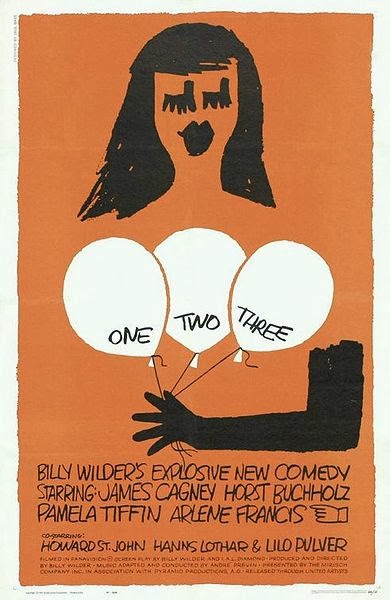
Poster by Saul Bass

One, Two, Three (Billy Wilder, 1961)

C.R. "Mac" MacNamara (James Cagney) is a high-ranking executive in the Coca-Cola Company, assigned to West Berlin after a business fiasco a few years earlier in the Middle East (about which he is still bitter). Nevertheless, Mac is angling to become head of Western European Coca-Cola Operations, based in London. After working on an arrangement to introduce Coke into the Soviet Union, Mac receives a call from his boss, W.P. Hazeltine (Howard St. John) in Atlanta. Scarlett Hazeltine (Pamela Tiffin), the boss's hot-blooded but slightly dim 17-year-old socialite daughter, is coming to Berlin and Mac is assigned the unenviable task of taking care of this young whirlwind.

Producer/director Billy Wilder is mostly remembered for his comedies like Some Like It Hot, The Apartment, and The Seven Year Itch. With One, Two, Three he once again goes into the comedic territory with lots of success. First, with his leading man James Cagney as Mac the ambitious executive of the Coca-Cola Company, by the way one of the most distinctive symbols of Capitalism, in the Berlin of the time they build the Berlin Wall. In fact, they were forced to leave Berlin for Munich to continue the shooting of the film because of the rising of the Wall. With his visions of expansion he has to deal with communists and Russians. With fast paced dialogues, Wilder wanted to make a funny film that would be like a whirlwind of jokes and strong moments. Much like, let’s say, Howard Hawks’ His Girl Friday.

One, Two, Three is also the last film of actor James Cagney before his retirement and also one of his great performances. He carries the film on his own. He also represents the classic Hollywood in the early 1960's where the New Hollywood was about to take the silver screen and put aside those dusty stars and directors. 

Almost entirely shot into Mac’s office and some exteriors of Berlin and the airport, One, Two, Three demonstrates how a strong script can set everything for a great comedy. Written by Wilder and I.A.L. Diamond, the plot is intelligent and is like a mix of Ninotchka, that Wilder co-wrote, and an Hungarian one act play by Ferenc Molnar. It is truly a great use of the stereotypes of the time on the battle between the West and the East. Much like the battle between Coca-Cola and Pepsi Cola; to use another figure that the film offers. One of the annoying things of this movie is the fact that the dialogues are so fast that they are almost yelled all along the picture. But much like any other screwball comedies it is almost an entire dispute the entire film that characterizes the genre. So yes they yell but every line is a pleasure and the delivery from Cagney, Pamela Tiffin, Arlene Francis, Lilo Pulver, Horst Buchholz, Hanns Lothar, and Howard St. John is deadpan funny.

 As often, heavy dramas gain respect and recognition and most of the time get the biggest awards. One, Two, Three is no rest with that and Cagney could at least been nominated for his performance at the Oscars. However, this movie isn’t on many lists of great films and not even on AFI’s 100 Comedies. It leaves me wondering who makes those lists and on which standards do they make their picks because this is definitely an omission. One of the greatest lesser known films from Billy Wilder who often gets its impact diminished because he left a bigger mark as a master at comedies than in a more serious genre. A great comedy that I highly recommend.


2013-11-27

Two Rode Together


Two Rode Together (John Ford, 1961)

Marshal McCabe (James Stewart) and First Lt. Jim Gary (Richard Widmark) are hired to bring back siblings and parents that have been kidnapped by the Comanches many years ago. They will meet Chief Quanach Parker (Henry Brandon) and make a trade for a young boy and the Squaw (Linda Cristal) of Stone Calf (Woody Strode). 

2012-10-23

The Innocents


The Innocents (Jack Clayton, 1961)

A young governess for two children becomes convinced that the house and grounds are haunted.

Starring Deborah Kerr, produced and directed by Jack Clayton, shot by cinematographer Freddie Francis who later would direct Horror classics at Hammer Films, and co-written by Truman Capote, The Innocents had the right formula to please any film buff out there. With high expectations and a recent viewing of Robert Wise’s The Haunting, I entered in this Classic ghost story.

Miss Giddens (Deborah Kerr), is a young woman who agrees to become the governess of two children raise in the country at a majestic manor. The whole place, his gardens, the many rooms, the deco, and even the young Flora are charming. Everything goes very well until young Miles comes back from school because he was expelled for a mysterious reason. Starting there, the house will seem inhabited by spectres and Miss Giddens will do whatever she can to protect the children and expel the unwelcomed ghosts.

The whole crew who worked on The Innocents was experienced and expert in his field. The use of space, sound, and the construction of frame is outstanding. Compared to The Haunting, the actual manifestations of the paranormal are visible and we clearly discover who the ghosts were. This is an element that withdraws the effect of fright and that reminded Alfred Hitchcock’s Rebecca in many ways.


Clearly, this landmark of ghost movies will influence the use of children in Horror movies for years to come and Deborah Kerr’s performance is outstanding just as the dame is known for. However, triple billed with The Haunting and Cat People, The Innocents seemed to be the blandest and the most traditional film of the three. Plus, the type of ghost story of The Innocents has been reproduced so many times that the original, while being widely influential, loses its luster.

2011-12-06

Last Year at Marienbad

L'année dernière à Marienbad aka Last Year at Marienbad (Alain Resnais, 1961)

This post is a part of the Seven Days of the French New Wave going on this Blog. But since Resnais wasn't a "member" of the "vague" I have to categorize him as an outsider that often been mistaken as a French New Waver because he was French and the fact that his films were more written oriented. With Last Year at Marienbad, Alain Resnais made one of the greatest masterpieces of Cinema. See Mediafilm's list of masterpieces.

The plot is a little hard to follow since the story is divided in time, sometimes we are in the present other times in the past and sometimes in the future or what the characters imagine will be their future. This facet of the structure of the story reminded me of the surrealist writing of The Discret Charm of the Bourgeoisie or even the deconstruction of memory of Malick's The Tree of Life. Resnais' adaptation is audacious because even with today's standards this is a fresh film and it is way more thoughful than Nolan's Inception that plays with memory and time without the Sci-fi effects and the spectacular imagery.


The atmosphere of Last Year at Marienbad probably influenced Kubrick on his The Shining, with the reclusion of the characters in this castle turned into a luxurious Hotel where the characters are walking like ghosts with deadpan faces and looking like they are disconnected with time and space. The memory and the presence of the characters is like if they always were a part of the Hotel and they are trapped in a continuum of time.

The beauty of the cinematography juxtaposed with the eerie and omnipresent music gives a mysterious yet thrilling vibe to the film. It makes me want to see more films of Alain Resnais since I deeply loved his Night and Fog while been disgusted by the atrocities it displayed and I've bored by his Hiroshima mon amour. Of Resnais great career, he still makes movies today, many films a yet to be reviewed here. Last year at Marienbad might be a difficult film to get into but since you past the uncommon structure of the story it is a masterpiece every film buff should at least watch one time in his/her life.

2011-02-26

The Hustler

The Hustler (Robert Rossen, 1961)

This picture is famous mostly for Paul Newman's strong lead as the talented billiard player: Fast Eddie. He'll try to make a fortune by being a real winner with a real life. Piper Laurie as his love interest will play the part of morale that keeps Eddie on the right path. Fast Eddie is one of the first anti-heroes of his generation. Besides his conventional settings he'll forge the path of the new American hero or antihero. Not as interesting or extreme as Taxi Driver's Travis Bickle, we sense that maybe Fast Eddie was one of its precursors.

The clean black and white photography reminds us the beautiful Noirs of the 1940's that probably inspired the many scenes shot in bars and billiard clubs. In comparison with Scorsese's sequel, The Color Of Money, the billiard scenes were shot in a more naturalistic way. Scorsese's film was more of an artistic experiment of moving cameras and angles.

The billiard is the wallpaper of the plot, Fast Eddie's approach to his relationships is the center of the story. His struggle against his weaknesses is his path.

The way the story evolves is very 1960's, because the filmmaker takes all the time to set up his story. In some way, I found some similarities between The Hustler and À bout de souffle. They aren't in the same category but I think that it treats of the same generation that grow in the post-Second World War era of plenty and freedom. Those kids represent the fallen heroes of the pre-1970's pictures. This generation of the Cold War era pre-hippie "fashion or trend" was the pivot between conformism and liberalism.

I don't think that The Hustler is a movie as important and as revolutionary as Godard's. But I think it slowly opened the way to a more progressive point of view in American Cinema.

It is indeed a great piece of film that I really enjoyed in the richness of its plot and the wonderful performances by Piper Laurie, George C. Scott, and Paul Newman. A Classic!

2010-09-27

West Side Story (1961)

West Side Story (Jerome Robbins & Robert Wise, 1961)

Winner of 10 Oscars, this adaptation of a Broadway musical could have been a complete disaster considering the latest screen adaptations of Broadway musicals like Rent. West Side Story has been a success on the stage and on the screen. Despite its over dramatic themes and conclusion, its story is more than worth the look. The musical parts bring the best of film.

The "mise en scene" is steady and strongly achieved by the sometimes over sometimes under appreciated Robert Wise (The Set-Up, The Day The Earth Stood Still) and the choreographs by Jerome Robbins are just perfect. Well, it may be one of the things that can tickle, the way the film feels that it is perfect. I tend to like films that are perfect in their imperfections. West Side Story seems like the film has been shot 300 times and the fury and the passion of the moment and of the performances just not feel as real as they really are. Sometimes flaws are a plus, and here, in this very Hollywood feature film it just feels too right. Well, so right it's wrong.

Don't get me wrong, I am a defender of Robert Wise's films and I think that West Side Story stands just where it deserves to stand in the History of Cinema it's just that if it was a film from the 1950's it would have had a better time table, but in the same year a little French film Une femme est une femme, a little musical, directed by a young sensation named Jean-Luc Godard feels fresher today by its rawness and human feelings of its crude colors and its revolutionised film making techniques.


West Side Story is a near masterpiece achievement in film making that every cinephile out there especially musicals and/or Broadway enthusiast should have seen!

2010-08-31

Une femme est une femme

Une femme est une femme (Jean-Luc Godard, 1961)


In a tribute to the musicals of the 1950's and introducing the style of Jacques Demy's films, Godard with Une femme est une femme assimitated his influences and reinterpreted them in his very own particular way. In the 1960's no director was more prolific than Jean-Luc Godard, as for his number of films to what they brought to Cinema.

Une femme est une femme is a film about Angela (Anna Karina) who desperately wants to have a baby. If it's not from her husband (Jean-Claude Brialy) It will be from her ex (Jean-Paul Belmondo). Angela is a strip-tease girl and besides the fact that she has an "uncommon" job for a married woman she has a very "common" need to have a baby. It's just the way she will have it that is more theatrical... Far from being the traditionnal Fred Astaire or Gene Kelly musical, Une femme est une femme is the child of those two influences on Jean-Luc Godard.

The story of the film itself reflects what the couple Godard-Karina just had to pass through, Karina was pregnant of Godard but complications made her loss the baby with the result of her being sterile. Godard wanted to give to Karina the chance to live and surpass this problem by playing a role that could made her get over that hard moment... But as many know, the couple was like a roller coaster and their relationship was too intense. Sometimes they were having a fight the eve of the shooting and the day after Godard would have written the script with the same words as the last day's fight. His inspirations are everywhere and he always has been the best recycler of everything in Cinema and in his life.

This is a film without any pretention and the way it was shot made it light and beautiful. The lavish colors gives it a melancolic tone perfectly agencing Karina's interpretation of the little Angela. Prior to Vivre sa vie and even after, Karina's characters are often closer to childish women than anything. In Une femme est une femme we have the feeling to see a kid wanting a child. Even her demand to her boyfriend is childish making scenes out of it and playing around. It's an interesting way to discover how Godard perceives women in general.

Une femme est une femme stands as one of the few comedies Jean-Luc Godard did in his whole oeuvre and should be seen for its originality. Godard may be one of the few "auteurs" to actually have changed the face of his art. It's a film that has been underappreciated but stands as one of the strongest efforts from its auteur and from the Nouvelle vague.

Related Posts Plugin for WordPress, Blogger...