Showing posts with label (2). Show all posts

2016-11-23

It's a Wonderful Life


It’s a Wonderful Life (Frank Capra, 1946)

An angel helps a compassionate but despairingly frustrated businessman by showing what life would have been like if he never existed.

The great American classic of Christmas movies that is It’s a Wonderful Life is like the Casablanca of holiday films. Almost everyone has seen it and some adore it while others, let’s call them the naysayers, call it overrated. Loosely based on Charles Dickens A Christmas Carol, Frank Capra’s film has passed through the ages like a classic novel that lustre the nostalgia of the old-fashioned Christmas.


2016-04-15

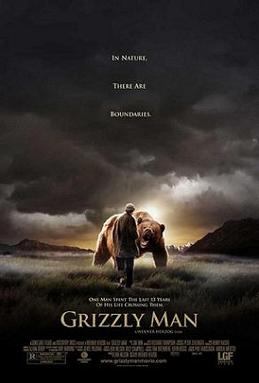
Grizzly Man


Grizzly Man (Werner Herzog, 2005)

A devastating and heartrending take on grizzly bear activists Timothy Treadwell and Amie Huguenard, who were killed in October of 2003 while living among grizzlies in Alaska.

2016-03-16

Berlin Alexanderplatz – Part I ‘’The Punishment Begins’’


(Rainer Werner Fassbinder, 1980)

Adapted from the Alfred Döblin novel of the same name, the short series of 15 ½ hours is an achievement in storytelling and book adaptation. With the boldness of Herr Fassbinder and his fascination for the History of Germany in the first half of the 20th Century Berlin Alexanderplatz holds a cult status amongst cinephiles.

2016-03-08

Veronika Voss


Veronika Voss (Rainer Werner Fassbinder, 1982)

Munich, 1955: A sports journalist meets Veronika Voss (Rosel Zech), an UFA actress who supposedly had an affair with Goebbels. Now declining, Voss is kept by her "kind" doctor, Dr. Katz, supplying her house, food, clean clothes and her favourite: morphine. Voss, trying to come back towards the cinema, cannot perform an absurdly simple scene, but it attracts the attention of the journalist, who suspects that something's very wrong regarding her doctor.

2016-03-04

Lola (1981)


Lola (Rainer Werner Fassbinder, 1981)

West Germany, late 1950s: Lola is a singing prostitute working in a brothel that the town's bigwigs, even the mayor, like to frequent. To the annoyance of the corrupt construction entrepreneurs, especially a crass man named Schukert, the town's new building commissioner von Bohm is an honest and idealistic man who tries to clean up the building license politics from bribery and cheating. 

2016-02-03

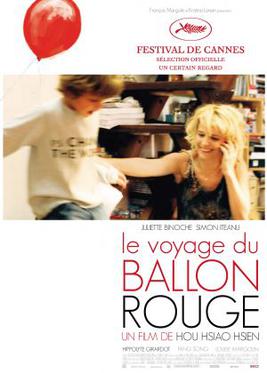
Flight of the Red Balloon


Flight of the Red Balloon aka Le voyage du ballon rouge (Hou Hsiao-hsien, 2007)

A little boy and his baby-sitter inhabit the same imaginary world: through their adventures they are followed by a strange red balloon.

2016-01-29

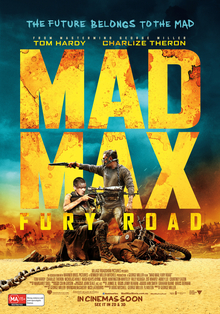
Mad Max : Fury Road


Mad Max : Fury Road (George Miller, 2015)

A woman rebels against a tyrannical ruler in post apocalyptic Australia in search for her homeland with the help of a group of female prisoners, a psychotic worshiper, and a drifter named Max.

2016-01-25

I Was Born, But…


I Was Born, But… (Yasujiro Ozu, 1932)

Two young brothers become the leaders of a gang of kids in their neighborhood. Their father is an office clerk who tries for advancement by playing up his boss. When the boys visit the boss' house with their father, they discover that their dad has been making a fool of himself to please his boss, who's son is an outwitted member of the boys' gang. The brothers' revolt claiming that hierarchy should be based on ability, not on social background.

2016-01-05

The Ballad of Narayama (1983)

The Ballad of Narayama (Shohei Imamura, 1983)

In a poor 19th century rural Japanese village, everyone who reaches the age of 70 has to climb a nearby mountain to die. An old woman is getting close to the cut-off age, and we follow her last days with her family.

2015-12-01

The Art of Flight


Note: this review is part of the Winter Sports blogathon hosted by the author of these lines Michaël Parent of Le Mot du Cinephiliaque


The Art of Flight (Curt Morgan, 2011)


2015-11-07

The Adventures of Robin Hood

Note : this review is a contribution to the Swashathon : a blogathon of swashbuckling Adventure hosted by Movies Silently.

The Adventures of Robin Hood (Michael Curtiz & William Keighley, 1938)

When Prince John and the Norman Lords begin oppressing the Saxon masses in King Richard's absence, a Saxon lord fights back as the outlaw leader of a rebel guerrilla army.

2015-10-01

Crumb


Crumb (Terry Zwigoff, 1994)

An intimate portrait of the controversial cartoonist and his traumatized family.

Back in my CEGEP years (equivalent of College) I had access to a huge library of comic books. Sometimes I would read comics that I never heard of or read about. When I got into Robert Crumb’s it was a revelation and a schock to me. His irreverent humor, social satire, and explicit sexual material (believe me for a seventeen year old it was something) left a permanent mark in my memory.

2015-08-31

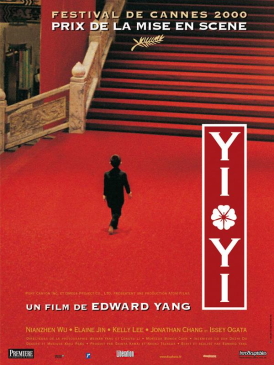
Yi Yi

Yi Yi (Edward Yang, 2000)

Each member of a family in Taipei asks hard questions about life's meaning as they live through everyday quandaries. NJ is morose: his brother owes him money, his mother is in a coma, his wife suffers a spiritual crisis when she finds her life a blank, his business partners make bad decisions against his advice, and he reconnects with his first love 30 years after he dumped her. His teenage daughter Ting-Ting watches emotions roil in their neighbors' flat and is experiencing the first stirrings of love. His 8-year-old son Yang-Yang is laconic like his dad and pursues truth with the help of a camera. "Why is the world so different from what we think it is?" asks Ting-Ting.

Can we use the word epic to categorize the size and the reach of a movie or is it just a saturated genre? Well, Edward Yang’s family drama of 2000 is one of the most beautiful film about family since the intimist grand scale studies of Yasujiro Ozu. Summarizing movies is not something I like to do in my reviews and I think it takes too much words that are already wrote by marketers.

But, Yang’s film is touching and riveting just like the pictures taken by Yang-Yang that reminds us of what the others see of us are a side we never see. With a naturalist direction Yang’s mastery is at storytelling and the sincerity of the feelings and situations his multifaceted’s characters embrace. This is honestly, the kind of film that throws you out of your chair.

To cite the late Roger Ebert : There was a time when a film from Taiwan would have seemed foreign and unfamiliar--when Taiwan had a completely different culture from ours. The characters in "Yi Yi" live in a world that would be much the same in Toronto, London, Bombay, Sydney; in their economic class, in their jobs, culture is established by corporations, real estate, fast food and the media, not by tradition. The great film critic couldn’t be more right about Yi Yi, this is a movie about contemporary life and the currents of life. Yang also puts up stories that defies the rules of regular romantic films and the fulfilment of parts of life that Hollywood often offers. Yang demonstrates how a person’s life is fulfilled by not only some moments that can be captured by a motion picture but as the evolution of someone and his actions in the maelstrom of society, family, friends, lovers.


With Yi Yi, Edward Yang left one of the greatest film about family in our contemporary world. It was the first film from Yang I ever watched and I can’t believe I waited this long to discover this talented filmmaker. I hate when I have to finish a film review with a sentence like that but I think Yi Yi s not far from being Yang’s masterpiece if I stick with its praise all over the film world. I’m now looking forward on watching his A Brighter Summer Day.

2015-06-22

One, Two, Three

Note : this review is my contribution to the Billy Wilder blogathon hosted by Outspoken & Freckled & Once Upon a Screen.

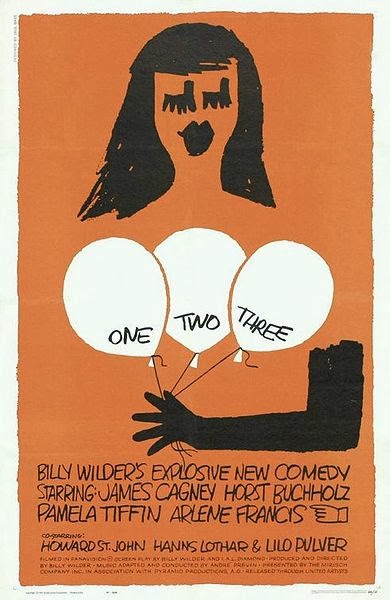
Poster by Saul Bass

One, Two, Three (Billy Wilder, 1961)

C.R. "Mac" MacNamara (James Cagney) is a high-ranking executive in the Coca-Cola Company, assigned to West Berlin after a business fiasco a few years earlier in the Middle East (about which he is still bitter). Nevertheless, Mac is angling to become head of Western European Coca-Cola Operations, based in London. After working on an arrangement to introduce Coke into the Soviet Union, Mac receives a call from his boss, W.P. Hazeltine (Howard St. John) in Atlanta. Scarlett Hazeltine (Pamela Tiffin), the boss's hot-blooded but slightly dim 17-year-old socialite daughter, is coming to Berlin and Mac is assigned the unenviable task of taking care of this young whirlwind.

Producer/director Billy Wilder is mostly remembered for his comedies like Some Like It Hot, The Apartment, and The Seven Year Itch. With One, Two, Three he once again goes into the comedic territory with lots of success. First, with his leading man James Cagney as Mac the ambitious executive of the Coca-Cola Company, by the way one of the most distinctive symbols of Capitalism, in the Berlin of the time they build the Berlin Wall. In fact, they were forced to leave Berlin for Munich to continue the shooting of the film because of the rising of the Wall. With his visions of expansion he has to deal with communists and Russians. With fast paced dialogues, Wilder wanted to make a funny film that would be like a whirlwind of jokes and strong moments. Much like, let’s say, Howard Hawks’ His Girl Friday.

One, Two, Three is also the last film of actor James Cagney before his retirement and also one of his great performances. He carries the film on his own. He also represents the classic Hollywood in the early 1960's where the New Hollywood was about to take the silver screen and put aside those dusty stars and directors. 

Almost entirely shot into Mac’s office and some exteriors of Berlin and the airport, One, Two, Three demonstrates how a strong script can set everything for a great comedy. Written by Wilder and I.A.L. Diamond, the plot is intelligent and is like a mix of Ninotchka, that Wilder co-wrote, and an Hungarian one act play by Ferenc Molnar. It is truly a great use of the stereotypes of the time on the battle between the West and the East. Much like the battle between Coca-Cola and Pepsi Cola; to use another figure that the film offers. One of the annoying things of this movie is the fact that the dialogues are so fast that they are almost yelled all along the picture. But much like any other screwball comedies it is almost an entire dispute the entire film that characterizes the genre. So yes they yell but every line is a pleasure and the delivery from Cagney, Pamela Tiffin, Arlene Francis, Lilo Pulver, Horst Buchholz, Hanns Lothar, and Howard St. John is deadpan funny.

 As often, heavy dramas gain respect and recognition and most of the time get the biggest awards. One, Two, Three is no rest with that and Cagney could at least been nominated for his performance at the Oscars. However, this movie isn’t on many lists of great films and not even on AFI’s 100 Comedies. It leaves me wondering who makes those lists and on which standards do they make their picks because this is definitely an omission. One of the greatest lesser known films from Billy Wilder who often gets its impact diminished because he left a bigger mark as a master at comedies than in a more serious genre. A great comedy that I highly recommend.


2015-04-27

Come and See

Come and See aka Idi i smotri (Elem Klimov, 1985)

After finding an old rifle, a young boy joins the Soviet Army and experiences the horrors of World War II.

Often described as the most realistic War film ever made, Elem Klimov’s final film, Come and See is a tour de force of acting, cinematography, and human extremism exposition. This engaging film of beauty and ugliness of a teenage boy who lives through World War II in Belorussia and who is taken to fight along the Russians against the Nazi occupation and its extermination of those who are called the White Russians.

Midway into this nightmarish vision of one of the worst aspects of humanity in the 20th Century, War and the extermination of nations, I felt like if I was watching the ultimate horror movie. Knowing that this kind of story never ends well I tried not to get too attached to the characters but from the first moments I was hooked with the kids playing on the beach looking to play war during War. As young boys we imagined playing war was fun and wanted to shoot and live those action movie moments. However, Florian (A. Kravchenko) gets way more than he asked for. Not long after he finds an old rifle he is taken from his mother and two young sisters to fight with the Red Army. Just as he is we are the silent witness of the worst humans can do. What frightens the most with Come and See is how it is probably not exaggerated how the horrors and the cruelty is done.

Often, the main critic about War films is that it depicts an exciting vision of killing enemies and action movie of good and bad guys. By far, Come and See is the most efficient anti-War film ever made. I’ve read somewhere that compared to it Apocalypse Now is the ultimate date movie, well Apocalypse Now and Full Metal Jacket are rewatchable movies and have an entertainment value that can distance us from the horrible aspects and are mostly artistic visions of War from their directors. With Klimov’s film there’s a high cinematic value and he probably used some of the most manipulative and involving techniques to makes us feel the disgust of War but no one can stay passive with this film.

As much as the qualities of Come and See are obvious as it is depicting one of the worst nightmarish visions, we feel that the manipulation and the strings of sensationalism are a bit overwhelming. Some scenes are almost unwatchable and no one is spared. Just as the conclusion of the film evokes, History can’t be erased or reversed and sadly monsters like the Nazis have lived before and nothing can be done to correct that. It is a bit pedestrian or blockbuster label but Come and See fells into the mandatory film category and not for the faint of heart too. It reminds us of the U.N.’s statement after the Second World War of never again we must let this happen.


2015-04-09

Beau travail


Beau travail (Claire Denis, 1999)

This film focuses on an ex-Foreign Legion officer as he recalls his once glorious life, leading troops in Africa.

This critically acclaimed film by Claire Denis is a beautiful tale of manhood in the 20th Century. A century that was punctuated by wars and the evolution of the man in the society. Centered around the tensions between men, the relationships of power and envy, and the clash between the military service, the civil life, and the opposition of the rich world (France) and the poor world (Djibouti) Beau travail demonstrates with metaphoric and symbolism a simple story of the post-modern world.

The central character of Galoup (Denis Lavant) is an interesting portrayal of a man in a position of power and submission. Leading a French Foreign troop in the deserts of Djibouti and directing a tough training feels isolated and even in those vast lands, a bit claustrophobic at times. A strong comparison comes to mind with a Spartan regiment of strong men musculated and often shown without a shirt. Their trainings are as gracious as dances and as demanding as a military exercise should be.

The camera of Agnès Godard, no relationship to Jean-Luc, is moving and creates a presence that involves the viewer. The editing proves to be particular and creates an ensemble of bits and moments of a fast but demanding lifestyle. Beau travail is exhausting and also relaxing when its moments of contemplation are in full effect.

As my second encounter with director Claire Denis, the first was 35 rhums, Beau travail is as beautiful as it is meditative and the character of Galoup gives a great canvas for its highly talented actor Denis Lavant. Evocative of many European auteur films to come in the early 21st Century, Denis’ film was probably a revelation in its whole but especially its aesthetics. Godard’s camera as aforementioned gives a nervous signature to the film.

2015-04-02

Él


Él (Luis Bunuel, 1953)

Francisco is rich, rather strict on principles, and still a bachelor. After meeting Gloria by accident, he is suddenly intent on her becoming his wife and courts her until she agrees to marry him.

With the important number of films by Luis Bunuel that are available from his Spanish period, his Mexican exil, and his late French cinephiles from around the world can at least get something for their tastes. Even if he is more reknown for his French surrealistic films, Bunuel took many genres under his particular signature and directed essential timeless films.

With Él and its story of an obsessive lover filled with jealousy, frustration, and paranoiac persona Bunuel will go on and make one of the most interesting thrillers that will go and inspire the great Alfred Hitchcock with his scene in the church bell tower. He also used jump cuts to let his viewer know the anti-hero’s point of view and how he perceives people.

Él was the kind of film I went into with no idea what was the subject and a little bit of a reluctance for another Mexican film from Bunuel fearing this might be a lesser film from the filmmaker. However, this is one of his films I enjoyed the most lately. The only negative comment I would have to say is not even about the film itself but the french subtitles that were poorly translated. As a french speaker, Spanish is also a Latin language and I understand some bits here and there of Spanish and Italian but I could sense that some subtitles needed to say more or were just not right for the scenes. This is a case where the old adage of lost in translation is right for the moment.

Personally, I would rank Él really high but not quite a masterpiece despite the elegant cinematography by Gabriel Figueroa, the elegant but pompous sets of Franscisco’s house, and the use of modern psychology for the central character’s mental disorder. If I would make a list of the 1000 Greatest films of all time, something I am planning to do sometime when I’ll finish the one from They Shoot Pictures, Él will be on it without a doubt.

Of the fifteen Luis Bunuel films listed on the 1000 Greatest Films list, I know have seen eleven and I enjoyed each and every one of them. Needless to say that I digged Él very much. The thriller value and the obsession of love portrayed here makes it one of the most efficient films on paranoia and mental illness.

2015-03-11

Whiplash


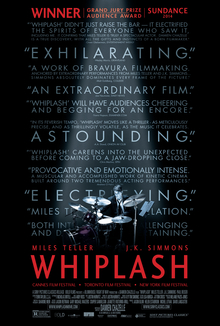
Whiplash (Damien Chazelle, 2014)

A promising young drummer enrolls at a cut-throat music conservatory where his dreams of greatness are mentored by an instructor who will stop at nothing to realize a student's potential.

It is important to immediately inform you the reader that before we get into this film review of Damien Chazelle’s Whiplash, I own and play on a drum occasionally and I even introduced the instrument to my daughter when she was six months old. So music and drumming are important to me and a strong interest for me. So in a way, this review might be tainted with other than a simple movie review.

Staring off with the mention of the tremendous performance by J.K. Simmons as Fletcher the tyrannical mentor is not an understatement to say that he steals every scene he is in. As his opposite, young Miles Teller plays the greatness driven Andrew who wants to become one of the best jazz drummer of his generation. It is a bit of a surprise that Teller was not nominated for an Oscar for his performance. The chemistry between the two actors works because the manipulative Fletcher works like a chameleonic presence of building and destroying to build better artists than they ever dream of.

My reading of Whiplash is a Freudian one with Andrew in the middle of his biological father who wants the best for his only child that he raised by himself having to be his father and his mother. While Andrew prefers Fletcher’s hard love father figure of a despotist dictator conductor. While he sees his father as weak and too soft for him he goes to Fletcher to get the kick and beat himself to become great. He is relegating his biological father as a figure of moral support but not a life guidance one. Feeling that his father has failed him and does not understand his drive and aspirations.

Apart from the great tension of the story and its acting performances, the cinematography and editing of the musical sequences are warm and well executed. Lighting is very dark but gives the right atmosphere for jazz music and how the conservatory seems to be taking its students into a close set of isolation and obsessive study.

Whiplash is a strong film and having never heard of its director, Chazelle, I’m looking forward to discover his next projects. It is a film that makes me want to grab the sticks and jam on my set during long hours. This is the kind of film that inspires and also understands how creative teachers can be pain in the ass but also just want to get the best out of everything. Personally, I had a father like that and it was difficult when I was a child and a teenager but today I would not be the man I am.

2015-02-25

Rafales


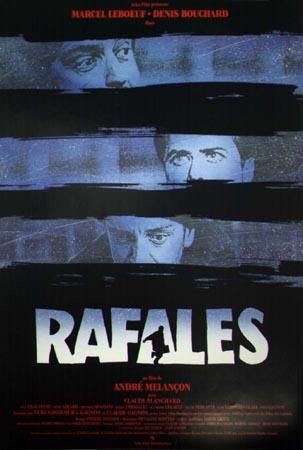
Rafales (André Melançon, 1990)

On Christmas eve a journalist (Denis Bouchard) witnesses a theft in a mall and later tracks one of the thieves (Marcel Leboeuf) and ends up being taken as his hostage at the radio station he works for.

Populated with the constant sound of the wind blowing during a snow storm on December 24th in Montréal, Rafales french for gusts is at first a powerful thriller that easily transcends borders of the french speaking Province of Québec.

With Marcel Leboeuf as Gérard Crépeau a garage employee involved in a theft that was orchestrated by his brother Normand (Guy Thauvette) and Pouliot (Claude Blanchard) the boss of the garage might feel like a standard robbery gone bad until Gérard shoots the mall’s Santa Claus and flies away with the money and meet Louis-Philippe Trépanier (Denis Bouchard). Normand is arrested and Pouliot does an act of treason.

Prior to the robbery, Trépanier sees Gérard and Normand argue about the crime they are about to commit, he is in a toy store and picks up toys for his kids. He sees Gérard’s gun and starts to follow him. There’s a strange fascination in the way that Trépanier watches Gérard, who is the most fragile character in the movie. Trépanier is an opportunist and sees a scoop in the tracking of the thief. While he has the chance to alert policemen he doesn’t do so at the first place.

In fact, with the conclusion of the film we understand that he was using Gérard for his own purpose and his career. In a way, it was Gérard who was the hostage in the radio station broadcasting live the negociation with the police. Rémy Girard, aka the Québec actor that is cast in every Québec film ever made, is the manager of the station and saw the potential in Trépanier’s actions taking advantage even in accepting to pass commercials during the aforementioned live broadcast.

One of the most human moments is when Gérard lifts an aging Russian woman (Kim Yaroshevskaya) and talks about her past and then moments of his childhood. It is one of those moments that can be a home run or a total pathetic pathos moment. In this case it is perfect and its purpose is also well used.

Dedicated to the late John Cassavetes who had just passed out months before the opening of Rafales, director André Melançon made a strong film with a mise en scène that demonstrates his great mastery at storytelling keeping lots of silences especially with nearly 20 minutes in the opening and almost no dialogues outside of the radio station.

Having watched more than 2000 films in my life and written about at least 500 of them it is now less often that I feel left being impressed or ecstatic. With Rafales, it is the case where I think I sat in front of something that was quite unique. This is a very good film and one of my favorite films from my part of the world; the Province of Québec.

2014-10-14

Gone Girl


Gone Girl (David Fincher, 2014)

With his wife's disappearance having become the focus of an intense media circus, a man sees the spotlight turned on him when it's suspected that he may not be innocent.

With recent success with The Social Network, The Girl with the Dragon Tattoo, and most notably the Netflix production House of Cards, David Fincher directs the adaptation of Gillian Flynn’s own best-selling novel Gone Girl. Fincher’s previous directing credits in investigations from Seven to Zodiac are more than worth mentioning. They are essential viewings for any film enthusiast.

Starting with a novel of more than five hundred pages and reducing it to more or less two hundred, author and screenwriter Flynn has done a tremendous job in skimming an unique plot and keeping the essential and the most interesting parts of her novel. While the novel has many ups and some downs or lesser parts, in the motion picture we are in the presence of the most interesting facets of the investigation. It is difficult to summarize the plot line because many elements are potential spoilers. However, the author of the novel had to pin point the plot aspects that were helping the story to evolve at a nice pace without compromising her idea and the whole situation it describes. Having read the novel weeks before I saw Gone Girl, I can state that it is one of the best adaptations that is true to the original material and could elevate its better parts to filmic bliss.

Talking of filmic hability, Fincher manages to once again throw a directing job with great mastery at a subtle level of execution. Everything is in the fact that we are leaded by a talented storyteller that doesn’t need any special trick or subterfuge to enjoy this story.

In front of the camera we have now respected as a director but still an actor Ben Affleck with a role that is almost written for him and his apathic presence of good family boy and his weird I want to make you feel okay smile. One thing that Fincher in fact wanted the most from Affleck. When reading the novel, imagining Affleck playing Nick Dunne feels right.
With Amy or Amazing Amy, Rosamund Pike gives a revealing performance of holding back but also complete control over the very meaty part she has to carry.
There are many interesting supporting parts of Detective Rhonda Boney (Kim Dickens), Margo (Carrie Coon) Nick’s sister, Desi (Neil Patrick Harris), and Tanner Bolt surprisingly portrayed and mastered by Tyler Perry.

Then you have the Trent Reznor and Atticus Ross score that follows their previous collaborations with David Fincher on The Social Network and The Girl with the Dragon Tattoo. Its texture and composition have been trademarks of Fincher excellence but also subtle or very present ambiant music that blends imagery and sound to a unique place. This might be one of the best score from Reznor and Ross just for the fact that it is present without overly taking too much space.

Gone Girl is another demonstration that the thriller genre can still be thrilling and gets into unexpected twists and turns. Genre novels and films need more Gillian Flynn and David Fincher to bring original stories alive and continue to get people’s attention. To be surprise and entertained is more and more difficult since everything is a product from a product that is a copy-paste of the original. Playing with the rules of a genre doesn’t hurt and Fincher seems to really enjoy himself playing into them and stepping on them just enough to get us a new way of seeing it without making a complete mess that would not appeal to a larger public. Not that I don’t like a mess once in a while but I each time I watch a Fincher film it reminds me how much I admire his films.

Related Posts Plugin for WordPress, Blogger...