Showing posts with label Woody Allen. Show all posts

2015-02-12

A Midsummer Night’s Sex Comedy


A Midsummer Night’s Sex Comedy (Woody Allen, 1982)

A wacky inventor and his wife invite two other couples for a weekend party at a romantic summer house in the 1900s countryside.

With a series of masterpieces like Annie Hall, Manhattan, and Stardust Memories in the late 1970’s and early 1980’s, actor-director Woody Allen would go on and fell into a more serious state of mind in the themes and stories of his films. With A Midsummer Night’s Sex Comedy he went back on the more comedic side of his craft. Obviously inspired by Ingmar Bergman’s Smiles of A Summer Night, the great Swede’s unique comedic success, Allen’s film doesn’t deliver at the level of his aforementioned films or of his inspiration.

Staring himself, Mia Farrow, Mary Steenburgen, José Ferrer, Julie Hagerty and Tony Roberts A Midsummer tells the story of ancient lovers, new love and missed opportunities. Well, some of Allen’s regular themes. Brilliantly shot by legendary cinematographer Gordon Willis we have in place many elements that could have made it a great movie but instead it fells flat and redundant at times. Allen seems to be forcing to get comedic elements into his already comic plot to justify the fact that he has the actual word comedy in the title of the film. However, with his aforementioned successes, he proved he can make intelligent comedy without the physical comedy of his earlier films. The line between romance, comedy, and drama is weirdly crossed in A Midsummer and it makes many awkward scenes and as the viewer I felt distant to those characters. Maybe the countryside is not favorable for Allen and he is more inspired by the city and urban settings.

As a genuine enthusiast of the films of the Woodman, it was the only directorial credit that I needed to watch from his prolific 1980’s decade of great films. My expectations were moderate but I was hoping to get a little gem but not a masterpiece. It is an average to good film but it never really gets on track and works for me. It is a difficult film to rate because its execution with the cinematography is faultless it is more on the content that it stumbles and drags. Although, later in his career, Woody Allen will direct a bunch of worst films that could help make this one feel like a nostalgic piece of the greatest era of his work.

2013-11-01

Manhattan Murder Mystery

Manhattan Murder Mystery (Woody Allen, 1993)
Larry Lipton (Woody Allen) and his wife Carol (Diane Keaton) meet their new next-door neighbors Paul (Jerry Adler) and Lilian (Lynn Cohen) House. They meet at the Houses' apartment for coffee, and they discover they have common interests. The next night, Larry and Carol find the Houses' door open and a crowd forming in the hallway. Lilian has died of a heart attack. The Liptons are surprised by the death because Lilian seemed so healthy.

2013-10-18

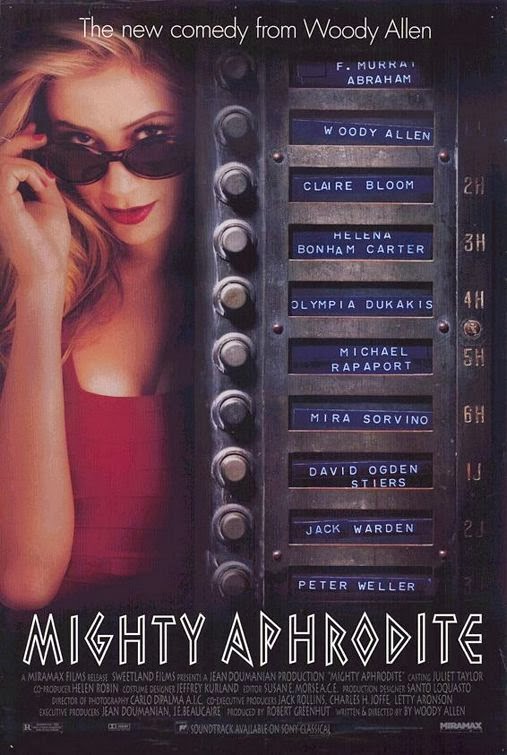
Mighty Aphrodite

Mighty Aphrodite (Woody Allen, 1995)
There are those directors that do nothing for you as a person and there are those who are a big deal for you because you can connect with them at a level that only a few are able to do. Amongst the vast variety of directors and filmmakers out there, Woody Allen could easily be the director that could write and direct my life. Not because I think that my life is like a Woody Allen movie or that I live a life like his, but it would be his touch and his color that I would like to have on my biography. The other possible directors are Wes Anderson, Martin Scorsese, Andrei Tarkovsky, and obviously Stanley Kubrick.

2013-10-09

Broadway Danny Rose

Broadway Danny Rose (Woody Allen, 1984)
In my illness that is cinephilia I have to admit to have more than one vice. But the most vile of them all is the fact that I am a completist. I like to watch all the movies a director has made all along his career. Even if it is as expansive as Alfred Hitchcock or Ingmar Bergman and even if it was shortened like Andrei Tarkovsky or Stanley Kubrick. When I like a director’s major films I tend to look to his underappreciated ones and watch them and most of the time like them. The same thing happens with Woody Allen a writer director who writes and direct at the pace of one movie per year since the early 1970’s has made easily more than forty films and seems to not even slowing down today.

2013-09-18

Alice (1990)

Alice (Woody Allen, 1990)
Blending the telling of Lewis Carroll’s Alice in Wonderland, Charles Dickens’ A Christmas Tale, and Federico Fellini’s Juliet of the Spirits, Woody Allen’s Alice starring Mia Farrow is often overlooked compared to his Crimes and Misdemeanors of 1989 and Husbands and Wives of 1992. Speaking of blends, Alice is also a blend of genres, navigating between comedy, fantastic, and drama, the character of Alice Tate (Mia Farrow) is the wife of a wealthy business man (William Hurt) but she isn’t really in love anymore.

2012-09-20

Midnight in Paris


Midnight in Paris (Woody Allen, 2011)

A family travel to the French capital for business. The party includes a young engaged couple who are forced to confront their differing views of a perfect life.

Directing a film per year since the early 1970’s, Woody Allen might become one of the most productive directors of all time. Let’s not count John Ford’s early Westerns or the many short films some directors may have directed in a year. Writing and directing a film every year at 76 years old might be a challenge since the Woodman has been occasionally accused of repeating himself over and over again. However, Midnight in Paris, released in 2011, became one of his most successful movies at the box office. So it was with high expectations I sat through the 94 minutes of this ode to the Paris of the 1920’s.

Gill (Owen Wilson) is about to marry Inez (Rachel McAdams), obviously the wrong girl and moreover the wrong family. He is a daydreamer and he wants to escape his screenwriter job to become a “real” writer and finish his novel. Gill is another Woody Allen-like protagonist, about that there is an interesting fact about the names of his characters. They are always short because he doesn’t like to lose too much time writing them. But here I digress, the couple is visiting Paris with Inez’ parents (Mimi Kennedy & Kurt Fuller). They also encounter Carol (Nina Arianda) and Paul (Michael Sheen) a couple of Inez’s friends. The latter is an old crush of the young woman. Completely exasperated by Paul’s scholar bragging, Gill decides to go walk alone one night. This will lead him to taste the dreams he always wanted.

Similarly structured as The Purple Rose of Cairo, Midnight in Paris is a movie for cinephiles and daydreamers. The romantic depictions of Paris, the encounters with historical figures are elements that I don’t want to spoil for those who haven’t seen the picture. It feels like if Woody wanted to connect with his own nostalgia like his very autobiographical movie Radio Days. The Gill character, played by Owen Wilson, got all the ticks and fads that Allen did when he used to star in his films. Wilson does a good job but it is more an impersonation than actually a composition. Not having read on Allen’s directing to Wilson might be a flaw for this review, but I tend to think that Wilson was on his own (no real directions from Allen) and rewatched early films of Woody and did his best to catch the unique character.

With my high expectations, Midnight in Paris felt a little flat for me and it is because the story isn’t that original or surprising. Even if Darius Khondji’s cinematography is warm and beautiful, the whole of the film lacked in depth and the script could have used some fresh air. However, we are in a Woody Allen movie and the recurring themes, the characters, and the unique Allenian feeling is there. Recommended.


2012-05-31

September

September (Woody Allen, 1987)

In the 1980’s Woody Allen directed eleven movies, many of those are near-masterpieces if not masterpieces. Amongst his films from this decade Crimes and Misdemeanours, Hannah and Her Sisters, Zelig, The Purple Rose of Cairo are my personal favorite. But, even if Allen pleased fans and critics thorough the 1980’s September is considered as the lesser and the most hated or simply oft-overlooked. It is quite easy to agree with everyone when a consensus is form for or against a particular movie. Well, twenty-five years after its initial release, I watched September for the first time lately and I must admit that it is far from being a masterpiece. Nonetheless, it is a very interesting movie that might not be as Allenian as Zelig or Hanna and Her Sisters but an above than average melodrama.

Shot strictly in the interiors of a house this huis clos evolves around a bunch of heavy loaded past characters: Lane (Mia Farrow), her mother Diane (Elaine Stritch), her lover Peter (Sam Waterston), her mother’s lover Lloyd (Jack Warden), the neighbour Howard (Denholm Elliot), and Stephanie (Diane Wiest). As IMDb summarizes the plot Howard loves Lane, she loves Peter that is secretly in love with Stephanie, who’s married with children. The whole story centers on these characters and their interactions with each other and as each discovers the love interests of one and another. Sure the central music is jazz, but what did you expect from Woody? The central scene, an evening during a thunderstorm a blackout occurs. The revelations are set in this almost eerie candle lit setting of stopped time by the ambient darkness and the alcohol ingested. This is the most successful aspect of the film and the scene makes the film.

However, Woody Allen brings us in known territories most of the time and the too many clichés and predictable lines but also the resemblance to the 1978 failure Interiors he probably wanted to revise and be forgiven but the melodrama might been well executed it lacks in the personal touch that Allen easily adds into his films without much effort.

When Allen did Interiors he wanted to make a film like his idol Ingmar Bergman filled with clean cold whites and perfectly directed women characters. The failure of Interiors is the impression of doing another director’s style, narrative, and genre. In September, the autumn tones in the colors and the script are more personal to the Woodman but still I got Bergman not far in my mind while I was watching this interior drama.

Far from being a dud, September might be considered as a lesser Woody Allen picture, but it is still better than his five to seven worst films. At least he’s doing something different and he was trying new things. An inspired Allen that takes risks might be less toothier but is more interesting than the old master resting in his old shoes.

2012-05-18

Radio Days

Radio Days (Woody Allen, 1987)

Woody Allen’s 1980’s were marked by a succession of near-perfect and near-masterpiece movies. Just think of Hannah and Her Sisters, Zelig, The Purple Rose of Cairo, and Crimes and Misdemeanours. Well, Radio Days sure inserts itself like a charm in this corpus of films. With this movie, Woody revisits his childhood memories of the great era of radio shows in the 1940’s. With his narration and a bunch of his regular actors: Mia Farrow, Julie Kavner, Danny Aiello, Josh Mostel, Jeff Daniels, Diane Wiest, and Diane Keaton. The autobiographical line of the film and the young Joe (portrayed by a young Seth Green) representing Woody himself, is bold and evident. However, his storytelling is wry and pitch-perfect.

The story can relate to one of Allen’s masters Federico Fellini’s film Amarcord as for the nostalgia and the personal recollection of moments of pre-teen and teen years. Even if bits of Radio Days remind of Fellini’s masterpiece, the film is very personal and doesn’t have to envy to the Maestro. The vignettes recalling the greatest moments of radio of the time and the favourite shows of the family are sometimes absurd, hilarious, touching, and always very Allenian. The colourful palette of the sets of every character are superb and Mia Farrow’s performance is outstanding. Her role of Sally White, the young woman who wants to do radio and get every opportunity to do show business is very well served by her writer.


Being too young to have actually lived this time of Radio and the mental picturing of the events, shows, and gossips of the media I can relate to the phenomenon of television when I grew up myself in the 1980’s and 1990’s. However, even if I haven’t lived in the era the film immerses us with a color and passion that Woody’s nostalgia and souvenirs embellishes or exaggerates. Roger Ebert described the film as a film without a narrative, well in some way it is right, but it is also a recollection of memories and anecdotes of the time and even if it doesn’t have a beginning and an ending the succession of vignettes is well intercalated and the reappearance of many characters over the movie gets your attention.


The best moments of Radio Days are the opening sequence of the two burglars answering the phone of the home they were robbing and winning the contest. The scene where Joe is in his dad’s arms when they learn that the little girl who fell in a well is tragically deceased. Of course, the final scene where the radio people get on the top of the club on New Year’s Eve and the snow begins falling down concludes the movie perfectly.

A moving autobiographical film that portrays another angle of the New York City of Woody Allen’s memory. A great love letter to the great years of radio and the effect it had on the life of a family of workers and the people actually working on the air.

2012-05-11

The Purple Rose of Cairo

The Purple Rose of Cairo (Woody Allen, 1985)

Another film in the golden years of Woody Allen’s monstrous career, The Purple Rose of Cairo stars Mia Farrow, Allen’s life partner at the time, and Jeff Daniels. In the Depression era a little frail woman named Cecilia (Mia Farrow) tries to make a living by waitressing while daydreaming of pictures, actors, and fictional stories. Her husband (Danny Aiello), a rude employed child-like man gives her every reason to want to escape her life with movies.

Made two years after his faux-documentary Zelig set in the same time period, the Great Depression, Woody Allen exploits the film in the film or the concept of the ouroboros. The simple act of going to the movies is reduced to its initial purpose here: to have a good time, dream, live or escape to another life. The moments where Cecilia sits in the theatre eating popcorn and delivering herself from her meaningless job and rough husband are pure cinematic bliss. We easily identify ourselves sitting in this almost empty theatre and watching Tom Baxter (Jeff Daniels) in the movie showed actually also titled The Purple Rose of Cairo. At first, when the character of Baxter gets out of the screen and flirt with Cecilia when might think that it is surrealist, and be a direct reference to Buster Keaton’s masterpiece Sherlock Jr. But, Baxter actually gets involved with the characters of Cecilia’s reality, with her husband, Hollywood actor Gil Shepherd (also Jeff Daniels), and the girls of a brothel. However, every scene involving Baxter seemed so caricatured that it is definitely an expansion of Cecilia’s phantasm of evasion and letting everything behind and realizing her dreams of Hollywood scale.

For those who care for that there will be spoilers in the next paragraph. In the final moments of the film there are many true Woody Allen signatures. First, when Shepherd convinces Cecilia to let Baxter go back in the movie and follow him to Hollywood we have a clear shot of Shepherd in the plane alone thinking of what he has done to save his career and hurting Cecilia in his measure. This is one of Woody Allen critic over Hollywood in his disdain for this city and how it all works. It also represents the structure of story he usually makes with the complete turnover until the final ending where almost everything is back in its place like it was when the film began. Allen likes his scripts to be like a two way ticket. Well, here you have these people they live an adventure and then they go back to their normal lives. Just like the audience that lived the movie and then go back home with the memories of Cairo, adventurers, etc.

With The Purple Rose of Cairo, Allen manages to blend one of his most well mastered mixture of romantic comedy and drama. Once again, this is one of Allen’s great genuine pictures, he is not trying to be Ingmar Bergman or Federico Fellini here, he does a Woody Allen picture that works and that deserves its place within the 1000 Greatest Films of All Time by They Shoot Pictures. It is also worth to mention the excellent work of cinematographer Gordon Willis, a long- time Allen collaborator. A touching film that reflects the love of movie from a movie lover to movie lovers.

2012-05-04

Zelig

Zelig (Woody Allen, 1983)

This smart imitation of the documentaries of specialized History oriented channels has everything of the clever comedies of Woody Allen and the content of his more introspective psychological dramas. With his constant obsession for Freud, Religion, Politics, and social issues Allen continues his streak following Stardust Memories and A Midsummer’s Night Sex Comedy. Portrayed by Allen himself, Leonard Zelig is a character who appeared many times in the news of the 1920’s. His ability to adapt to the world and people around him makes him fit with everyone and everywhere. It doesn’t take long before he is discovered and following the buzz of the 1920’s on psychoanalysis Zelig gets under the “microscopes“ of the Scientifics. Specifically, Dr. Eudora Fletcher a young psychiatrist who wants to help Zelig and use the cure to get some recognition from her peers.

The effects of camouflage of Allen into faux-archived images and real archives is efficient. With the use of cameras, lighting, and scratches on the film, and the use of the dramatic music of the documentaries the illusion is almost-perfect. The insertion of Allen along President Wilson, Adolf Hitler, Babe Ruth, and many more historical figures with the technology of blue screen reused more than a decade later by Robert Zemeckis’ crew in Forrest Gump is as convincing as the later film. Here stops the comparison between the two pictures, Gump is more on the nostalgic, conservatism, and sensible side of the road while Allen exploits absurd situations, satire, and psychological references.

One of the most interesting facets of Zelig, the movie and the character, is how it represents the conformism and our constant will to be liked and appreciated by the people around us. Zelig, the chameleon man, transforms himself to fit to the group he lives in. Adapting the appearance and the ideology of the people surrounding him. His body and personality is malleable. The comment of the film is even more realistic when Zelig is seen with the SS representing the most important movement of fitting into the masses and forming a common nation leaded by only one head that decides everything for the group. This is an interesting critique on totalitarianism and the contemporary societies. In a lower scale than the National-Socialists and in a much much lesser extremist way, the American nation represents the volition to blend its population together even if it’s one of the most mixed bags of human diversity. There is a will to take every Man on the same level.  But we, as a society, like that everyone thinks like us. It is a modern world illness that our society conditions us to react in this way. The weight of the majority, its influence on us is more subtle than we would ever thought. I mentioned the American society because Leonard Zelig is an American in this movie. Yet, it represents a modern-day disease or observation more than a simple exercise of designation. Allen scratch the surface of a problem that the individuality of capitalism is contradicted by the majority of democracy. Just like every good recipe, it takes a good balance between the right tastes and textures.


Allen’s director of photography, Gordon Willis, does an outstanding job with the shooting of false-real archival footage for the set-up of the story in the 1920’s and 1930’s. The mix between his footage and the original archives is hardly noticeable.

The enjoyment of Zelig works on two levels. First, it is a fun satire of the 1920’s that isn’t really that much distant from us. The choice of format, documentary, is surprisingly entertaining and lets the writer-director some leash on the traditional filmmaking and storytelling. On a lesser note, it reminds the cinematic prowess of the storytelling of Annie Hall and the mastery of every trick of filmmaking. Even if Zelig is lesser than the aforementioned masterpiece, it is still a very entertaining and yet smart movie.

2011-11-30

Top films of Woody Allen by LMdC


On the eve of Allen's 75th birthday, I've decided to honour the man with a Top of his films and a modest presentation of the second to best filmmaker of New York city, the first being the great Martin Scorsese. In the beginning of his career, Allen was a stand-up comedian with punched one-liners like no one. At thirty years old he starred in his first ever movie called What's New Pussycat? One year later he directed his first film What's Up Tiger Lily? The first seven films he made were straight up comedies bringing a fresh and unseen absurb approach to the genre. Sometimes on the surrealist side but always heavily accentuated by Allen's unkind humour. His first real recognition as a serious filmmaker was his first masterpiece Annie Hall in 1977. Allen won the Oscar for Best Picture, Best Director, and Best Screenplay and was also nominated for Best Actor.

2011-03-01

Cassandra's Dream

Cassandra's Dream (Woody Allen, 2007)

From Woody Allen, a monument in the history of filmmaking with 46 moving pictures credited to his IMDb resume, Cassandra's Dream is in the continuity of his 'th youth of Match Point more than of his trademark comedies. To many cinephiles, Allen's comedies are annoying and look all the same. In my opinion he had one of the most interesting careers of the 1970's and 1980's together. Nowadays, Allen reminds me of the late Fellini that was a caricature of himself. Anyway, as I am a fan of his work I will continue to follow his films and discover what tricks he still can pull out of his hat. For those who are acquainted to Woody Allen you all know that he has a bag or a hat full of short stories/ideas for film that he wrote and picks one up and make a film with. Well, even if his You Will Meet Dark Tall Stranger wasn't that good we can't blame the man for not trying, with a ratio of one film per year, he has lots to offer. Let's just see if he still has juice in this fruit...

Cassandra's Dream is a modern day adaptation of the novel Brothers Karamazov by Dostoievski. The plot is well written even if it's not the twist of the century. Like Dostoievski, Allen likes to play with the motivations of the characters to commit the unthinkable. The story has this classic and sober tone to it and we feel that this film could have been made any other time in the history of Cinema and it would have worked. The main problem with the plot it's that it's not involving an issue that could have interested a wider audience. Compared to a more modern movie made by a director of approx the same age of Woody Allen, Sydney Lumet's Before the Devil Knows You're Dead, Cassandra's Dream feels a little bland.

The brothers pictured in Cassandra's Dream: Ewan McGregor and Colin Farrell are has usual very good. As I've read in some interview with Allen by Eric Lax, Allen never really directs the actors. But in this case this lack of stage directions may have created the right chemistry between the two actors. I appreciated both their presences and both kind of measure how their characters had to deal with moral issues. A regular supporting actor, Tom Wilkinson gives a memorable performance as the crooked uncle.

On the visual side, Cassandra's Dream looks like a British film with its clouded exteriors and dark colors.

For a Woody Allen, it's maybe a little over serious or too dramatic... However, I'll continue to watch Allen's films because I think he has some interesting ideas but I shouldn't think of Manhattan or Crimes and Misdemeanors because I'll regret those great films and this amazing period in his career...
Related Posts Plugin for WordPress, Blogger...