Showing posts with label jacques tati. Show all posts

2015-02-18

Jour de Fête


Jour de Fête (Jacques Tati, 1949)

Once a year the fair comes for one day to the little town 'Sainte-Severe-sur-Indre'. All inhabiters are scoffing at Francois (Jacques Tati), the postman, what he seems not to recognize.

The first feature length film by actor/director Jacques Tati is also the only film in which his character talks. Obviously inspired by Buster Keaton’s physical comedy and Charlie Chaplin’s observation of the common people, Jour de fête is set in Sainte-Severe the village where Tati was hiding during the Second World War.

Tati’s films excels in making the viewer the witness of the everyday life and little to no moments. His use of deep focus is important because in every frame there is something going on and it might or might not catch our eye at first. More than often, serious action is in the front of the image while comedic action is in the back. It is a visual work of camera settings and construction of every frame that Tati elaborated and later perfected with Play Time for instance.

The themes of the lunatic postman François doing his tour in the village delivering and taking post demonstrate the old Europe and especially France. Taking his time, talking here and there. Everything changes when he watches a short film about US’s postal service and their obsession with fast delivery and efficiency. It demonstrates the clash of the civilization between two world; the old and the new. With the liberation by Americans, France changed and allowed more American culture with a whole bunch of American films and products. The film of Tati is like an homage to the village that kept him away from the War but also how his country was never the same after the whole fair that represents War and the Vichy Regime. It was far from an happy event, but it brought turned up and down the whole country of France just like the installation of the fair would do.

Tati often meditated on the progress and the slow evolution of urban life. With his comedies he makes a portrait of a time of constant change but also contemplating the present moment of the characters. The story is almost the story of the cameraman who is there and gazes at moments and bits of life. While not being celebrated as much as Mr. Hulot’s Holiday, Mon oncle, and Play Time, Jour de Fête is a great first effort by Tati and I hope will be more highlighted by the recent release of Criterion’s Complete Tati boxset which is a great gift for cinephiles all over the world.

2012-09-17

Playtime


Playtime (Jacques Tati, 1967)

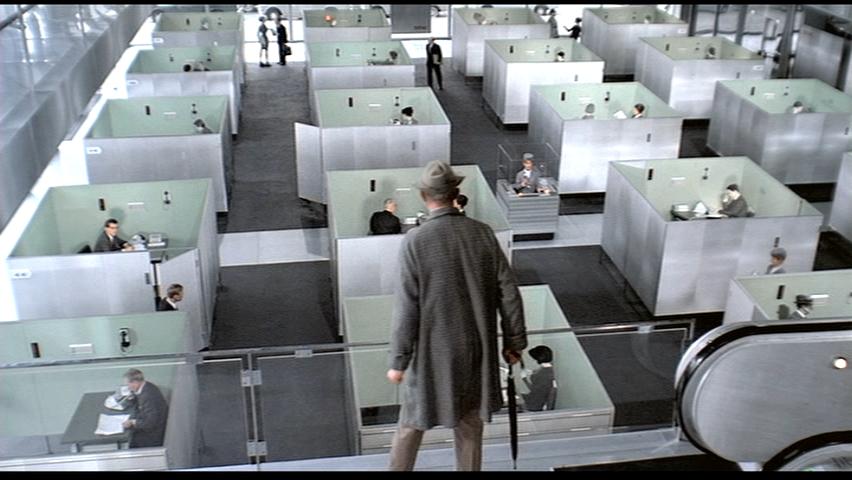
Monsieur Hulot has to contact an American official in Paris, but he gets lost in the maze of modern architecture which is filled with the latest technical gadgets. Caught in the tourist invasion, Hulot roams around Paris with a group of American tourists, causing chaos in his usual manner.

Tati is a quiet observer of the evolution of societies. There’s not much plot to talk about here just as any other Jacques Tati film. First you have Tati’s Monsieur Hulot, a simple but innocent charming man that seems to be from another time. Let’s say Keaton and Chaplin’s time if we must place him into a time table. Throughout the films, Hulot has been on a holiday, visiting family, and now visiting Paris to contact an American official.  For Tati, every scene is a set up of the everyday life and he takes Hulot into those ironies, aberrations, and modernisations to point the fact that after all we forgot about the simplicity of life and the little common things that makes our daily moments.

In his own way, Tati’s humor is subtle and almost invisible to the modern day viewer. His detached approach makes the audience wander like Hulot within the grey sets and the urban atrocities of the brutalism movement of the 1960’s. The structure of Playtime is very architectural and sticks to Mies van der Rohe’s motto: less is more. This is a very keen comedy and a masterpiece in the same vein that the two aforementioned greats of comedy Keaton and Chaplin would have been proud of birthing.

Prior to my first watching of Playtime I only saw Monsieur Hulot’s Holiday, which I liked in parts but not in its ensemble. With a little distance both films take more and more depth and I kind of learn to love Holiday. On the other hand, Playtime was an instant hit for me and a much stronger work from its father. The accuracy of Tati’s observation and the sheer brightness of the situations and the whole goodbye to the ancient world places Playtime not just amongst the greatest comedies of all time but with the greatest films of all time. It’s also a shy hello to the new world that was on the verge to hatch with the end of the 1960’s.

Moreover, this is a very unique film that can’t really be compared to anything that was released back in 1967 and to anything that Tati made either. The more someone discovers about Tati the more his films make perfect sense and their sensibility fells like a comfy outfit that you want to revisit because their message can’t be digested in its whole without repeated viewings. Highly recommended.

2011-11-16

Mon oncle

Mon oncle (Jacques Tati, 1958)

In this warm up through the month of November until the event of the Seven Days of French New Wave, countless French films will  be explored to contextualize the French film industry of the time. This 1958 film from France, by one of the most anachronical director of all-time: Jacques Tati is a masterpiece amongst Les vacances de Monsieur Hulot aka Mr. Hulot's Holiday and Playtime. Playing with Silent comedy and slapstick gags, the crossover between Chaplin, Keaton, and cartoons could vaguely described this character.
Like its director, the character played by Tati himself, seems to come out of another time, he is a silent witness of the not always successful progress and constant changes in the society.
The success of a Tati film isn't palpable for everyone because it can easily bore someone out. The slow-pace action, the repetition of effects, and the not so obvious gags makes Mon oncle, and all his films, very difficult to appreciate for the modern day viewer's eye. However, if the audiences take the time to observe and appreciate the finesse and the subtle comedy that Tati's Mr. Hulot has to offer it will discover how it is well worth effort and moreover the concentration.
It is another important aspect that I learned with Tati, the concentration of the viewer should be at its maximum anytime because when you think that some scene doesn't matter this is exactly the moment when Tati will get you. I would love to see a film by this director about how the society has changed since the 1970's and I'm sure he would have made a film about everyone connected to his/her phone in a restaurant full of people texting and being isolated from each other while posting little non-sense sentences of Facebook or Twitter.
Mon oncle is by far my favorite film by Jacques Tati, a filmmaker that made not so many films but that worked so hard on each one of them that it is already a lot when you calculate the number of gags and the quality of them all. He was the last of a tradition lost probably forever because this kind of humor only makes laugh nostalgics and stubborn film buffs like me...

Related Posts Plugin for WordPress, Blogger...