Showing posts with label (3). Show all posts

2023-08-01

Barbie


Barbie
(Greta Gerwig, 2023)

(3) Famous Barbie doll gets on a journey to find more than the meaning of her space in little girls' lives. A comedy that has a more depth and flavor than the saccharine and saturated pink that comes with its packaging. Outstanding performances from Margot Robbie and Ryan Gosling.

2017-02-01

Spotlight


Spotlight (Tom McCarthy, 2015)

The true story of how the Boston Globe uncovered the massive scandal of child molestation and cover-up within the local Catholic Archdiocese, shaking the entire Catholic Church to its core.

2016-02-12

The Martian


The Martian (Ridley Scott, 2015)

During a manned mission to Mars, Astronaut Mark Watney (Matt Damon) is presumed dead after a fierce storm and left behind by his crew. But Watney has survived and finds himself stranded and alone on the hostile planet. With only meager supplies, he must draw upon his ingenuity, wit and spirit to subsist and find a way to signal to Earth that he is alive.

2015-10-14

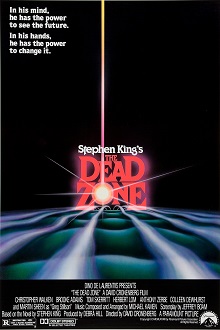
The Dead Zone (1983)


Note : this review is a contribution to the Kingathon hosted by Movie Reviews 101 and Movie Rob.

The Dead Zone (David Cronenberg, 1983)
A man awakens from a coma to discover he has a psychic detective ability.

2015-09-10

Repo Man

Repo Man (Alex Cox, 1984)

Young punk Otto becomes a repo man after helping to steal a car, and stumbles into a world of wackiness as a result.

Lately, I’ve joined the Cult Film Club and Alex Cox’s Sci-fi amalgam of counter culture of punk rockers blended with a metaphor on American Capitalism was the subject of their latest podcast. Having never seen this film before, I was intrigued with the poster on the website of the club. Added to that, Repo Man was included for the first time in the 2015 list of They Shoot Pictures1000 greatest films of all time.


2015-09-09

Ten

Ten (Abbas Kiarostami, 2002)

Ten sequences examine the emotional lives of women at significant junctures.

Filmed with digital cameras attached to the dashboard and shot entirely in the car driven by Mania Akbari, Ten paints a picture of a woman that wanted to be more than a submitted housewife in a world of that sadly repressive men are still accepted. The first sequence with her son Amin (Amin Maher) presents her as a divorced woman that has been remarried with a man she loves and that her son doesn’t. Amin seems already trained to be carrying the stereotypes his father told him.


2015-06-10

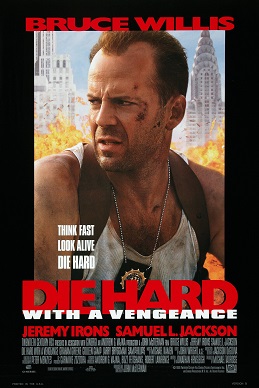
Die Hard : With a Vengeance

Note : this review is my contribution to the Beach Party blogathon hosted by Speakeasy and Silver Screenings.

Die Hard : With a Vengeance (John McTiernan, 1995)

John McClane and a Harlem store owner are targeted by German terrorist Simon Gruber in New York City, where he plans to rob the Federal Reserve Building.

This is the third instalment in the Die Hard franchise and my favorite one. Based on Hercules’ twelve labors and helped by Zeus (Samuel L. Jackson), John McClane (Bruce Willis) has to stop a terrorist in the biggest city of America; New York City. After the criminal bombs a commerce he plays a game of Simon says asking for McClane who is alcoholic and suspended to achieve every tasks he is asking him.

With director John McTiernan back on board, Die Hard : With a Vengeance is a fun ride of action film sequences and mind games. Set during summer, the opening with The Lovin’ Spoonfull track Summer in the City gets us into the mood. Then Michael Kamen embarks us on a great soundtrack with a use of When Johnny Comes Marching Home that fills some of the best scenes of the film. Some bits of his score from the first two film are reused but they all blend together to get us on the edge of our seats.

I remember going to the theater on May 19 1995 with two of my friends, I was eleven years old at the time and I was only one who haven’t seen the other films from the franchise. However, I was becoming a Die Hard fan. Even if the first film of the now five entries is by far the best and one of the best films of all time, Die Hard : With a Vengeance is my favorite one. The setting, my favorite city and almost my second home; New York City does do something in the whole. The fact that they did not visit tourist locations and included inside local places does it for a lot. It makes us feel as we know the city from the inside. It is a nice rally race that reminds us of the first NYC action films of the 1970’s like The Taking of Pelham 123.


All in all, he third instalment in the Die Hard franchise might not be as well praised as the first one but I wanted to highlight it as a summer blockbuster entertainment. And it is everything I’m looking for when I want to catch this kind of film. It has a dear place into my film lover memory and I tend to revisit it almost every year.

2015-05-13

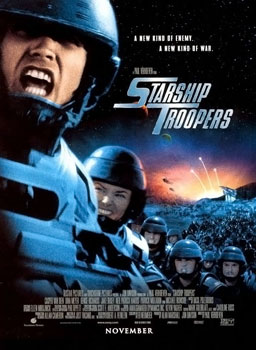
Starship Troopers


Note : This review is my contribution to the Film Preservation blogathon hosted by Ferdy on Films, This Island Rod, and Wonders in the Dark. Please donate generously.

Starship Troopers (Paul Verhoeven, 1997)
Humans in a fascistic, militaristic future do battle with giant alien bugs in a fight for survival.

Over the years, the many films of Dutch film director Paul Verhoeven have passed the test of time and became cult films. Just think of Robocop, Total Recall, Basic Instinct, and Showgirls for his work in Hollywood and his early European productions are underground hits with strong sexual and violent images.

Starship Troopers is more a virulent critic of America, the use of medias, and the way action movies are representing a right wing perception of life. The story is accessory to Verhoeven’s message of second level one liners and overbearing violence. In the films of Verhoeven, violence is not really stylised or cool, it is in your face just like when Peter Weller dies in Robocop before being in the robot. Even in Starship Troopers, Verhoeven has a way to present violence that does not appeal even with all the saturated frames of blood and special effects. With a production of 105 millions of dollars, Verhoeven achieved a level of imitation of fascism and opulence that only Albert Speer’s architecture could have been compared to.

Many sequences are shot by shot exactly like Leni Riefenstahl’s Triumph of the Will documenting Nazi reunions of the German party. The irony and satiric tone of Starship Troopers makes it such a great piece of anthology that it is almost frightening to think that American ideologies are not that far from what the film represents.

Curiously, at the time Starship Troopers was released, the critics and the public were not that warm about the film. Probably not ready for such an examination of their foreign politics, the turning of the 21st Century with the sad and condemnable events of September 11 may have demonstrated to the face of the world America’s belligerent politics.


As a film enthusiast, or as I like to call myself a cinephile, I really enjoyed Starship Troopers for its second level of reading and how he uses the action sequences to demonstrate a point. They are also really entertaining and this is one of the best part of this film. It has both values that few films of the genre have. In fact, I like most of Verhoeven’s films and I would watch Robocop, Total Recall, or Starship Troopers anytime knowing that it will be a good time and that I will find a little detail I haven’t seen before. They have great watch value and it adds a little omph to the whole thing.


2015-03-27

The Criminal Life of Archibaldo de la Cruz


The Criminal Life of Archibaldo de la Cruz (Luis Bunuel, 1955)

The delirious journey of a mental disordered man, who is obsessed in making the perfect crime.

Another film from Luis Bunuel’s Mexican period, The Criminal Life of Archibaldo de la Cruz, works on many recurrent themes of the director’s filmography with the use of dreamt or fantasized sequences, sexual provocation and its politics, and freudian elements of childhood traumas.

As with Bunuel’s other films of this era, this is a visually interesting film with sumptuous camera movements, and an imagery of suggestive sexual elements. With its overture with the death of the governess and the revealing of her legs you have everything that you need to know about this film. The suggestion that Archibaldo de la Cruz desires death to women and links it with sexual desire. Since that movie was made in 1955 it is easily readable as the choices to suggest sexual desire and not attribute the deaths to Archibaldo was to represent a repress sexual desire but also to respect some censorship rules. In fact, the movie is much more efficient in its representation of sexuality and the imaginary criminal life of its subject.

This is a deep film in its meanings and sadly a lesser known film in the vast filmography of its director. Sure it is not as important as Los Olvidados in his Mexican period, but The Criminal Life of Archibaldo de la Cruz is essential as to its use of many surrealist elements like the mirrors and Bunuel’s foot fetish.

On my main reference list as a movie watching goal, this is the lowest ranked film in the Bunuel selection. However, this is one of the most underrated and this surpasses many titles that don’t even deserve their spot on the list. Sure it is not as celebrated as Un chien andalou or The Discreet Charm of the Bourgeoisie but I believe that once a cinephile starts digging deeper into a cinĆ©aste he must get into the lesser known titles and discover the director’s films as a whole.

Coming soon in my Bunuel reviews; El (1952) and The Exterminating Angel both also from his Mexican period. I’ll also try to get my hands on his most virulent punch in the face of religion Simon of the Desert and the last title I’ll have to watch will be Tristana that never really interested me.

2015-03-13

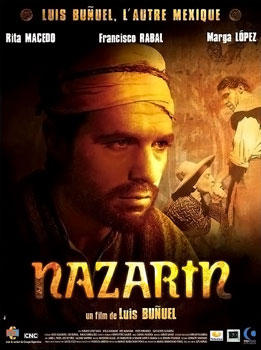
Nazarin


Nazarin (Luis Bunuel, 1959)

Nazarin is a priest, attempting to living a pure and honest life strictly according to Christian principles - but others only show him distrust and hatred, apart from the local prostitute...

Of Luis Bunuel’s Mexican period many major films have earned their recognition with Film History. Nazarin is without a doubt one of them. Winning the 1959 International prize at the Cannes festival this story of a defrocked priest trying to help and preach in a world of poverty, sickness, and injustice. As Jeffrey M. Anderson mentioned in his short and sweet review Bunuel’s Nazarin is very down to earth and his far from his surrealist cinematic approach. Anderson also highlights with his great knowledge of John Ford’s films, that Nazarin feels like Ford’s The Fugitive and was shot by the same cinematographer Gabriel Figueroa. The later’s camera work is subtle, natural, dusty, highly filled with sumptuous camera movements that captures the arid exteriors and darkens the interiors.

Religion is a central theme in Bunuel’s filmography and his treatment has often criticized by subversive manner the subject and how sometimes messianic figures can be psychotic, illogic, and contrary to moral or common sense. His moral often permitted to his storytelling abilities to punch in the face of his subject without getting too much blame.

With Nazarin, Bunuel wants to pass a message that even the most good willed fellow can fail to help their peers. Every scene ends with Nazarin letting the people in a worse position that they were before he got there. He leaves the hotel and the prostitute he was helping put fire in his room and burned down the whole place, then the workers get into a fight after he left the field, and on and on. He doesn’t solve a problem and, in fact, he tries but never succeeds. This is subtle for Bunuel but it is like as if Bunuel has decided that humanity has failed religion and not the other way around.

Nazarin is a deep film filled with deep meanings and is one of the best from Luis Bunuel’s Mexican era along with his masterpiece Los Olvidados. The fans of the director are split in two groups; the lovers of the Mexican period and the lovers of the French surrealist era. I would be more inclined to rewatch his later films that are in the second group but the whole body of Bunuel’s work is way richer with his early Spanish films, his Mexican ones, and his comedic surrealist French films. Nazarin is a must see but way more sober than The Discreet Charm of the Bourgeoisie.

2015-03-09

Birdman : Or (The Unexpected Virtue of Ignorance)


Birdman : Or (The Unexpected Virtue of Ignorance) (Alejandro Gonzalez Inarritu, 2014)

A washed-up actor, who once played an iconic superhero, battles his ego and attempts to recover his family, his career and himself in the days leading up to the opening of his Broadway play.

Strong from its four wins at the 2015 Academy Awards, Birdman, the latest film from the Mexican New Wave director Alejandro G. Inarritu, this cynical view of the comeback of a has been of the show business sure has its moments but does it delivers has much as the noise surrounding it?

Winning for best picture, best director (Inarritu), best original screenplay (Inarritu, Nicolas Giacobone, Alexander Dinelaris, Armando Bo), and best cinematography (Emmanuel Lubezki) in other words two of the major awards (picture and director) and two technical important ones (original screenplay and cinematography) Birdman is sure an impressive movie. Technically and visually this is the act of masters especially Lubezki with his superb camera movements following the protagonists and dancing like the interior voice of Riggan (Michael Keaton). It doesn’t take long to understand that we are in the point of view of the Birdman and we are gravitating around the production of this stage show. Lubezki who worked on two of the most beautiful film on the last five years The Tree of Life and Gravity has almost surpassed his wonderful camera work of Tree of Life with Birdman. However, the Terrence Malick vehicule is a masterpiece and Birdman is not.

With actors as talented as Edward Norton, Emma Stone, Naomi Watts and other wonderful surprises like Zack Galifianakis, Andrea Riseborough, Amy Ryan and obviously Michael Keaton starring in a major motion picture and giving the performance of a life time as the man behind the birdman. Sure everyone gives an outstanding performance and no one is afraid to be vulnerable or a complete looser. In fact, this is almost a tale on losers and the need to humiliate yourself to grow up and achieve something.

As mentioned before this is a visually stunning film and its concept or gimmick gives him a unique feel and touch but its story doesn’t elevate to the next level. The film relies on its technical aspects a bit too much and its characters as outstandingly portrayed by every actors, are a bit one sided and might have needed more flesh and feathers around the bones from the writing department.

Finally, to answer my previous interrogation, as a whole the film delivers a refreshing tale of popularity, stardom, egocentrism but on the storyline and content I was left a bit disappointed. The icing on the cake is more appealing to watch but after the first bite the whole thing seems to be one note and we feel it was maybe prettier if left untouched.

2015-02-18

Jour de FĆŖte


Jour de FĆŖte (Jacques Tati, 1949)

Once a year the fair comes for one day to the little town 'Sainte-Severe-sur-Indre'. All inhabiters are scoffing at Francois (Jacques Tati), the postman, what he seems not to recognize.

The first feature length film by actor/director Jacques Tati is also the only film in which his character talks. Obviously inspired by Buster Keaton’s physical comedy and Charlie Chaplin’s observation of the common people, Jour de fĆŖte is set in Sainte-Severe the village where Tati was hiding during the Second World War.

Tati’s films excels in making the viewer the witness of the everyday life and little to no moments. His use of deep focus is important because in every frame there is something going on and it might or might not catch our eye at first. More than often, serious action is in the front of the image while comedic action is in the back. It is a visual work of camera settings and construction of every frame that Tati elaborated and later perfected with Play Time for instance.

The themes of the lunatic postman FranƧois doing his tour in the village delivering and taking post demonstrate the old Europe and especially France. Taking his time, talking here and there. Everything changes when he watches a short film about US’s postal service and their obsession with fast delivery and efficiency. It demonstrates the clash of the civilization between two world; the old and the new. With the liberation by Americans, France changed and allowed more American culture with a whole bunch of American films and products. The film of Tati is like an homage to the village that kept him away from the War but also how his country was never the same after the whole fair that represents War and the Vichy Regime. It was far from an happy event, but it brought turned up and down the whole country of France just like the installation of the fair would do.

Tati often meditated on the progress and the slow evolution of urban life. With his comedies he makes a portrait of a time of constant change but also contemplating the present moment of the characters. The story is almost the story of the cameraman who is there and gazes at moments and bits of life. While not being celebrated as much as Mr. Hulot’s Holiday, Mon oncle, and Play Time, Jour de FĆŖte is a great first effort by Tati and I hope will be more highlighted by the recent release of Criterion’s Complete Tati boxset which is a great gift for cinephiles all over the world.

2014-10-17

La Haine


La Haine (Mathieu Kassovitz, 1995)

After local youth Abdel is beaten unconscious by police, a riot ensues on his estate during which a policeman loses his gun. The gun is found by Vinz who threatens he will kill a cop if Abdel dies.

This major hit from the wunderkind director of the time in France, Mathieu Kassovitz and the now established star Vincent Cassel, La Haine might be one of the most notorious French film of the 1990’s. Almost twenty years later, still actual and even more right on its telling of the racial, social, political context in modern France, this black and white drama is, by far, its director’s best offering.

With a bright black and white cinematography that can relate to some early Jean-Luc Godard films, the mise-en-scĆØne and visual effects calls for a sheer admirer of Martin Scorsese and a bit of Mikhail Kalatozov. Sometimes it is a little annoying when watching a young filmmaker and being able to pin point his influence and homage. They are clear and well executed in La Haine even if they feel a bit forced and like a homework to show that he can too do those tricks.
Surprisingly, I tend to like the first half of films and sometimes I think that the second half never quite delivers from a great original idea. However, with La Haine, Kassovitz throws a better second part than his first half. Once, the camera tricks are out of the way, the plot gets subtler and the characters are getting more and more into it.

In the francophonie, La Haine left a bunch of lines that are as important as some Pulp Fiction lines. For the teens of the time of its release in 1995, it was a groundbreaking movie that was talking to them and about them. It depicted without any filter a reality that too many immigrants and French were living. In France, there’s a long record of police brutality, riots, and racial crimes. It did not solve the problems that are presented in the movie but it reflected a reality that eventhe media were not able to present to the public.

It is a difficult genre because it is hard to not fall into the clichĆ© and also to be too partisan of a side. However, the three lead characters are not really sympathetic and yes we are on their side, we know that they are teenagers who make mistakes and do the best they can with what they have. Kassovitz doesn’t try to make them look like they are saints. At the end, it is anyhow difficult to not have a certain contempt for the French policemen.

After all, Kassovitz was a young and inspired filmmaker on the rise and he probably got the best film he ever did with La Haine. Even if he could have tone it down on the visual trickery and let the strong story resonate with long takes and a subtler mise-en-scĆØne. Still, it is very efficient and will definitely leave a mark in any cinephile’s mind.

2014-10-07

Kes


 Kes (Ken Loach, 1969)

A young, English working-class boy spends his free time caring for and training his pet falcon.

Billy (David Bradley) is a fifteen years old boy abused by his half brother and ignored by his mother. He has no expectations of life, doesn’t like school and no real friends until he develops an interest in falconry. The story has been told many times in Cinema, just look at FranƧois Truffaut’s 400 Blows or Claude Jutra’s Mon oncle Antoine.

What makes Ken Loach’s film standout is the British angle of the film with the reality of England. He is a child facing abandon, a difficult life, and he has a sentiment of being alone. Until he finds a passion and become interested in something that makes sense in his life. Something that makes him interesting for his English teacher and makes him feel worth something.

Loach documentary style of filmmaking involves the viewer in this child’s life. Filmed with a eye for observation but also an introspect vision of the daily life of the young Billy. The dark tones of the film, the greys, the browns, and the natural lighting give a visual that is not that appealing but the sequences with the falcon are lighted with natural sunshine juxtaposed with a joyous tune of flute that reveals a subtle sensibility in this quite sad film.

A recurrent comment of Kes is the Yorkshire accent of the actors. Sometimes, it was presented with subtitles to help American viewers understand. As it is for me, my mother language is French and English is my second language and I didn’t had much problem understanding the accent. At first, it took me a minute or two to adjust my ear but I didn’t missed much. So I suggest that you don’t let this little detail retain you from watching this English classic. Especially, if you liked and enjoyed Cannes’ Palme d’or winner The Wind That Shakes the Barley also from director Ken Loach. The later is a succinct and efficient sociologist that can dress a clear portrait of realities of his mainland.

With the latest years, Kes has become more and more recognized with a Criterion Collection treatment and a very obvious homage in The Royal Tenenbaums. As it climbs rankings in many lists, Kes is a great film but not a masterpiece even if it let a clear staple. A nice gem.
 

2014-07-29

Bob le flambeur

Bob le flambeur (Jean-Pierre Melville, 1956)

Bob (Roger Duchesne), an old gangster and gambler is almost broke, so he decides in spite of the warnings of a friend, a high official from the police, to rob a gambling casino in Dauville. 

As one of the French directors who orbited around the French New Wave without being really in it because he made films before and during the period of this revolution, Jean-Pierre Melville was a strong supporter of the young generation of filmmakers that were coming from Les Cahiers du Cinema emulating American films and threw a big rock into the calm pond of French films.

Melville's films are stylised gangster films widely inspired by Fritz Lang, Anthony Mann, William Wyler, Howard Hawks, and many other directors he regarded as true authorists and forefront names of the Film Noir genre. With Bob le flambeur, Melville does more than just a simple homage to the films and directors that he admired. He brought a French charm of the sexy women of Paris into the Femme Fatale element with Anne (Isabelle Corey) and a much more pessimistic view on gangsterism and transgressing the law. Yes, Bob is cool and his gambler friends have a hype around them, they get beautiful women and are all interested in easy money and low life living.

Having only seen Le samourai before visiting this popular entry in Melville's filmography, I was afraid that Bob didn't stand up as good as his other near masterpiece of coolness staring Alain Delon and one of the most interesting guns and hat movie ever. I have a vivid feeling that Melville's films were huge influence on filmmakers like Martin Scorsese and Quentin Tarantino. The latter with an even more prominent presence in his films. Knowing that, Melville's films have a contemporary freshness that their stories and vibe carry along.

Bob le flambeur easily fells into the recommended films category that can be appealing to the film buff but that can also appeal to a wider audience in the way that its storytelling, its qualities, and its value as a piece of entertainment is untouched. 


2014-07-21

THX 1138

THX 1138 (George Lucas, 1971)

Set in the 25th century, the story centers around a man and a woman who rebel against their rigidly controlled society.

In the 1970's, the films about the future and the Science Fiction features were according to project a dystopian vision of what mankind will be. In George Lucas lecture of the things to come, a pure white virginal world of machines and programmed events puts Robert Duvall as THX in a near George Orwellian world of greater power and crushed human conditions.

Being the follow up to Lucas' student film, THX 1138 was produced by his friend Francis Ford Coppola and became a sandbox for him to experiment for his game changing Star Wars movie that became the multi billion dollar franchise that it is today. Watched as a precursor of Lucas' talent and so-called vision, THX could be a nice little first film for any director. However, it is shadowed by the aforementioned Star Wars films. While keeping in mind that it is a first film, the story is well handled even if a little conventional for the genre but it is the visual mastery and the storytelling approach of few dialogues and a lot of space for the nothingness of the sets and the claustrophobic society depicted. The use of Techniscope gives and sense of depth and its large framing could only be appreciated in theaters until HD televisions were introduced in everyone's homes.

The presence of Donald Pleasance might be the most interesting of the interpretations in this particular movie. His relationship with Duvall's character is unhealthy at best. Pleasance is disturbing and uses all the screen time he has to be the most interesting character of the movie. It is about alienation and every character seems to bring its own in this unappealing world.

All in all, this is a short movie of under 90 minutes that gives a little something to the fans of the early films that had the spirit that Lucas wrote and directed. It also lost with the passage of time since many films of the same era are now considered as Sci-Fi classics for example: 2001: A Space Odyssey might overshadow any Sci-Fi film to ever be released. 

2014-06-05

Thelma & Louise


Thelma & Louise (Ridley Scott, 1991)

An Arkansas waitress and a housewife shoot a rapist and take off in a '66 Thunderbird.

2014-06-03

The Unknown


The Unknown (Tod Browning, 1927)

A criminal on the run hides in a circus and seeks to possess the daughter of the ringmaster at any cost.

2014-05-09

Footloose (1984)

Footloose (Herbert Ross, 1984)

It tells the story of Ren McCormack (Kevin Bacon), an upbeat Chicago teen who moves to a small town in which, as a result of the efforts of a local minister (John Lithgow), dancing and rock music have been banned.

2014-03-24

Young Mr. Lincoln


Young Mr. Lincoln (John Ford, 1939)

A family traveling through New Salem, Illinois in their wagon need groceries from Lincoln's store and the only thing of value they have is a barrel of old books including a law book, "Blackstone's Commentaries." After thoroughly reading the book, Abe (Henry Fonda) opts for the law after receiving encouragement from his early, ill-fated love, Ann Rutledge (Pauline Moore).

Related Posts Plugin for WordPress, Blogger...