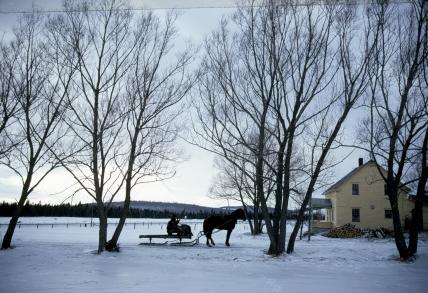
THX 1138 (George Lucas, 1971)
Set in the 25th century, the story centers around a man and a woman who rebel against their rigidly controlled society.
In the 1970's, the films about the future and the Science Fiction features were according to project a dystopian vision of what mankind will be. In George Lucas lecture of the things to come, a pure white virginal world of machines and programmed events puts Robert Duvall as THX in a near George Orwellian world of greater power and crushed human conditions.
Being the follow up to Lucas' student film, THX 1138 was produced by his friend Francis Ford Coppola and became a sandbox for him to experiment for his game changing Star Wars movie that became the multi billion dollar franchise that it is today. Watched as a precursor of Lucas' talent and so-called vision, THX could be a nice little first film for any director. However, it is shadowed by the aforementioned Star Wars films. While keeping in mind that it is a first film, the story is well handled even if a little conventional for the genre but it is the visual mastery and the storytelling approach of few dialogues and a lot of space for the nothingness of the sets and the claustrophobic society depicted. The use of Techniscope gives and sense of depth and its large framing could only be appreciated in theaters until HD televisions were introduced in everyone's homes.
The presence of Donald Pleasance might be the most interesting of the interpretations in this particular movie. His relationship with Duvall's character is unhealthy at best. Pleasance is disturbing and uses all the screen time he has to be the most interesting character of the movie. It is about alienation and every character seems to bring its own in this unappealing world.
All in all, this is a short movie of under 90 minutes that gives a little something to the fans of the early films that had the spirit that Lucas wrote and directed. It also lost with the passage of time since many films of the same era are now considered as Sci-Fi classics for example: 2001: A Space Odyssey might overshadow any Sci-Fi film to ever be released.
Showing posts with label 1971. Show all posts
2014-07-21
2013-09-30
Harold and Maude
Harold and Maude (Hal Ashby, 1971)
Harold (Bud Cort) is a twenty something son a of a wealthy socialite woman (Vivian Pickles) who wants him to become someone and be more like her. He is just doing the exact opposite and simulates his death by multiple simulated suicides. He even regularly attends funerals and he is captivated by death. Until one day, at a funeral, he met Maude (Ruth Gordon) who is passionate about life and is 79 years old.
2013-09-27
The Devils
The Devils (Ken Russell, 1971)
Banned in many countries and rated X in others, Ken Russell’s telling of Urbain Grandier’s (Oliver Reed) priest life and trial is an unforgettable film. Depicting a sexually repressed head nun, sister Jeanne (Vanessa Redgrave) masturbating and dreaming of Grandier as a christ figure that she wants to fornicate with. She goes berserk when she learns that the priest got married with another woman. Accusing him of witchcraft and fornication.
2013-01-23
McCabe & Mrs. Miller
One year after the huge success of the War satire of M*A*S*H, director Robert Altman revisits another classic Hollywood movie genre with great results. More than forty years after its release, McCabe & Mrs. Miller still stands as one of the most interesting Westerns to ever get on American big screens. With bigger than life star Warren Beatty, still hot from his performance in Arthur Penn’s Bonnie & Clyde, Beatty seems to fully embrace the spirit of the 1970’s generation of young directors. While being the pretty face protagonist, he also knows how to make himself vulnerable and fit into the casting of the complex emotional story of Altman’s film. An excellent anti-hero of his era. On the other side of the bill, you have the beauty of Julie Christie who plays the classy whore that comes from the town and lives the difficult life of being in the wilderness and in the birth of a mining little town. Eventually, McCabe (Beatty) will fall for Mrs. Miller (Christie) and as the textbook of Westerns says; you should never fall in love with a whore, nothing good will come out of it.
2011-09-29
The Last Picture Show
The Last Picture Show (Peter Bogdanovich, 1971)
Peter Bogdanovich is the kind of director that eats and breaths Cinema. His encyclopaedic knowledge of films, directors, and the whole business is as impressive as Martin Scorsese’s. Bogdanovich made his name in the early 1960’s with reviews, books, interviews with the greats of the 1950’s and 1940’s. His series of interviews with Orson Welles, Alfred Hitchcock, and John Ford are references in the American Cinema. With just this work he could have been as important as Pauline Kael or Manny Farber. But, he always had the desire to pass behind the camera to write and direct his own films. However, the man never reached full success with the audiences and the critics. Judged severely by his peers and probably misunderstood the man had to direct TV movies, miniseries episodes and pay check jobs to survive in the studio controlled years of the 1980’s, a time where directors weren’t considered as apt as they were in the 1970’s. Although, this decade, the most prolific of Bogdanovich’s directorial career, is marked by the second Golden age of American Cinema. The Last Picture Show is clearly a film of that decade for many reasons while it contains many references of its director’s heritage.
The 1970’s was a time where the kids and teenagers of the 1950’s were becoming the legendary directors of today: Martin Scorsese, Francis Ford Coppola, Hal Ashby, Peter Bogdanovich, Stanley Kubrick, Terrence Malick, Robert Altman, and many more, The Last Picture Show is almost like if Bogdanovich wanted to represent the coming of age of this new generation of directors from boyhood to manhood with the characters his second film. The Last Picture Show is a pivotal film that is set in Texas, shot in a classic black and white that digest the lessons of Orson Welles and John Ford for its mise en scène of subtle camera placing at the height of the eyes and few camera movements. The visual aspect is very classical and reminds of the films of the 1950’s with a nostalgic but not too bold feeling. The Fordian theme of the community, the ensemble cast and the little town, and of course the many Ford films displayed (Wagonmaster and The Sands of Iwo Jima).
Meanwhile, the themes and the preoccupations of its characters are serious and the main theme of the film circles around their sexuality and how their lives evolve in this dying town. We clearly feel the European influence on Bogdanovich: Jean-Luc Godard, François Truffaut, and Ingmar Bergman amongst many. The approach and the way the themes are exploited reminded me of the important films of the 1960’s of these remarkable directors.
Overall, The Last Picture Show is a smart film that brings you into known territories and then surprise you with its mature themes and its wonderful and touching story. The use of Howard Hawks’ Red River is pure genius. It gives a great emotional push for the film’s final moments. Every cinephile should watch this cinephile crafted film. And for the record, Cybill Shepherd: WOW!
Peter Bogdanovich is the kind of director that eats and breaths Cinema. His encyclopaedic knowledge of films, directors, and the whole business is as impressive as Martin Scorsese’s. Bogdanovich made his name in the early 1960’s with reviews, books, interviews with the greats of the 1950’s and 1940’s. His series of interviews with Orson Welles, Alfred Hitchcock, and John Ford are references in the American Cinema. With just this work he could have been as important as Pauline Kael or Manny Farber. But, he always had the desire to pass behind the camera to write and direct his own films. However, the man never reached full success with the audiences and the critics. Judged severely by his peers and probably misunderstood the man had to direct TV movies, miniseries episodes and pay check jobs to survive in the studio controlled years of the 1980’s, a time where directors weren’t considered as apt as they were in the 1970’s. Although, this decade, the most prolific of Bogdanovich’s directorial career, is marked by the second Golden age of American Cinema. The Last Picture Show is clearly a film of that decade for many reasons while it contains many references of its director’s heritage.
The 1970’s was a time where the kids and teenagers of the 1950’s were becoming the legendary directors of today: Martin Scorsese, Francis Ford Coppola, Hal Ashby, Peter Bogdanovich, Stanley Kubrick, Terrence Malick, Robert Altman, and many more, The Last Picture Show is almost like if Bogdanovich wanted to represent the coming of age of this new generation of directors from boyhood to manhood with the characters his second film. The Last Picture Show is a pivotal film that is set in Texas, shot in a classic black and white that digest the lessons of Orson Welles and John Ford for its mise en scène of subtle camera placing at the height of the eyes and few camera movements. The visual aspect is very classical and reminds of the films of the 1950’s with a nostalgic but not too bold feeling. The Fordian theme of the community, the ensemble cast and the little town, and of course the many Ford films displayed (Wagonmaster and The Sands of Iwo Jima).
Meanwhile, the themes and the preoccupations of its characters are serious and the main theme of the film circles around their sexuality and how their lives evolve in this dying town. We clearly feel the European influence on Bogdanovich: Jean-Luc Godard, François Truffaut, and Ingmar Bergman amongst many. The approach and the way the themes are exploited reminded me of the important films of the 1960’s of these remarkable directors.
Overall, The Last Picture Show is a smart film that brings you into known territories and then surprise you with its mature themes and its wonderful and touching story. The use of Howard Hawks’ Red River is pure genius. It gives a great emotional push for the film’s final moments. Every cinephile should watch this cinephile crafted film. And for the record, Cybill Shepherd: WOW!
2011-09-11
Duel

This first film, made for TV, by one of the wealthiest director of its time, and maybe of all-time is a success of Hitchcockian grandeur. The story can be resumed to one line: a rep/seller on the road of California is menaced by a trucker until their ultimate showdown. As for Hitchcock’s The Birds not much is explained here except the fact that the menace is there and we are on the edge of our seat from the first moment until the generic. Do we really have to know why the birds attacked this little Californian town? No! It is the same here, the trucker is never seen and the tension rises gradually until the very end of this confrontation of the man versus the machine. The plot also revolves around the symbolism of the manhood of the two opposite forces. The little red Plymouth Valiant against the truck as a phallic representation of the two males. The impotent car against the powerful all-American truck. It also represents a rite of passage for Dennis Weaver’s character: his relationship with his wife is mentioned in a quick phone call where he demonstrates his inability to be a man, a real man. This event will make him face himself and be a stronger person.
However, the qualities of Duel mostly resides in its stylistic beauty and the mastery of its director. The simple plotline could have made this a poor TV-movie that could have been in the shelves and forgotten. Nonetheless, it was released in theatres and applauded. Made in thirteen days, Spielberg shows how he understood moviemaking and how he innovated with few resources. Nowadays, Spielberg has hundreds of millions of budgets and his films aren’t has great has they were in the 1970’s. The mise en scène of Duel deserves its place amongst the great films of its time. The way Spielberg places the viewer into the action, just like the master Hitchcock, is inspired and thoughtful.
As an admirer of Spielberg’s earlier work (Duel, Jaws, Close Encounters of the Third Kind, Indiana Jones original trilogy, even Jurassic Park I loved as a kid) and a detractor of his later work (War of the Worlds, Munich, The Terminal) it will always be a tormenting thing when thinking about the filmmaker himself. Nonetheless, Duel is an astounding start for the career of one of the most prosperous director of all-time.
2011-08-04
A Clockwork Orange

A Clockwork Orange (Stanley Kubrick, 1971)
The films of Stanley Kubrick became the references of the modern day Cinema. He was the ultimate “auteur” within every genre he explored. Kubrick’s own particular vision and exploration of narratives characterizes his oeuvre. Subsequent viewings of all his films makes every experience richer and more meaningful to the spectator.
A Clockwork Orange may be the most famous film made by Stanley Kubrick, the ultra-violence depicted, the scandals, the banishments, and the aura around it makes it one of the most popular film of all-time. In this critics’ opinion, every Kubrick picture is a masterpiece. A Clockwork Orange is no less.
Alex (Malcolm McDowell) a young man lives by night getting high on “shakes”, violence, rape, and stealing. He dresses as a dandy by day and as some kind of punk with army boots and white clothes by night. As the leader of his droogs Alex fulfills their need in drugs, sex, and brawls. One day his lead of the gang needs to be reinforced, so he decides to give them a good lesson. Formed of three other droogs; his gang, evidently exasperated by Alex, plans a trick to be sure he will get in for good by a stronger authority than his mild mannered parents and the weird/pederast principal of his school to reform his behaviour. Later after ending up in prison, he’ll offer himself to get a treatment that cleans the brain from “bad” or “wrong” thoughts from his nature. He’ll then be able to get back into society with a normal/passive temperament. This treatment will dehumanize Alex and rehabilitate him to the society.
One part exposing Kubrick’s fear of America (he left New York for England because he was afraid of the violence and the nuclear menace in the USA) and one part the demonstration of the nature of humans that couldn’t be castrated or sedated. Humanity must have a choice of its actions and it should be moral. We can’t brainwash someone and erase his entire personality. Human nature is formed of good and evil and both must get into our minds to fully balance themselves. Sometimes in society we have to be clever and be better but other times we must fight and stand our guards. Be passive in some situations just makes us bland as sheep. The meanings of A Clockwork Orange are interesting and one must notice that this is a masterpiece as for its content so for its visuals.
Every frame of this film is composed of superb imagery and as a perfectionist as Kubrick was it shows how he took so much time working on a film refining a particular idea. The scene under the bridge where the droogs beat up a drunk bum is lit like a Film Noir with such a mastery that even if this is a cruel scene this is one of the most beautiful scenes of Cinema. Visually the colours, the frames and the movement of camera in A Clockwork Orange doesn’t have any flaws.
Adapted from Anthony Burgess’ novel by the same name, this feature is way much better than the original material and I think the same for Kubrick’s version of The Shining. The symbolism and the psychological/philosophical depth of Kubrick’s films can’t really be described, you have to see/live those films to fully appreciate every aspect of them all. The differences between Burgess and Kubrick are that the film success in bringing an entertaining story with the most unfriendly character ever presented. This is one of the most pessimistic films and one of the most ironic too. Nobody would want to live in this kind of world where everyone is ugly and inhuman. The dehumanization of Alex is done by vicious scientists and his rehabilitation is the action of political manipulations. Evil is everywhere and irony reigns. The roles switched in many cases, the writer who got beat up and got his wife raped by Alex and his gangs gets his revenge by torturing the mild dehumanized Alex without any remorse.
On a technical aspect, the use of classical music, especially Beethoven’s, Alex’s favourite compositor, sets the standard that Kubrick already did with 2001: A Space Odyssey. Those classical masterpieces were remixed and are characterized by the perfect use of music in films. When I hear Beethoven my mind automatically will remind me of the accelerated threesome scene, the record store just before, or the morning when Alex puts on music in his room. This is a celebration of the magnificence of Beethoven’s oeuvre. The first time we discover this film, the music of Beethoven makes a clash because this is such a beautiful, elegant, and passionate piece of art that Alex isn’t the type of individual who’ll connect with this kind of music. You would think that in this near future he would listen to some distorted guitar à la Black Sabbath or The Stooges, something dark and heavy, but still. Kubrick probably choose those masterpieces that transcended time and imagination, like his other pictures he needs something that doesn’t reflect a time period but that evokes and awakes many layers of emotions. A Clockwork Orange is an example of mastery in the use of a soundtrack and demonstrates how a score should fit with the imagery it presents.
Like any other masterpiece, A Clockwork Orange has its detractors. Some say it’s too violent, others say that it depicts a surreal world of nonsense and coldness. The violent aspect of the film is there and the weaker hearted may find some scenes unwatchable but still, this is a film that denounces this kind of gratuitous violence. On the other hand, sure this is a surreal world, this is a science-fiction movie that projected the world of tomorrow just like George Orwell’s 1984. The last argument of the detractors, the most justified in my opinion, is the cold approach of Kubrick towards the story and the characters. Kubrick is not a warm director and his characters are more pieces of chessboard than the players of a John Cassavetes movie. He uses them to tell the story. The objective of the camera always seems distant to the characters and they are shot with blissful movements of camera. It creates some sort of objectivity through the subjectivity of the story. Unlike Hitchcock, for example, we are not pulled into the story as the wrong man. We are the watchers of the story, Kubrick uses other tricks to interpel his public. His favourite director, Max Ophüls and his always moving camera influenced the work of Kubrick. The uncommon camera angles and unique framings destabilize the viewer in his experience.
As you may have guessed this is a film I love with passion. I have seen it a dozen times and each viewing has showed me a different aspect of the film. When I think about the perfect director I always put Stanley Kubrick in number one. Even if it’s not my favourite Kubrick or my favourite movie of all-time, A Clockwork Orange will always have a special place in my cinephile heart.
2009-12-06
Mon oncle Antoine
Mon oncle Antoine (Claude Jutra, 1971)
With the holiday season coming I will present and analyze some Christmas movies. This is a film from my country/province. Claude Jutra's 1971 Mon oncle Antoine. In a miner town in the Province of Quebec in the 1940's a young teenager; Benoit who works at the General store witnesses and sees on the 24th of december how the adults behave and live in this joyful time.
The transition of Benoit to the adult wold is well presented on many angles with his discovery of the young Carmen, the death of a boy about his age and the many discussions he will witness at the General store.
With a script that recalls the traditionnal litterature of the first writers of the Province of Quebec, Jutra presents with his documentary style the life and beings of the people living in this little town on the only day of the year that the mine is closed, Christmas Eve.
Meanwhile, the second half of the film is difficult for the characters and it reflects on the viewer that would prefer see the joyful celebrations instead of uncle Antoine being terribly drunk...
I, however, really liked the many interactions between the characters and the generations. I also enjoyed the traditionnal celebrations of Christmas Eve that reminded me how it was the only day the workers had a break of the exhausting working conditions.
Critique en français -
Dans cette série de critiques qui tentera de vous présenter des films à thème/sur fond de Noël pour ce mois de Décembre 2009. Je vous présente un film bien de chez moi. Dans une ville minière au Québec dans les années 1940; Benoît, jeune adolescent qui travaille au magasin général de son oncle Antoine vit et observe en cette journée du 24 décembre comment les adultes qui l'entourent vivent ces réjouissances.
Le passage vers l'âge adulte de Benoît nous est montré sur plusieurs facettes dont sa découverte de la jeune Carmen, le décès d'un jeune homme de son âge et les nombreux échanges dont il est témoin au magasin général.
Avec un scénario qui rappelle la littérature du terroir québécoise, Jutra nous expose avec son style très documentaire la vie d'un village québécois à un rare moment de réjouissances, le réveillon de Noël.
Cependant, la seconde moitié du film est très pénible pour les personnages et peu à peu cela se transmet à l'auditoire qui préférerait de loin assister aux réjouissances qu'à la soulerie monumentale de l'oncle Antoine...
J'ai, par contre, bien aimé les interactions et la musique qui nous rappelle les Noël d'antan et les traditions bien de chez nous.
Subscribe to:
Posts (Atom)