Showing posts with label 3hstar. Show all posts

2017-02-23

The Big Short


The Big Short (Adam McKay, 2015)

Four denizens in the world of high-finance predict the credit and housing bubble collapse of the mid-2000s, and decide to take on the big banks for their greed and lack of foresight.

As Hollywood is telling financing success (see The Wolf Of Wall Street) and crisis (The Big Short), we are propulsed in a world that is as unclear who are the good guys and who are the bad guys. A bit like we you are watching a gangster flick and the cops are as full of shit as the bad guys. In Adam McKay’s The Big Short, almost every person wants his piece of the pie and everyone is at some time a bad guy.


2016-04-12

Mother Kusters’ Trip to Heaven


Mother Kusters’ Trip to Heaven (Rainer Werner Fassbinder, 1975)

Frau Kusters (Brigitte Mira) is preparing dinner late one seemingly ordinary afternoon in her seemingly ordinary kitchen in Frankfurt, Germany. Mrs. Kusters wants to add canned sausages to the stew, her annoying daughter-in-law thinks otherwise. The point, we soon find out, is moot: Mr. Kusters has murdered the personnel director at the soap factory where he works before committing suicide.

2016-02-01

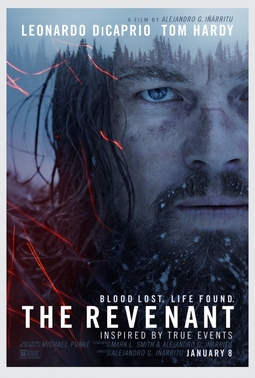
The Revenant

The Revenant (Alejandro G. Inarittu, 2016)

A frontiersman on a fur trading expedition in the 1820s fights for survival after being mauled by a bear and left for dead by members of his own hunting team.

2015-09-15

Misery

Note : this review is my contribution to The Lauren Bacall blogathon hosted by In the Good Old Days of Classic Hollywood.

Misery (Rob Reiner, 1990)

Few days after being rescued and sheltered from a car crash caused by a blizzard by a nurse who claims to be his number one fan, a well-known author begins suspecting the mental health of his savior.

Paul Sheldon (James Caan) is a widely known best-selling author who just finished his more recent novel in a remote cabin in the Colorado. Being very superstitious he always has the same routine when he finishes a write-up and he takes his Mustang on the road just before a huge snowstorm. Obviously, he leaves the road and is badly hurt but someone saw him and saves him from a certain death. It is nurse Annie Wilkes (Kathy Bates) who is also her number one fan. Slowly we understand that she keeps him from the rest of the world and he is hers. She forces him to destroy his latest novel and asks him to write a new Misery novel. Slowly recovering from his accident, Sheldon had both legs broken at several places and an arm in bad shape too. He is reduced to a wheel chair for a moment. Annie also locks his room and quickly becomes aggressive and dangerous. Paul knows he’ll have to escape if he wants to survive.


2015-05-04

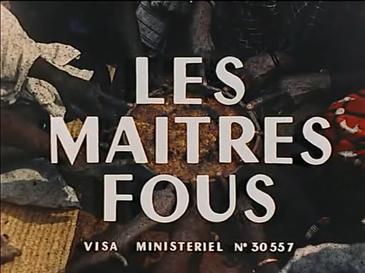
Les maîtres fous (The Mad Masters)

Note : This review is my contribution to the Shorts! blogathon hosted by Movies Silently from May 2nd to the 4th of 2015. Please visit the links and enjoy the readings of the other great writers participating.


Les maîtres fous (The Mad Masters) (Jean Rouch, 1955)

The effects of colonialism are exposed in this film on indigenous Africans via specific rituals developed as a reaction to the colonial system. The film turns into a crazy elaboration on both the madness of such a political system and man himself.
Banned in Niger and British territories like Ghana, Jean Rouch’s Les maîtres fous is a docufiction about ethnology and colonialism. Rouch was himself a well known ethnologist and developed the genre ethnofiction. At the time when Rouch directed and presented his film nations were about to get free from their masters. Movements of nationalism and liberation were budding all over the world. In 1958, Niger for example gained its Independence.

Les maîtres fous presents the sect of the Haukas that initiates its participants with possessions and representations of the behaviors of their masters. In a way they try to emulate the actions of their oppressors and simulate and expiate their sufferings. As they do this afterwards the Haukas are shown working with big smiles and happiness despite the poor condition of hard work.


Another explanation of this tradition is an African interpretation of the rituals as it is a way to take their rivals power and eat it. For non-African people this interpretation seems difficult to understand but many rituals executed in Africa are old of hundreds, if not, thousands of years and are anchored deep into the collective mind of these people.

Jean Rouch with his docufiction seems to be exploiting a sensationalist behavior that gives a racist vision of colonialism. Well, let’s face it, colonialism was the act of Imperialist nations wanting to spread their culture and conquer the world with ideas, language, religion. It was also a way to get resources at almost no price with cheap labor. Sure racism has many masks but colonialism was one of them. Discarding the locals’ culture and imposing your own can’t be good for your politics and men.

But Rouch wants to show the reaction of the locals after many years of colonialism in their home land. No surprise the film was banned; it depicted without any filter the direct effects of nations on the verge of their independence living under the leaders of imperialist nations and making benefits on the hard work and land of their locals.

As a film of 36 minutes, Les maîtres fous was less disturbing that I thought it would be. It is straight to the point and narrated by Rouch himself. What’s interesting with documentaries, in this case a sixty years old one, is that it is a document depicting a slice of history very specific to a part of the world where few documents are available since history was more an oral tradition than our academic interpretation of the discipline. It is important that such short films and documentaries are preserved for generations to come to understand the past and the variety of ethnicity.


2015-02-20

Room 237

Room 237 (Rodney Ascher, 2012)

An exploration of various interpretations of Stanley Kubrick's horror film, The Shining (1980).

Dedicated to the many possible meanings of Stanley Kubrick’s masterpiece The Shining, Room 237 is narrated by many fans, enthusiasts of the film and its director. At first, the most important fact about Room 237 is that it demonstrates how much people actually love and cherish this movie. Even I can’t hide my enthusiasm and cult towards The Shining. It is my favorite film from my favorite director of all time and each new viewing is an experience that is almost religious for the atheist that I am.

With this documentary I realized first that I am not the only one to vow such a cult to this movie, and that many people are interepreting films and analyzing so many elements that the movie itself gets forgotten. Sure, Kubrick was one heck of a wizard with his obsessive control over his films and perfectionism of every detail. When interpreting a movie, every theorie is as worth as the other. It is interesting to discover some of the most out of there and other more consensual visions of The Shining. It leads us to many things to think about : much like an artist less we know about the original meanings of its creator there is more to discover; it is impossible to have only one reading of a dense work of art; is the Calumet can there on purpose or not, is it true that Kubrick directed the landing on the moon, do we tend to give too much credit to Kubrick and his films and should watch them for their first level of reading.

Well, as aforementioned, every theory is as worth as the other and when a movie is celebratred by critics and the public it is recognized as worthy. But suppose that Citizen Kane was never revisited and completely forgotten maybe it wouldn’t be the masterpiece we know today just because it was at first hated and almost destroyed by the industry. Let’s think about this, for Kubrick’s The Shining its initial released was received with mixed reviews, except the fact that Kubrick was already established as a cult director, it could have been the death of the value of it. However, time and revisits, many revisits, led the film to be recognized as technically, esthetically, and thematically important in the history of films and in Kubrick’s filmography.

It is a playful documentary that has the merit to making its viewer wanting to watch again its subject. However, the exercice seems to loose its breath near its end and it probably would need a book to accompany this film essay. By the way, I would buy such a book.

2015-02-06

The Naked Spur


The Naked Spur (Anthony Mann, 1953)

A bounty hunter trying to bring a murderer to justice is forced to accept the help of two less-than-trustworthy strangers.

Famously being the third movie that united star actor James Stewart to director Anthony Mann, The Naked Spur holds a sweet spot for the Western lovers. Also with Janet Leigh and Robert Ryan other A-List actors, this film is in the vein of great classic American Westerns that populated the 1950’s. While John Ford was making them one after the other, Anthony Mann was also mastering the genre with an obvious admiration for Ford’s style, themes, and actors.

The concept of community of survival à la Ford and the idea of a group of professionals taking care of a serious business is a theme that was dear to Howard Hawks and his popular Westerns like Red River. Bankable actor James Stewart with his average Joe presence is making a clear difference in this story. Much of the silences in this film bring the violent tension with the murderer as for the sexual tension with Janet Leigh. Anthony Mann captures a lot of the male psychology in this blend of male with the aging prospector (Mitchell Millard) as the father figure for the adults and their disputes. Just as kids who play cowboys and fight for the right to be with the lady.

This is a deep film that demonstrates all of Mann’s talent in storytelling and analyzing human nature. The cinematography by William C. Mellor is splendid just as in any Anthony Mann picture with lots of exteriors and action sequences that elevated the art of the time.

Now more than sixty years since its release The Naked Spur has been a classic Western that steps up for its originality, its themes in a conventional matter, and its deep cinematic language. As being in the shadow of John Ford and his plethora of great films, Anthony Mann never shined as much as the most celebrated American movie director but in made films in a way that influenced many of his followers including the long respect and tribute of Martin Scorsese towards many of his lesser known films.

2014-09-08

Happy Together


Happy Together (Wong Kar-wai, 1997)

Ho Po-Wing (Leslie Cheung) and Lai Yiu-fai (Tony Leung Chiu-Wai), a couple from pre-handover Hong Kong, visit Argentina hoping to renew their ailing relationship. The two have a pattern of abuse, followed by breakups and reconciliations. One of their goals in Argentina is to visit the Iguazu waterfalls, which serves as a leitmotif in the movie.

Highly stylized romance drama about the difficult last moments of a relationship between two Hong-Kong men living in Argentina, Wong Kar-wai’s Happy Together is a visually beautiful film that leaves impressions more than leaving a clear reflexion on the story that is told in those experimental images.

With impressive shots of black and white and other superb color images, Happy Together feels more or less incomplete in a way that it is almost frustrating that such a beauty needs a couple of final brushes. As much as I think that My Blueberry Nights was too harshly reviewed when it came out, Happy Together did not made a consensus either with critics and fans.

When one reads further on the details of the making of this film, we learn that actors and the director didn’t knew which direction they would get to and the story was being written as they shoot the picture. Wong’s been questioning himself for all scenes and how they would go. This drafty angle of the making of confirms that the film never really materializes in front of our eyes since its director never had a vision of it. This is much like shooting bits here and there but without a tangible purpose. Sometimes great things can happen from this but with Happy Together it doesn’t deliver like we would hope.

It’s not everyday that we can gaze at a Wong Kar-wai film and even if it’s a real visual delight, this is another example of the auteur’s taste for style and form for his film more than substance and something toothier.
In his review,
Jonathan Rosenbaum described this better than I could ever formulate it : Like its characters, Happy Together is less a film with a subject than a film about not being able to find one. At best it’s a movie about being at loose ends, though it seems to mean something more for some Chinese viewers.

What consoles me, is that I still haven’t watched Ashes of Time, The Chungking Express, Fallen Idols, and Days of Being Wild and I hope they live up to my expectations.

2014-09-03

Rain Man


Rain Man (Barry Levinson, 1988)

Selfish yuppie Charlie Babbitt's (Tom Cruise) father left a fortune to his savant brother Raymond (Dustin Hoffman) and a pittance to Charlie; they travel cross-country.

This popular success film that won many Academy Awards is an iconic piece of film that delivers a nice entertainment that sealed Dustin Hoffman as one of the most respected Hollywood actors but also that proved to many of Tom Cruise’s detractors that he could act in a more serious film.

Much like other Academy Awards winner for Best Actor, like Forrest Gump for instance, Rain Man is about an actor portraying mental illness and making us believe in it. With a plot full of wit, sometimes comedy, and heart warming moments we are in the presence of the kind of family movie you can watch and feel no harm. It brought a little more light on autistic people and their challenges.
It makes us face how capitalism represented by Cruise’s character often forget how it is important to give more money on social programs for the less fortunate and those who can’t live by themselves. This is a nice moral lesson.

However, I have some struggles ranking Rain Man as one of the greatest films of all time. Yes this is a very good script and it deserves recognition. There’s also all those iconic moments parodied in The Simpsons and remembered in The Hangover by the character of Alan.

On a more personal note, I tend to like films of the 1980’s with their more conformism form and less control to the directors since the crash of Michael Cimino’s Heaven’s Gate saga. I don’t like the fact that directors had less power over their films. In fact, I hate this. But there’s something to the films of the 1980’s that reflects the time of my childhood and how America tried to connect to better times. In fact, connecting to the baby-boomers’ childhood of the 1950’s. Just look at Back to the Future and its mega success with the story of a teen that goes back to the time his parents met.

With Rain Man, we are dead on this, they go in Las Vegas, a place that had its best moments in the 1950’s with the Rat Pack and the presence of Elvis, Sinatra, and all those classy American acts. In fact, Rain Man had a very good screenplay and it is one of the reasons why it worked so well with audiences in 1988 and still works well today.

2014-08-28

Love Streams

Note: this review is a contribution to the 1984 A-Thon hosted by the great folks over at Forgotten Films. The films Big Brother was watching.

Love Streams (John Cassavetes, 1984)

Two closely bound, emotionally wounded siblings reunite after years apart.


Of the many things I want in a movie to be satisfied with I need an interesting plot about human beings that I can believe in. Also, I need a story that involves unpredictable events and it doesn’t have to be mind blowing things. It must like it is the first time it is happening in front of my eyes and I want to believe in its characters. The later don’t have to be perfect they can be strong but at the same time have weaknesses and do things they not always understand or control.

With John Cassavetes and his films, things often get to places you never could have guessed. His masterpiece, A Woman Under the Influence, delivers samples of life. With Love Streams, John Cassavetes and Gena Rowlands portray unique characters that love too much, live intensely and are not the typical lead roles Hollywood would put on a thirty foot poster.
Cassavetes made Love Streams right after receiving a diagnosis that he would only live for six months. For that, it is considered as his last film even if he directed Big Trouble in 1986 after writer Andrew Bergman declined directing, Love Streams is the last genuine Cassavetes film.

As mentioned before, John Cassavetes and Gena Rowlands give tremendous performances and the couple who impersonate siblings in Love Streams have the same frailty and depth and all the spotlight is used to highlight the complex human beings they portray. The natural realism of the mise en scène leaves much to the story and the characters. It doesn’t feel like a film that was made in the 1980’s or anytime span. It just feels like a bit of life that could be from any family in any era.

Even before knowing that Cassavetes was ill while making Love Streams, I learned that fact after viewing it, this is pretty clear that he was not at the top of his physical form. There’s a sadness and an urgency in Love Streams for Cassavetes but also for Rowlands. Their characters seem to be incapable of fulfilling their emptiness of love and affection. Just like artists that create, perform, and act to gain the love of the public and get the recognition they need just like fuel or food.
As the audience, we want them to be happy and fill the void they have while making, most of the time, fools of themselves.

As a final note, this review was a contribution to the aforementioned 1984-a-thon and was a pleasure to be a part of. However, Love Streams is a film that doesn’t feel 1984ish and even if it’s a very rewarding film to watch I don’t think that it can be well catgorized as a 1980’s film.
Much like other Cassavetes films, Love Streams can only be categorized as a Cassavetes film and nothing else.

2014-08-25

Sawdust and Tinsel


Sawdust and Tinsel (Ingmar Bergman, 1953)

An aging circus ringmaster visits his estranged wife to see his young sons. Meanwhile, his jealous young lover has an affair with an actor.

Ingmar Bergman has left a tremendous amount of film to his fans behind him and his later career was more internationally followed by fans and media. But his pre The Seventh Seal films, prior to 1957 if you prefer, are lesser known except for the hilarious Smiles of a Summer Night and the sexy Summer With Monica. Back then, only initiated cinephiles watched and enjoyed early Bergman films.

Staring Harriet Andersson, Sawdust and Tinsel is seen as one of the most rewarding gems that Bergman directed. Involving the lives of the members of a moving circus, we follow the constant humiliation of his characters and how they are outcasts of the conformist society. Bergman observes the lives of artists he sure could relate to. His career of film and theater director led him to pass into many difficult process that can be compared to what is seen in Sawdust and Tinsel.

Apart from the fact that much of the story and the character involvement are recurrent themes in Bergman’s films, the photography by Sven Nykvist easily links to the wonderful shots of The Seventh Seal and the presence of travelling performers like in his The Magician and the aforementioned masterpiece.
On the other hand, the story is quite heavy and feels very academic in its treatment of structure and its approach to drama. I believe that Bergman was still in his shell with his storytelling abilities and he later had his own voice with Wild Strawberries or Cries and Whispers for instance.

Since many of the characters are despicable and are difficult to relate to it is a film that may leave its audience cold and loose points when compared to the best offerings that Bergman has done in his career. Still, lesser Bergman is still better than most director’s best films. For Bergman fans it is an essential viewing, for completists it is worth the look, and for the average movie-goer I’d suggest you get by The Seventh Seal and Wild Strawberries before getting to Sawdust and Tinsel. It is far from being an average movie but this is the kind of feature that could but that was essential to its director to get to better works. Finally, it is an Ingmar Bergman film that delivers a genuine Ingmar Bergman film.


2014-06-23

Scanners

Scanners (David Cronenberg, 1981)
A scientist (Patrick McGoohan) sends a man (Stephen Lack) with extraordinary psychic powers to hunt others like him.

2014-06-20

The Fury

The Fury (Brian De Palma, 1978)
A government agent (Kirk Douglas) is determined to come to his son's (Andrew Stevens) rescue when a sinister official (John Cassavetes) kidnaps him to harbor his extremely powerful psychic abilities.

2014-05-22

Spider

Spider (David Cronenberg, 2002)

Spider is the story of Dennis Cleg (Ralph Fiennes), a man who is given a room in a halfway house catering to mentally disturbed persons. Cleg has just been released from a mental institution and in his new abode starts piecing together or recreating in his memory an apparently fateful childhood event.

2014-05-20

The Seven Year Itch


The Seven Year Itch (Billy Wilder, 1955)

This romantic comedy staring Marylin Monroe and Tom Ewell became one of the most iconic moments of Monroe’s career. The famous white dress blowing over the subway trap that unveils her legs to the audience and the male main character.

2014-05-14

Report


Report (Bruce Conner, 1967)

This 13 minutes short film using footage of the assassination of President John Fitzgerald Kennedy and other key moments of his life is a hard to find piece of great cinematic art.

2014-03-31

Starbuck


Starbuck
(Ken Scott, 2011)

David (Patrick Huard) is a delivery man for the family butchery. He is the black sheep and owes 80 000$ to a gang. He grows weed in his apartment and one day he learns that he is the father of 533 children. Having given more than 600 times to a sperm bank twenty years ago, signing by the pseudonym of Strabuck the famous Canadian bull who produced great milk cows, David is asked to reveal his true identity for a group of 142 of his biological children looking for their father.

2014-03-28

Blissfully Yours


Blissfully Yours (Apichatpong Weerasethakul, 2002)

The story of a love affair that begins during a picnic on the Thai-Burmese border.

2014-02-17

Beyond the Valley of the Dolls


Beyond the Valley of the Dolls (Russ Meyer, 1970)

Three young women—Kelly MacNamara (Dolly Read), Casey Anderson (Cynthia Myers), and Petronella "Pet" Danforth (Marcia McBroom)—perform in a rock band, The Kelly Affair, managed by Harris Allsworth (David Gurian), Kelly's boyfriend. The four travel to Los Angeles to find Kelly's estranged aunt, Susan Lake (Phyllis Davis), heiress to a family fortune.

2014-02-05

The Fortune Cookie


The Fortune Cookie (Billy Wilder, 1966)

CBS cameraman Harry Hinkle (Jack Lemmon) gets injured when football player Luther "Boom Boom" Jackson (Ron Rich) runs into him while he is covering a Browns game at Cleveland Stadium. Harry's injuries are minor, but his conniving lawyer brother-in-law William H. "Whiplash Willie" Gingrich (Walter Matthau) convinces him to pretend that his leg and hand have been partially paralyzed. This way, they can receive a huge indemnity from the insurance company. Harry reluctantly goes along with the scheme because he is still in love with his ex-wife, Sandy (Judi West), and it might win her back.

Related Posts Plugin for WordPress, Blogger...