Showing posts with label blogathon. Show all posts

2017-04-25

Frank Shirley in Christmas Vacation - 2017 Great Villain Blogathon


 Frank Shirley in Christmas Vacation

Editor’s note : this piece is a part of the legendary Great Villains Blogathon (2017Edition) and an informal return from my semi-retirement as a film critic.

2016-01-23

Takashi Shimura and Akira Kurosawa

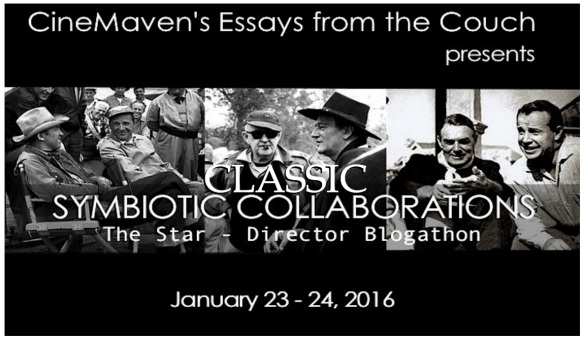
Note : this review is a contribution to Symbiotic Collaborations blogathon hosted by CineMaven’s Essays From the Couch.


Takashi Shimura and Akira Kurosawa


While Japanese film director Akira Kurosawa doesn’t need an introduction amongst cinephiles, actor Takashi Shimura is a more obscure actor name for the majority of film fans. The actor who is generally linked with Kurosawa is Toshiro Mifune, especially as the samurai archetype. Well, Takashi Shimura made 21 films under the directing mastery of Akira Kurosawa while Mifune did 16 and a bunch of them were overlapping the two actors. Shimura was the lead actor in Drunken Angel, Ikiru, and Seven Samurai. Not a bad resume a all.

2015-12-07

The Wings of Eagles

This post is part of the “Try It, You’ll Like It!” Blogathon, hosted by Sister Celluloid and Movies Silently, where we write about “gateway films” that might bring non-classic-film lovers into the fold!

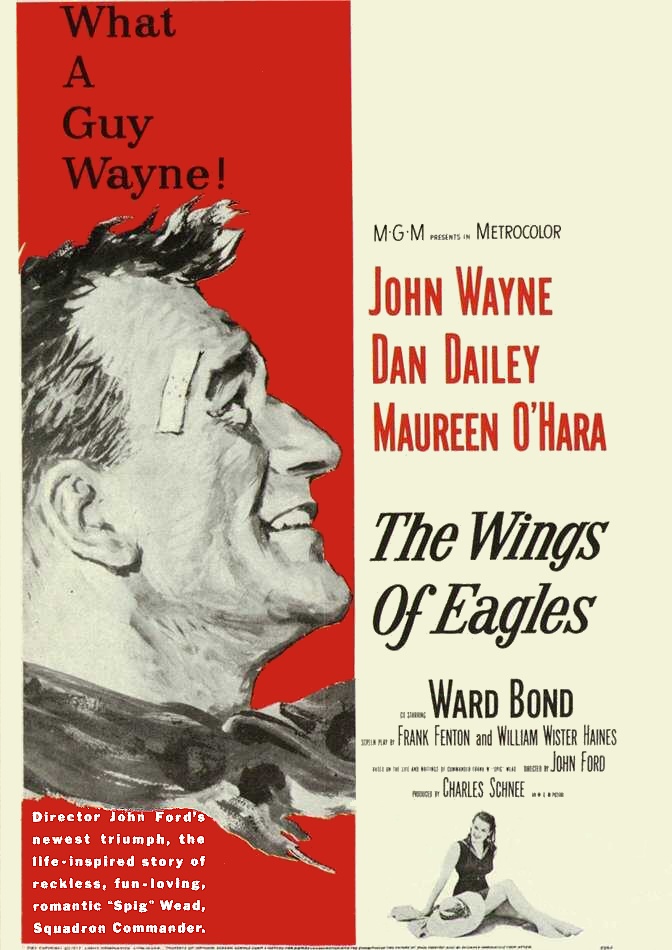
The Wings of Eagles (John Ford, 1957)

A biography of Navy flier-turned-screenwriter Frank W. "Spig" Wead.

In the shitload of films John Ford and John Wayne made together, most of them were Westerns and this is mostly what the collaboration between the two men is now remembered. However, they also made many war films like They Were Expendable. The writer of this feature film was Frank Wead a retired Army man also a friend of John Wayne. So ten years after the death of Wead in 1947, Ford and Wayne made an homage to the once pilot and screenwriter with a movie based on his life.

2015-11-21

Harry Dean Stanton : Character Actor

Note : this review is a contribution to What A Character! blogathon hosted by Once Upon A Screen, Outspoken & Freckled and Paula’s Cinema Club.

Harry Dean Stanton : Character Actor

Harry Dean Stanton

When my ever lasting sickness of cinephilia infected me fifteen years ago, I was discovering many pans of cinema and many subtleties passed by me. One of my early discoveries was the 1986 Wim Wenders film Paris, Texas. Staring Harry Dean Stanton as an almost mute presence of a lone man walking and wandering around in life since his divorce with his wife (Natassja Kinski). Back then, I knew Kinski as the daughter of the famous Klaus but Stanton was a familiar face from David Lynch films but not much. Needless, to say that Wenders’ film left a great impression on me and Stanton forged a fascination for introspective characters and loners in cinema. Read here my obsession with Taxi Driver. Stanton’s performance still haunts me to this day and it is something at first that I couldn’t grasp that hooked me. Needless to say, but Wenders’ film is a masterpiece even if it’s a little early to put this crowning label, it generally takes thirty years to actually rank a movie as a masterpiece, I entirely assume my saying of this praise.

2015-11-07

The Adventures of Robin Hood

Note : this review is a contribution to the Swashathon : a blogathon of swashbuckling Adventure hosted by Movies Silently.

The Adventures of Robin Hood (Michael Curtiz & William Keighley, 1938)

When Prince John and the Norman Lords begin oppressing the Saxon masses in King Richard's absence, a Saxon lord fights back as the outlaw leader of a rebel guerrilla army.

2015-10-30

The Birds


Note : this review is a contribution to The Universal blogathon hosted by Silver Scenes.

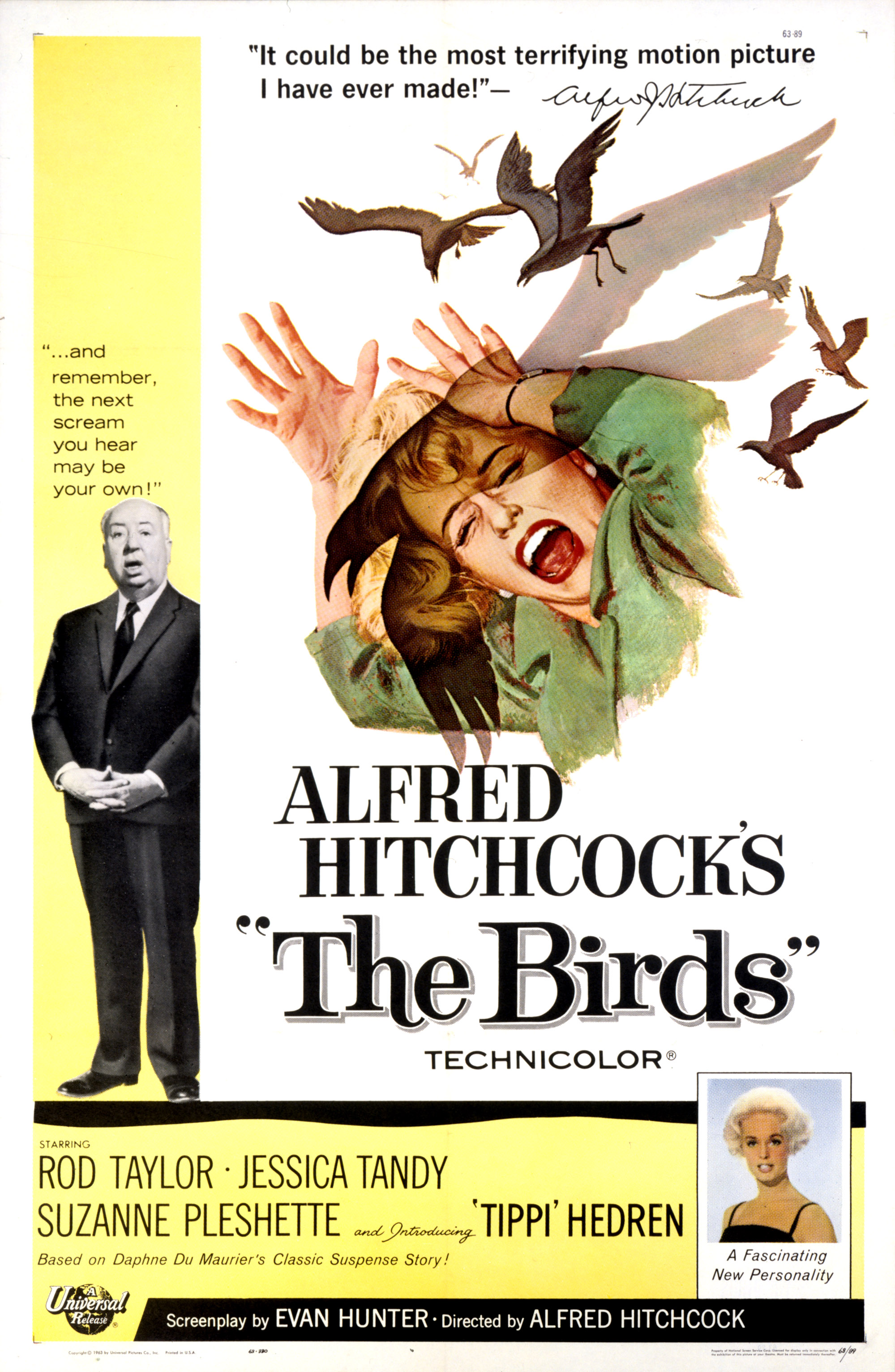
The Birds (Alfred Hitchcock, 1963)

A wealthy San Francisco socialite pursues a potential boyfriend to a small Northern California town that slowly takes a turn for the bizarre when birds of all kinds suddenly begin to attack people there in increasing numbers and with increasing viciousness.

2015-10-26

The Cabinet of Dr. Caligari


Note : this review is a contribution to The Silent Cinema blogathon hosted by In the Good Old Days of Classic Hollywood and Lauren Champkin.

The Cabinet of Dr. Caligari (Robert Wiene, 1920)

Dr. Caligari's somnambulist, Cesare, and his deadly predictions.

2015-10-24

La Roue


Note : this review is a contribution to The Silent Cinema blogathon hosted by In the Good Old Days of Classic Hollywood and Lauren Champkin.

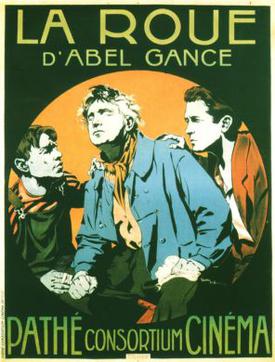
La roue (Abel Gance, 1923)

Sisif, a railwayman, and his son Elie fall in love with the beautiful Norma (whom Sisif rescued from a train crash when a baby and raised as his daughter), with tragic results.

2015-10-14

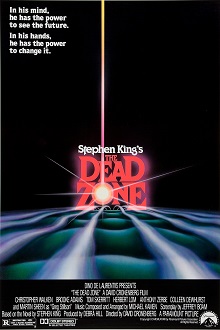
The Dead Zone (1983)


Note : this review is a contribution to the Kingathon hosted by Movie Reviews 101 and Movie Rob.

The Dead Zone (David Cronenberg, 1983)
A man awakens from a coma to discover he has a psychic detective ability.

2015-09-15

Misery

Note : this review is my contribution to The Lauren Bacall blogathon hosted by In the Good Old Days of Classic Hollywood.

Misery (Rob Reiner, 1990)

Few days after being rescued and sheltered from a car crash caused by a blizzard by a nurse who claims to be his number one fan, a well-known author begins suspecting the mental health of his savior.

Paul Sheldon (James Caan) is a widely known best-selling author who just finished his more recent novel in a remote cabin in the Colorado. Being very superstitious he always has the same routine when he finishes a write-up and he takes his Mustang on the road just before a huge snowstorm. Obviously, he leaves the road and is badly hurt but someone saw him and saves him from a certain death. It is nurse Annie Wilkes (Kathy Bates) who is also her number one fan. Slowly we understand that she keeps him from the rest of the world and he is hers. She forces him to destroy his latest novel and asks him to write a new Misery novel. Slowly recovering from his accident, Sheldon had both legs broken at several places and an arm in bad shape too. He is reduced to a wheel chair for a moment. Annie also locks his room and quickly becomes aggressive and dangerous. Paul knows he’ll have to escape if he wants to survive.


2015-08-27

Elena et les hommes


Note : this review is my participation to The Wonderful Ingrid Bergman blogathon hosted by the wonderful Virginie at The Wonderful World of Cinema.

Elena et les hommes aka Paris Does Strange Things (Jean Renoir, 1956)

Polish countess Elena falls in love to a French radical party's candidate, a general, in pre World War I Paris, but another officer pines for her.

This French Technicolor fresque about a time where gallantries and polite high society was manners and courtship, we follow the Polish princess Elena, a superb 41 years old Ingrid Bergman who looks like her mid twenties, as a debonair woman ready for amusement and entertainment.

Bergman seems to be in her element as a princess in a Renoir world of Paris and high society. She shines on the screen and her presence is elegant, naive, sexy, and lovable. It was her first film after her departure from her husband Roberto Rossellini and we see her as a new woman. She seems liberated and despite having been broken from this relationship she is still a star and the camera simply loved her.

Elena and Her Men, is not Bergman’s one-woman show despite the presence of Jean Marais and Mel Ferrer. It is a Jean Renoir film and another vignette of his Paris and his France. His films are a visual storytelling of his land and the way people lived and were during his child life. Most of Renoir’s stories are influenced by his childhood in Paris and his later films were his reconnection with his motherland. However, it was not his best depiction of the nostalgia of a memory and the story seems to be too much centered on Bergman’s character and not enough on the politics of France and the implications it could have done.


The story and its treatment is too light for us to really care for the issue of anything but Elena. While Renoir’s most celebrated films had the lenght and depth to reach for greatness, Elena and Her Men is a nice little love story on a political back drop. 
As a huge fan of Jean Renoir and Ingrid Bergman I would suggest to give it at least a watch because both were at turning points of their career having already legendary credits they have had superb careers. For classic film lovers, Elena and Her Men is a delight and may not be a great film but a nice Technicolor eye candy. 

2015-06-26

The Year 1968 in France’s Cinema


Note : this review is my contribution to the Classic Movie History Project blogathon hosted by Movies Silently & Silver Screenings & Once Upon a Screen.

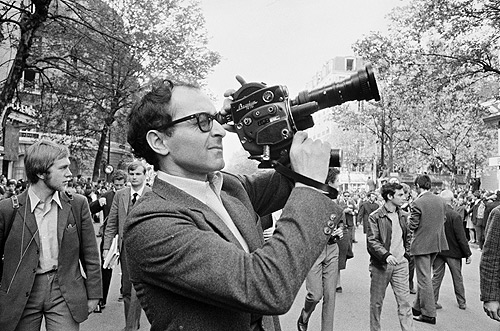
Surfing on the recent successes of the now widely recognized French New Wave, La nouvelle vague, France was a burgeoning location for directors and auteurs. However, an event in May 1968 will change the face of its Cinema and break the greatest friendship of the New Wave. This essay will try to put some light on one of the defining element of the films to follow.

Of the most important films released in France in 1968 we can list François Truffaut’s The Bride Wore Black, Les Biches by Claude Chabrol, Jean-Luc Godard’s Sympathy for the Devil featuring The Rolling Stones, Je t’aime, je t’aime directed by Alain Resnais, Maurice Pialat’s debut film L’enfance nue, also from Chabrol The Unfaithful Wife, Truffaut’s second take in the Antoine Doinel cycle Stolen Kisses, and the porte-manteau film Spirits of the Dead co-directed by Federico Fellini, Louis Malle and Roger Vadim.

As of 1968, two directors were the stars of the New Wave and France’s film industry : Jean-Luc Godard and François Truffaut. Friends from the time they were critics in Les Cahiers du Cinéma they each aligned a series of highly successful films.
Jean-Luc Godard

For Godard, 1968 was a turning point in his career that was already on the edge of a political  metamorphosis. His films were filled with more and more revolutionary content. Just look at two of the films he released in 1967, Week End with obvious revolutionary slogans and La chinoise which was his allegiance  to Maoism. Then in 1968 his film Le Gai savoir, banned by the French government, was about a couple listening to the radio and discussing politics. He also released One Plus One aka Sympathy for the Devil, a film of the creating process of The Rolling Stones while writing and recording the song Sympathy for the Devil interposed with Black Panthers speeches and images. 

Godard was more and more concerned by politics, Marxism, sociology, philosophy, and classic literature than ever. His constant struggle with stardom and the emptiness of the fame that accompany his success made him more concerned about how we should change the world and stop Americanization, Capitalism, consumerism, and reconsider everything and how everything was done. As he said of that era he was washed up from the common form of cinema.
François Truffaut

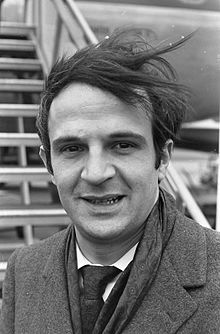
On the other end of this friendship, François Truffaut has become a classic filmmaker with a more and more conventional approach to filmmaking and acquaintance to the studio system. With Stolen Kisses, the second chapter of the Antoine Doinel series, the Jean-Pierre Léaud character that revealed Truffaut to the world with The 400 Blows in 1959, we have a Truffaut slowly falling into sentimental venues. His other release of 1968, The Bride Wore Black, is a story of revenge that was often compared to a proto precursor of Quentin Tarantino’s Kill Bill.

Then came the events that provoked May 68 in France and the Langlois affair. The Langlois affair is about the way the French government decided to cut short the financing of the Cinémathèque and fire its director Henri Langlois. In support many international directors signed a letter for Langlois’ restitution to the French institution. Even if in late April, Langlois was reintegrated into his functions, the actions of the administration of President François Mitterand will lead to May 68 and bring the French people in the streets. Issues are about a huge social movement that won’t be summarized here. However, their effects will be reflected in the French cinema and the Godard-Truffaut friendship.

For those who are not sure about the nature of this relationship, it would be easier to compare it to the Lennon-McCartney friendship. Once it was broken up, both parties started saying harsh things about the other.

Godard accused Truffaut of not being enough concerned by the revolts and being too close to the power to make sure to have financing. While Truffaut was more concerned about storytelling and technique Godard abandoned both to make documentary films and political contents.

In a way, those events marked the end of the French New Wave. Well, any new wave must have a definite time table, this one even marked a long time and a superb evolution in French cinema. It’s influence will be palpable on many other New Waves but also in the New Hollywood. All in all, the year 1968 in France’s cinema might not be the most interesting in the quality of films released but marked an important shift from an emerging bunch of young and talented storytellers and those who will make a serious career out of it. Those who continued making films after this year have left a permanent mark in films.


2015-06-22

One, Two, Three

Note : this review is my contribution to the Billy Wilder blogathon hosted by Outspoken & Freckled & Once Upon a Screen.

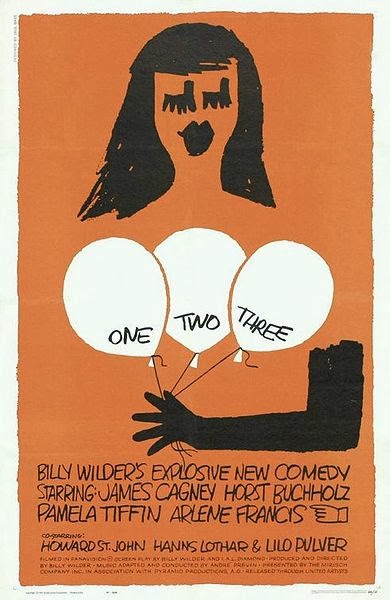
Poster by Saul Bass

One, Two, Three (Billy Wilder, 1961)

C.R. "Mac" MacNamara (James Cagney) is a high-ranking executive in the Coca-Cola Company, assigned to West Berlin after a business fiasco a few years earlier in the Middle East (about which he is still bitter). Nevertheless, Mac is angling to become head of Western European Coca-Cola Operations, based in London. After working on an arrangement to introduce Coke into the Soviet Union, Mac receives a call from his boss, W.P. Hazeltine (Howard St. John) in Atlanta. Scarlett Hazeltine (Pamela Tiffin), the boss's hot-blooded but slightly dim 17-year-old socialite daughter, is coming to Berlin and Mac is assigned the unenviable task of taking care of this young whirlwind.

Producer/director Billy Wilder is mostly remembered for his comedies like Some Like It Hot, The Apartment, and The Seven Year Itch. With One, Two, Three he once again goes into the comedic territory with lots of success. First, with his leading man James Cagney as Mac the ambitious executive of the Coca-Cola Company, by the way one of the most distinctive symbols of Capitalism, in the Berlin of the time they build the Berlin Wall. In fact, they were forced to leave Berlin for Munich to continue the shooting of the film because of the rising of the Wall. With his visions of expansion he has to deal with communists and Russians. With fast paced dialogues, Wilder wanted to make a funny film that would be like a whirlwind of jokes and strong moments. Much like, let’s say, Howard Hawks’ His Girl Friday.

One, Two, Three is also the last film of actor James Cagney before his retirement and also one of his great performances. He carries the film on his own. He also represents the classic Hollywood in the early 1960's where the New Hollywood was about to take the silver screen and put aside those dusty stars and directors. 

Almost entirely shot into Mac’s office and some exteriors of Berlin and the airport, One, Two, Three demonstrates how a strong script can set everything for a great comedy. Written by Wilder and I.A.L. Diamond, the plot is intelligent and is like a mix of Ninotchka, that Wilder co-wrote, and an Hungarian one act play by Ferenc Molnar. It is truly a great use of the stereotypes of the time on the battle between the West and the East. Much like the battle between Coca-Cola and Pepsi Cola; to use another figure that the film offers. One of the annoying things of this movie is the fact that the dialogues are so fast that they are almost yelled all along the picture. But much like any other screwball comedies it is almost an entire dispute the entire film that characterizes the genre. So yes they yell but every line is a pleasure and the delivery from Cagney, Pamela Tiffin, Arlene Francis, Lilo Pulver, Horst Buchholz, Hanns Lothar, and Howard St. John is deadpan funny.

 As often, heavy dramas gain respect and recognition and most of the time get the biggest awards. One, Two, Three is no rest with that and Cagney could at least been nominated for his performance at the Oscars. However, this movie isn’t on many lists of great films and not even on AFI’s 100 Comedies. It leaves me wondering who makes those lists and on which standards do they make their picks because this is definitely an omission. One of the greatest lesser known films from Billy Wilder who often gets its impact diminished because he left a bigger mark as a master at comedies than in a more serious genre. A great comedy that I highly recommend.


2015-06-10

Die Hard : With a Vengeance

Note : this review is my contribution to the Beach Party blogathon hosted by Speakeasy and Silver Screenings.

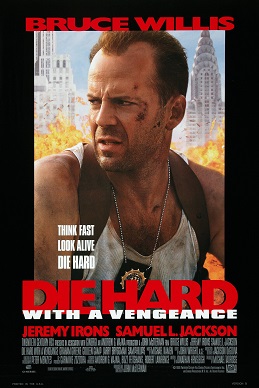
Die Hard : With a Vengeance (John McTiernan, 1995)

John McClane and a Harlem store owner are targeted by German terrorist Simon Gruber in New York City, where he plans to rob the Federal Reserve Building.

This is the third instalment in the Die Hard franchise and my favorite one. Based on Hercules’ twelve labors and helped by Zeus (Samuel L. Jackson), John McClane (Bruce Willis) has to stop a terrorist in the biggest city of America; New York City. After the criminal bombs a commerce he plays a game of Simon says asking for McClane who is alcoholic and suspended to achieve every tasks he is asking him.

With director John McTiernan back on board, Die Hard : With a Vengeance is a fun ride of action film sequences and mind games. Set during summer, the opening with The Lovin’ Spoonfull track Summer in the City gets us into the mood. Then Michael Kamen embarks us on a great soundtrack with a use of When Johnny Comes Marching Home that fills some of the best scenes of the film. Some bits of his score from the first two film are reused but they all blend together to get us on the edge of our seats.

I remember going to the theater on May 19 1995 with two of my friends, I was eleven years old at the time and I was only one who haven’t seen the other films from the franchise. However, I was becoming a Die Hard fan. Even if the first film of the now five entries is by far the best and one of the best films of all time, Die Hard : With a Vengeance is my favorite one. The setting, my favorite city and almost my second home; New York City does do something in the whole. The fact that they did not visit tourist locations and included inside local places does it for a lot. It makes us feel as we know the city from the inside. It is a nice rally race that reminds us of the first NYC action films of the 1970’s like The Taking of Pelham 123.


All in all, he third instalment in the Die Hard franchise might not be as well praised as the first one but I wanted to highlight it as a summer blockbuster entertainment. And it is everything I’m looking for when I want to catch this kind of film. It has a dear place into my film lover memory and I tend to revisit it almost every year.

2015-05-16

The Red Shoes

Note : this review is my contribution to the blogathon My Favorite Classic Movie hosted by Rick at Classic Film & TV Café.

The Red Shoes (Michael Powell and Emeric Pressburger, 1948)

A young ballet dancer is torn between the man she loves and her pursuit to become a prima ballerina.

As debatable as this affirmation can be, The Red Shoes is The Archers’ masterpiece. And I’m standing firmly on my position about this opinion. Even if they have a bunch of other outstanding films like Black Narcissus, A Matter of Life and Death, and The Life and Death of Colonel Blimp, the great dancing sequences and the superb composition of frames and the tremendous acting of Moira Shearer and Anton Walbrook, just to name those two, makes it one of the most re watchable movies of all time.

Previously, I wrote The Archers which is the name of the company of co-directors Michael Powell and Emeric Pressburger. Together they directed nineteen films and half of them are considered as classics and five of the whole lot are at some level masterpieces. We’ll however concentrate our attention on The Red Shoes and its qualities.


With its careful treatment by the Criterion Collection, cinephiles of today can watch it in a condition that is as good as at the time the film was released in 1948. On the question of his favorite film of all time, famous great director Martin Scorsese has often answered The Red Shoes and places it with Jean Renoir’s The River as the two best Technicolor films of all time. His admiration of the film is so strong that the sets and his signature in his film New York, New York are directly inspired by The Archers’ film.

Talking about The Red Shoes’ influence, you have Dario Argento’s masterpiece Suspiria that borrows the vivid colors and aesthetics of its dancing predecessor. Argento’s violent film also has a visual beauty in his Hitchcock horror. In the latest years, the Darren Aronofsky batshit crazy Black Swan film which the story is also about a female ballerina dancer has obviously been projected the crew to get some of the elements and feels. Especially the relationship between the dancer and the director is different but shows how strong this element can be in the life of a ballerina.

It is a sumptuous film that Powell and Pressburger did in The Red Shoes and the production and the final are proving me right when I state, once again, that it is their masterpiece. It’s been ten years since the first time I watched The Red Shoes and I can vividly recall every scene from this first watch. Since then, it became a favorite of mine and this is why choose to pick this movie as my favorite classic film for the first National Classic Movie Day.


2015-05-13

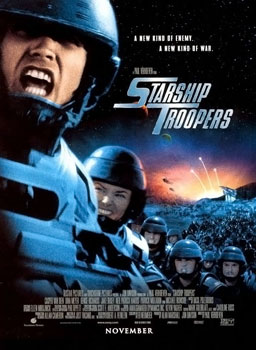
Starship Troopers


Note : This review is my contribution to the Film Preservation blogathon hosted by Ferdy on Films, This Island Rod, and Wonders in the Dark. Please donate generously.

Starship Troopers (Paul Verhoeven, 1997)
Humans in a fascistic, militaristic future do battle with giant alien bugs in a fight for survival.

Over the years, the many films of Dutch film director Paul Verhoeven have passed the test of time and became cult films. Just think of Robocop, Total Recall, Basic Instinct, and Showgirls for his work in Hollywood and his early European productions are underground hits with strong sexual and violent images.

Starship Troopers is more a virulent critic of America, the use of medias, and the way action movies are representing a right wing perception of life. The story is accessory to Verhoeven’s message of second level one liners and overbearing violence. In the films of Verhoeven, violence is not really stylised or cool, it is in your face just like when Peter Weller dies in Robocop before being in the robot. Even in Starship Troopers, Verhoeven has a way to present violence that does not appeal even with all the saturated frames of blood and special effects. With a production of 105 millions of dollars, Verhoeven achieved a level of imitation of fascism and opulence that only Albert Speer’s architecture could have been compared to.

Many sequences are shot by shot exactly like Leni Riefenstahl’s Triumph of the Will documenting Nazi reunions of the German party. The irony and satiric tone of Starship Troopers makes it such a great piece of anthology that it is almost frightening to think that American ideologies are not that far from what the film represents.

Curiously, at the time Starship Troopers was released, the critics and the public were not that warm about the film. Probably not ready for such an examination of their foreign politics, the turning of the 21st Century with the sad and condemnable events of September 11 may have demonstrated to the face of the world America’s belligerent politics.


As a film enthusiast, or as I like to call myself a cinephile, I really enjoyed Starship Troopers for its second level of reading and how he uses the action sequences to demonstrate a point. They are also really entertaining and this is one of the best part of this film. It has both values that few films of the genre have. In fact, I like most of Verhoeven’s films and I would watch Robocop, Total Recall, or Starship Troopers anytime knowing that it will be a good time and that I will find a little detail I haven’t seen before. They have great watch value and it adds a little omph to the whole thing.


2015-05-04

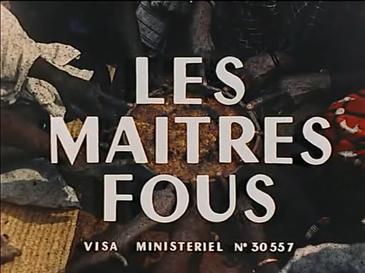
Les maîtres fous (The Mad Masters)

Note : This review is my contribution to the Shorts! blogathon hosted by Movies Silently from May 2nd to the 4th of 2015. Please visit the links and enjoy the readings of the other great writers participating.


Les maîtres fous (The Mad Masters) (Jean Rouch, 1955)

The effects of colonialism are exposed in this film on indigenous Africans via specific rituals developed as a reaction to the colonial system. The film turns into a crazy elaboration on both the madness of such a political system and man himself.
Banned in Niger and British territories like Ghana, Jean Rouch’s Les maîtres fous is a docufiction about ethnology and colonialism. Rouch was himself a well known ethnologist and developed the genre ethnofiction. At the time when Rouch directed and presented his film nations were about to get free from their masters. Movements of nationalism and liberation were budding all over the world. In 1958, Niger for example gained its Independence.

Les maîtres fous presents the sect of the Haukas that initiates its participants with possessions and representations of the behaviors of their masters. In a way they try to emulate the actions of their oppressors and simulate and expiate their sufferings. As they do this afterwards the Haukas are shown working with big smiles and happiness despite the poor condition of hard work.


Another explanation of this tradition is an African interpretation of the rituals as it is a way to take their rivals power and eat it. For non-African people this interpretation seems difficult to understand but many rituals executed in Africa are old of hundreds, if not, thousands of years and are anchored deep into the collective mind of these people.

Jean Rouch with his docufiction seems to be exploiting a sensationalist behavior that gives a racist vision of colonialism. Well, let’s face it, colonialism was the act of Imperialist nations wanting to spread their culture and conquer the world with ideas, language, religion. It was also a way to get resources at almost no price with cheap labor. Sure racism has many masks but colonialism was one of them. Discarding the locals’ culture and imposing your own can’t be good for your politics and men.

But Rouch wants to show the reaction of the locals after many years of colonialism in their home land. No surprise the film was banned; it depicted without any filter the direct effects of nations on the verge of their independence living under the leaders of imperialist nations and making benefits on the hard work and land of their locals.

As a film of 36 minutes, Les maîtres fous was less disturbing that I thought it would be. It is straight to the point and narrated by Rouch himself. What’s interesting with documentaries, in this case a sixty years old one, is that it is a document depicting a slice of history very specific to a part of the world where few documents are available since history was more an oral tradition than our academic interpretation of the discipline. It is important that such short films and documentaries are preserved for generations to come to understand the past and the variety of ethnicity.


2015-04-13

Analyzing Jack Torrance in Stanley Kubrick's The Shining For The Great Villain Blogathon


Analyzing Jack Torrance in Stanley Kubrick’s The Shining For The Great Villain Blogathon 2015

As anyone who followed this blog for many years, you can easily guess that Stanley Kubrick is my favorite movie director, it is also a given that The Shining is my favorite film from his filmography (note : as favorite I don’t say that it is his greatest film, the answer to that topic might be 2001 : A Space Odyssey). When I got aware of this Blogathon, I immediately wanted to write about Jack Torrance. Apart from the fact that I deeply love this film and that Stephen King hates it (note : King is one of my favorite contemporary author but I disagree with him on many subjects especially this one) I like the fact that Torrance is not completely a movie villain as the classic definition of the term would designate.

First, a movie villain must impersonate an antagonist position with the hero of the story, he is the cause of evil or bad things happening to the hero. In The Shining, Torrance is at first presented as the central character and in some way he is the protagonist of the story. But he is also the father who brings his family to keep in order a closed resort during the winter. He is the bringer of evil since the Overlook Hotel is supposedly haunted. The last element stated as supposedly, the haunting of the hotel, is never really clear and depending on the reading of the film you choose to pick out, the spirits might be visions of Torrance’s mind.

Since the family is isolated in the hotel Jack suffers of writer’s block, of a clear sexual repression from an unsatisfied need for encounter, and a severe need for alcohol. Sober for a long time, Torrance seems to be rekinkling with his old habits as long as the film evolves. Even taking part at an evening in the Golden Age ballroom drinking a bourbon in a room filled with ghosts. At this point, Jack’s implication with the hotel is more than just a job. He is possessed by the power of the hotel and he is given a mission to take care of his family just like Grady did before. Grady was his predecessor and murdered his twin girls with an axe in a bloody way. He was then promoted by the hotel as a permanent resident something Jack now seeks for his career.

On some level, the character might be read as the evil counter part of Danny, his son who is gifted with the shining, deliberately bringing his young family to a resort where solitude and ennui is right at the corner. However, Jack is happy and seems to need to get there and take this job. His motivation is never really clear except from having some quiet time to finish his novel. From the beginning he seems to have a natural attirance towards this job and is fearless to do it.

Towards his job, we never see him actually taking care of the hotel or even his family. His wife, Wendy, takes care of all of this. She checks the furnace and plays with Danny while Jack tries to work on his novel. Most of the time he is wandering, throwing a ball to the wall and struggling to get words onto the paper.

There are many facets of Jack that I think that can be linked to the author’s personality; Stephen King was a noticeable alcoholic in his early days and I’ve always read the novel The Shining as a play on a writer having to write through writer’s block. King often put teachers or writers as his protagonist’s occupations and this is one of his recurrent themes. An old master has said that you have to write about what you know. He sure put it to value giving Torrance both the writer and the teacher titles.


Jack Nicholson is in the role of Jack Torrance in one of his most famous characters with the legendary scene where he’s trying to open the locked door toilet door with an axe. The documentary by Viviane Kubrick, Stanley’s daughter, shows the preparation of  the actor for this highly intense scene. Nicholson seems to have no trouble getting into the right piece of mind to do those scenes while actress Shelley Duvall, who plays Wendy Torrance, struggled with Kubrick’s dictatorial directing. She often complained that Kubrick asked him to redo some scenes more than a hundred times. Following The Shining and also One Flew Over the Cuckoo’s Nest, Nicholson will often be asked to play over the top and his acting will be reduced to be a caricature of himself.

Let’s get back to our villain Jack Torrance, his job was to bring his family to keep the hotel from the possible degradation from the difficult winter elements. In the supernatural reading of the film, Jack was mandated to bring his super powered son to be a gift or an offering to the power of the hotel.

While another reading of the film is a Freudian one, which is probably more accurate when considering the many Freudian elements from Kubrick’s filmography, Jack the biological father of Danny must get Dick Halloran (the hotel’s chef and the man who exposes to Danny all about the shining) out of the way. Halloran is taking the role of Danny’s father figure because Jack is not a potent father figure. In Freudian words, a child who doesn’t feel that he is getting the right kind of fatherly love and strong father figure will try to get it from a more convenient and potent man. In this case, a man that understands him and that knows how to correctly protect him. One could add the Oedipus Rex complex to that where Wendy compensate for Jack’s lack of attention to his son and the child will get rid of his father to be the partner of his mother. A strong father figure has to be imposing a presence of the right kind of authority and indulge fear in his son’s mind that if he tries to get intimate with his mother his father will castrate his son.

It is useless to say that Jack is a failure and at the end of the film he is tricked by his son when at the same time the sacrifice of Halloran helped Danny and his mother to save them from another horror at the Overlook.

A great villain makes a great film and I personally think that Jack is a great villain with a complex construction and he is not easy to define but always interesting to observe and enjoy.


Related Posts Plugin for WordPress, Blogger...