Showing posts with label 1967. Show all posts

2016-11-25

The Trip

Editor’s note : a big thank you to Olive Films for the promotional copy of this Blu-Ray release of this cult classic.


The Trip (Roger Corman, 1967)

Paul Groves (Peter Fonda), a television commercial director, is in the midst of a personality crisis. His wife Sally (Susan Strasberg) has left him and he seeks the help of his friend John (Bruce Dern), a self-styled guru who's an advocate of LSD. Paul asks John to be the guide on his first "trip".

Often cited as the worst film of all time, The Trip is a gem that reflects the spirit of its time. This experiment, cause filming those kaleidoscope drug trips permitted to lead to Dennis Hopper’s Easy Rider also starring Peter Fonda and Jack Nicholson who wrote The Trip. Fonda’s performance is interesting and well nuanced in this extravagant film that has a look of the 1960’s of Michelangelo Antonioni’s Blowup with the depiction of free sexuality and rock music.

2014-05-14

Report


Report (Bruce Conner, 1967)

This 13 minutes short film using footage of the assassination of President John Fitzgerald Kennedy and other key moments of his life is a hard to find piece of great cinematic art.

2014-01-22

Point Blank


Point Blank (John Boorman, 1967)
This cult classic staring Lee Marvin as Walker a man seeking for revenge against the organization that owes him money and that has a scheme that Walker will try to erase.

2013-04-11

In The Heat of the Night

In The Heat of the Night (Norman Jewison, 1967)
In a small town of Mississippi named Sparta and during a normal night, a policeman Sam Wood (Warren Oates) finds the body of the richest man in town dead and in blood. His head seems to have been smashed by an object. Passing by the same night is the homicide agent Virgil Tibbs (Sidney Poitier) from Philadelphia. At first, people of the place make the easiest link between the stranger in town and the murder. Especially since Tibbs is a black man, Gillepsie (Rod Steiger) the county sheriff gets all his suspicions on him. However, he soon discovers that Tibbs is a police officer and that he could be his best help to resolve the crime.

2012-09-17

Playtime


Playtime (Jacques Tati, 1967)

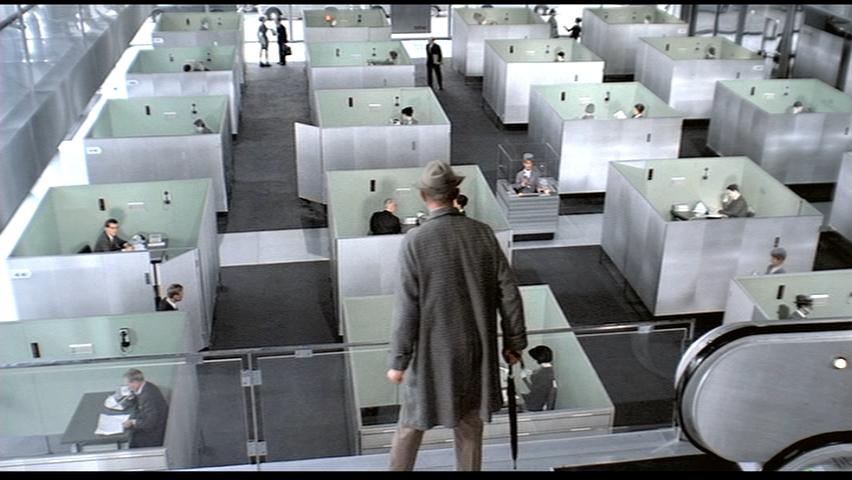
Monsieur Hulot has to contact an American official in Paris, but he gets lost in the maze of modern architecture which is filled with the latest technical gadgets. Caught in the tourist invasion, Hulot roams around Paris with a group of American tourists, causing chaos in his usual manner.

Tati is a quiet observer of the evolution of societies. There’s not much plot to talk about here just as any other Jacques Tati film. First you have Tati’s Monsieur Hulot, a simple but innocent charming man that seems to be from another time. Let’s say Keaton and Chaplin’s time if we must place him into a time table. Throughout the films, Hulot has been on a holiday, visiting family, and now visiting Paris to contact an American official.  For Tati, every scene is a set up of the everyday life and he takes Hulot into those ironies, aberrations, and modernisations to point the fact that after all we forgot about the simplicity of life and the little common things that makes our daily moments.

In his own way, Tati’s humor is subtle and almost invisible to the modern day viewer. His detached approach makes the audience wander like Hulot within the grey sets and the urban atrocities of the brutalism movement of the 1960’s. The structure of Playtime is very architectural and sticks to Mies van der Rohe’s motto: less is more. This is a very keen comedy and a masterpiece in the same vein that the two aforementioned greats of comedy Keaton and Chaplin would have been proud of birthing.

Prior to my first watching of Playtime I only saw Monsieur Hulot’s Holiday, which I liked in parts but not in its ensemble. With a little distance both films take more and more depth and I kind of learn to love Holiday. On the other hand, Playtime was an instant hit for me and a much stronger work from its father. The accuracy of Tati’s observation and the sheer brightness of the situations and the whole goodbye to the ancient world places Playtime not just amongst the greatest comedies of all time but with the greatest films of all time. It’s also a shy hello to the new world that was on the verge to hatch with the end of the 1960’s.

Moreover, this is a very unique film that can’t really be compared to anything that was released back in 1967 and to anything that Tati made either. The more someone discovers about Tati the more his films make perfect sense and their sensibility fells like a comfy outfit that you want to revisit because their message can’t be digested in its whole without repeated viewings. Highly recommended.

2011-11-09

Le samouraï

Le samouraï aka The Godson (Jean-Pierre Melville, 1967)

In my warm up for my upcoming Seven Days of French New Wave I wanted to catch up with the French filmmakers that made films during the Nouvelle Vague years that weren't a part of it or considered as New Wavers. Jean-Pierre Melville has been very influential on the "auteurs" of the French New Wave, with his neo-noirs starring impassive leading characters wearing trenchcoats and hats. Melville's presence in the wave was resented as the presence of a big brother for all the young directors like Truffaut, Godard, Rohmer, etc. He even made a famous cameo in Godard's À bout de souffle.

Le samouraï is the first Melville film I've ever seen, the fact that he wasn't a part of the New Wave was probably one of the reasons why I didn't watched any of his films before. Well, now I know I should have looked up Melville before. This 1967 release is an instant classic, the slow paced action, the dead pan face of Alain Delon's Jef Costello the Samurai theming and the wonderful simple but efficient cinematography took me 30 seconds into the film to know I would fall in love with this film.

Having read the Bushido many years ago, when I first saw Akira Kurosawa's Rashomon, I completely understood the main character and the title: Le samouraï (The samurai). With only one reference to the title in the openning of it, Jef Costello is literally a samurai, always dressed like if it was the most important day of his life, with a clean trench coat, a well worn hat, always clean shaven and even when he gets hurt he'll take care properly of himself and clean his wounds himself. His final mission was a suicidal one an aspect of the Bushido that is more than central is the fact that the samurai must die in a valiant way by his enemies or by a clean suicide.
The direct influence of Kurosawa's samurai film is palpable not only in the Bushido references but also in the framing of the film that doesn't mistake at all. There is also the influence from the contemporary theme films of Kurosawa; The Bad Sleep Well, High and Low, Stray Dog. The kind of story where the details are more than important and the construction of the plot is strongly mastered. I will be discovering more Melville films in the next weeks because this is a filmmaker that diserves  my attention. He makes the kind of films I admire like Coppola's The Conversation, Pakula's All The President's Men, and Fincher's Zodiac. A must see!

2010-11-04

La collectionneuse (1967)

TSPDT Greatest Films #836 La collectionneuse (Eric Rohmer. 1967)

 The fourth part of Rohmer's Six Moral Tales is one of the most sublime film ever made. The story is very simple. Adrien is about to realize his most profound dream: open an Art gallery. But before actually do it he takes vacations in a country house imposing so basic rules to his living. This is somewhat like volountary simplicity. Living of nothing and getting up and sunrise and having a priest-like way of life. He shares the villa with friend called Daniel that agreed to live by the same rules. There is another person living with them in the house: Haydée an easy girl that lives the opposite of Adrien, she is out all night and meeting many men every night. At first, Adrien and Daniel despite Haydée's way of life and they will confront her by first refusing to sleep with her and contempting her. Obviously as Adrien continues to refuse to have sex with Haydée he will slowly fall in love with her.

The simplicity of the story sets you off and like Rohmer's other films it takes some time to understand where he wants to lead us. The storytelling of the story with Adrien as the narrator helps the viewer to understand and apreciate the somtimes confusing acts of seduction and love depicted on the screen. One of the many interesting facets of it is the way how everything is consciensly narrated by the protagonist of the story and how he finally accepts his sentiments towards the girl that in first place he contempted.

La collectionneuse is a film that can rightfully describe the camera-pen the French New Wave talked about. The film goes like a classic novel and the images are the support to the text. This is like an inversion of the classic way films were shot.

Having only seen two (Ma nuit chez Maud & La collectionneuse) of the Six Moral Tales by Rohmer I am looking forward to discover the rest of the tales. I actually enjoyed both very much and couldn't decide now which I prefred. Which one Moral Tale is your favorite?

2010-09-12

2 ou 3 choses que je sais d'elle

TSPDT Greatest Films #252 2 ou 3 choses que je sais d'elle (Jean-Luc Godard, 1967)

A Godard film is as always a film that makes people think and talk about it. For 2 ou 3... it's this pattern that I can use to present the film. Well, it's an uncommon and sometimes floppy film. The scenes are rhythmed with urban and industrial shots of modern life.

The woman is a spouse and a mother that prostitutes herself to feed and to provide for her family. This is not Godard's first or last thoughts on prostitution. Besides being the oldest profession of humanity it's a job that represents and reflects the changes on the modern society. In 2 ou 3... we never really encounter the clients of the protagonist unlike Vivre sa vie where the "milieu" and the rituals are more explored. Godard chose look at the materialist world and consumerism that breeds the needs to earn more and more money to fulfill those empty materialists needs. The woman is used like a vehicule to show the changes of the urbanity and how the modernity is killing inch by inch the integrity of humans by giving them new "opiums" for the masses with negative conclusions. The late 1960's were a period of changes and the Vietnam War was more and more a concern in Godard's mind. Like Masculin Feminin, 2 ou 3... has also his anti-War message with the son of the main character telling a dream about the Vietnam.

Far from being as good as Tout va bien, Week-end, Pierrot le fou, 2 ou 3 choses que je sais d'elle is interesting as a cult Godard film. It should be seen as a pre-Dziga Vertov group film.

Related Posts Plugin for WordPress, Blogger...