Showing posts with label 1951. Show all posts

2014-02-24

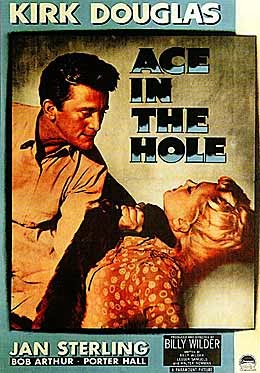
Ace in the Hole


Ace in the Hole aka The Big Carnival (Billy Wilder, 1951)

American film noir starring Kirk Douglas as a cynical, disgraced reporter who stops at nothing to try to regain a job on a major newspaper.

2013-08-09

The African Queen

The African Queen (John Huston, 1951)
This namesake adaptation of C.S. Forester’s novel of 1935 is an adventure movie starring Humphrey Bogart and Katharine Hepburn. Robert Morley and Katharine Hepburn play Samuel and Rose Sayer, brother and sister British Methodist missionaries in the village of Kungdu in German East Africa at the beginning of World War I in August/September 1914. Their mail and supplies are delivered by the rough-and-ready Canadian boat captain Charlie Allnut (Humphrey Bogart) of the African Queen, whose coarse behaviour they tolerate in a rather stiff manner. When Charlie warns them that war has broken out between Germany and Britain, the Sayers choose to stay on, only to witness the Germans burning down the mission village and herding the villagers away. When Samuel protests, he is beaten by a German soldier. After the Germans leave, Samuel becomes delirious with fever and soon dies. Charlie returns shortly afterward. He helps Rose bury her brother, and they set off in the African Queen.

2012-10-15

The Thing From Another World


The Thing From Another World (Christian Nyby and Howard Hawks, 1951)

Scientists and American Air Force officials fend off a blood-thirsty alien organism while at a remote arctic outpost.

The Thing From Another World was the first directorial effort of editor Christian Nyby and it was produced by famous Howard Hawks. This blend of Horror and Science-Fiction is the only contribution of Hawks in both genres. Why I say that it was his contribution? Well, it is clear that he did more than just produce this film. Many elements of his “signature”, to paraphrase Jeffrey M. Anderson, are present. The overlapping dialogues, the smooth storytelling, the emphasis on the group of professional’s dynamics instead the Horror, the compressed time and space, and the typical female character portrayed by Margaret Sheridan.

In a station in the North Pole a group of scientists, pilots, and a newspaperman made a historical discovery from outer space. The interactions between the professionals, the scientists and the pilots brings back the old debate between science and action. An American paradox that populates movies of the 1950’s picturing scientists as madmen who could sacrifice everything in the name of Science. The opposition of Captain Patrick Hendry (Kenneth Tobey) and Dr. Arthur Carrington (Robert Cornthwaite) represents a typical Hawksian conflict. While the Captain plays the secure paternal figure à la John Wayne in Rio Bravo, we see how Hawks was involved in the writing. Just as aforementioned, Nikki (Sheridan) represents with her strong repartee just like the boys a typical Hawksian woman.

It is more than you can actually tell one of the most important films of its time and genre. Influencing John Carpenter obviously with its remake of 1982, but also in the plot structure and the use of the subtle Horror. Appearing in Carpenter’s own Halloween while the kids are watching TV, Nyby’s film was one of the cornerstone of Sci-Fi meets Horror. Many critics and film enthusiast will tell you that Ridley Scott and his near masterpiece Alien was the first time Science-Fiction was blended with Horror, The Thing From Another World would be a much more important game changer.

In 2011, a remake of the remake by John Carpenter was released. I however haven’t seen the latest release, but as great as the 1951 movie is I honestly preferred Carpenter’s icy landscape of terror involving frightening special effects and Kurt Russell. It doesn’t removes the qualities of the Nyby/Hawks film.

Note: in my quest of the TSPDT 1000 Greatest Films I would have finished all the Howard Hawks pictures I had to watch with The Thing from Another World. Don’t get me wrong, it won’t be the last time you’ll heard of Hawks here and definitely not the last of his films I will catch. But it felt kinda weird to say that it was finished with it. Same thing happened last week with Buster Keaton’s movies and I must say that every time I complete a director I admire I am proud and a little sad because I loved every moment of their wonderful deep films.
2011-12-06

Journal d'un curé de campagne

Journal d'un curé de campagne aka Diary of A Country Priest (Robert Bresson, 1951)

A difficult film at first because of the thin thin story told and the lean and unappealing visual treatment of it all. However very influential to many spirituality tormented directors like Andrei Tarkovosky and Martin Scorsese. The lack of actual plot and the long silent reclusion of the almost anti-hero, the priest, his pain and arid living gives you this inspirationnal feeling that faith as to be a necessary suffering. Considered by critics and cinephiles as one of the quintessential films of the Art I personally don't feel like this is one of the greatest film of all time.
Even if I'm not very fond of Bresson's work I think that it is far from being his better contribution to the media. The spiritual depth talked about Journal is painful not only to the main character but also to the viewer who must endure and understand the emptiness of the life of this priest. The messianique figure that Bresson tries to paint here isn't quite up the act as he does with his way better Au hazard Balthazar displaying a donkey as the witness of the avidity and evil of humanity.
Compared to his spirituality tormented peers, Bresson lacks of technique and storytelling. Take Dreyer's Ordet for example, a blissfull masterpiece slow paced while being filled with tremendous technique and mastery. On the other hand, still within scandinavian cinema, Bergman displayed with his trilogy on the silence of God an outstanding comprehension of faith and spirituality. However, it might be Bresson's twisted and ambiguous approach to the whole that can not really be well discerned thorough the spiritual Cinema.

2011-04-26

The Day the Earth Stood Still (1951)

The Day the Earth Stood Still (Robert Wise, 1951)


This Science fiction classic by Robert Wise the man who directed masterpiece noir films like The Set-Up, musicals like West Side Story (co-directed with Jerome Robbins) and The Sound of Music, horror films like The Haunting and who edited Citizen Kane, did a strong impressive film with The Day the Earth Stood Still. Shot in 1951, during the McCarthyist era, this film tells the coming of a stranger from outer space in a little town of America. The actual alien, in the form of a man is helped by a little boy to hide.

The alien has a message to deliver to planet Earth, stop the wars and unite all nations together to save planet Earth from its own annihilation. It may be bold that the film wants to tell the world to stop the Cold War and make peace. The visitor from outer space represents the terror of the communism. It recalls in Steven Spielberg’s War of the World the kid yelling are they terrorists? Both the rogue menace of their times: in the 1950’s the menace was coming from the communism inside America and in the 2000’s it was(is) terrorism, sometimes from inside the country. The Day the Earth Stood Still is a critic of the current witch hunt of the time. Robert Wise an inside filmmaker of Hollywood surely knew some of the show business people targeted and blacklisted in Hollywood. His film might have been some kind of gesture towards his contemporaries in support to them. Set in the Sci-fi genre, a film had a easier ground to tell a virulent message.

In the form, The Day the Earth Stood Still has a beautiful black and white picture as every other Robert Wise picture. However, the frames are classic but well shot and the subtle but strong “mise en scène” by Wise places this film amongst the greatest films of its time. The directing of a film doesn’t needs to be off the wall, a strong film like Lumet’s style or Polanski’s are almost absent like the best example: a Fordian picture. When you don’t think about where the filmmaker put his camera during the film it means that you are in the presence of a mastered subtle “mise en scène”. Unlike Hitchcock or Scorsese, a subtle directing gives a more realistic approach to a story and we don’t feel like we are at the movies. The Day the Earth Stood Still, is a Sci-fi film and the realistic approach could be absent but instead the way it was filmed makes it even more believable, it is also more efficient that way to believe that an alien actually landed on Earth. The same strategy as M. Night Shyamalan used in his slightly above average Signs.
The Day the Earth Stood Still influenced many Science fictions films to come and still stands as one of the best films in the genre. Even if it’s “propos” isn’t as actual as it was in 1951 it still deserves it’s recognition.

2010-12-15

The Steel Helmet (1951)

The Steel Helmet (Samuel Fuller, 1951)


Set during the Korean War, The Steel Helmet was written, directed, and produced by Sam Fuller. Shot entirely in studio it tells the story of a soldier, Sergeant Zack, who lost his entire batallion. He meets a young Korean boy who will help him find a small group of American soldiers. They took refuge in a Buddhist temple but got caught in a "guet-à-pents".

This is epic Sam Fuller filmmaking, the story doesn't depicts a great battle or a turnover in War. It presents simple soldiers doing the best they can with the only resources they can count on: their will to continue. This film shows great respect to the soldiers that give everything they had in Wars. The ending is particular because it says that this is not an end for these soldiers. Despite some cheesy emotional moments with the young boy this is a very manish picture that doesn't pretend to be more than it is: a true American gem. Well, there is nothing epic in the common sense of the word or genre but in the directing way it's an epic film.

Students in filmmaking school should watch all of Fuller's films (especially the 1950's) to understand what storytelling is all about. Even if it's not Sam Fuller's best picture it shows lots of reality and true heart, a very modest film that was way ahead of its time for its form and its substance.
Related Posts Plugin for WordPress, Blogger...