Showing posts with label sci-fi. Show all posts

2016-02-12

The Martian


The Martian (Ridley Scott, 2015)

During a manned mission to Mars, Astronaut Mark Watney (Matt Damon) is presumed dead after a fierce storm and left behind by his crew. But Watney has survived and finds himself stranded and alone on the hostile planet. With only meager supplies, he must draw upon his ingenuity, wit and spirit to subsist and find a way to signal to Earth that he is alive.

2015-09-10

Repo Man

Repo Man (Alex Cox, 1984)

Young punk Otto becomes a repo man after helping to steal a car, and stumbles into a world of wackiness as a result.

Lately, I’ve joined the Cult Film Club and Alex Cox’s Sci-fi amalgam of counter culture of punk rockers blended with a metaphor on American Capitalism was the subject of their latest podcast. Having never seen this film before, I was intrigued with the poster on the website of the club. Added to that, Repo Man was included for the first time in the 2015 list of They Shoot Pictures1000 greatest films of all time.


2015-05-13

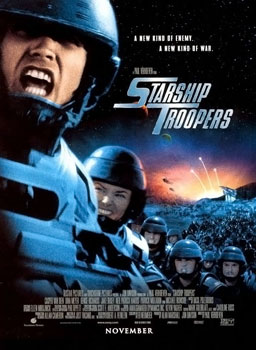
Starship Troopers


Note : This review is my contribution to the Film Preservation blogathon hosted by Ferdy on Films, This Island Rod, and Wonders in the Dark. Please donate generously.

Starship Troopers (Paul Verhoeven, 1997)
Humans in a fascistic, militaristic future do battle with giant alien bugs in a fight for survival.

Over the years, the many films of Dutch film director Paul Verhoeven have passed the test of time and became cult films. Just think of Robocop, Total Recall, Basic Instinct, and Showgirls for his work in Hollywood and his early European productions are underground hits with strong sexual and violent images.

Starship Troopers is more a virulent critic of America, the use of medias, and the way action movies are representing a right wing perception of life. The story is accessory to Verhoeven’s message of second level one liners and overbearing violence. In the films of Verhoeven, violence is not really stylised or cool, it is in your face just like when Peter Weller dies in Robocop before being in the robot. Even in Starship Troopers, Verhoeven has a way to present violence that does not appeal even with all the saturated frames of blood and special effects. With a production of 105 millions of dollars, Verhoeven achieved a level of imitation of fascism and opulence that only Albert Speer’s architecture could have been compared to.

Many sequences are shot by shot exactly like Leni Riefenstahl’s Triumph of the Will documenting Nazi reunions of the German party. The irony and satiric tone of Starship Troopers makes it such a great piece of anthology that it is almost frightening to think that American ideologies are not that far from what the film represents.

Curiously, at the time Starship Troopers was released, the critics and the public were not that warm about the film. Probably not ready for such an examination of their foreign politics, the turning of the 21st Century with the sad and condemnable events of September 11 may have demonstrated to the face of the world America’s belligerent politics.


As a film enthusiast, or as I like to call myself a cinephile, I really enjoyed Starship Troopers for its second level of reading and how he uses the action sequences to demonstrate a point. They are also really entertaining and this is one of the best part of this film. It has both values that few films of the genre have. In fact, I like most of Verhoeven’s films and I would watch Robocop, Total Recall, or Starship Troopers anytime knowing that it will be a good time and that I will find a little detail I haven’t seen before. They have great watch value and it adds a little omph to the whole thing.


2015-02-04

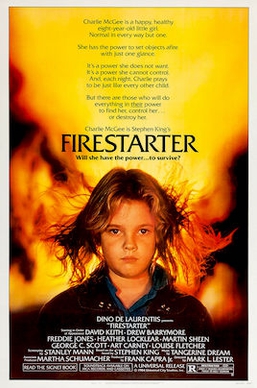
Firestarter


Firestarter (Mark L. Lester, 1984)

Adapted from Stephen King’s novel of the same title, Firestarter stars a young Drew Barrymore as the little Charlie who has a special gift of putting fire just by the power of her mind. Her father Andy (David Keith) and her mother Vicky (Heather Locklear) were guinea pigs for the Lot 6 experiment. It was a secret government laboratory experiment that tested a substance on the human mind. Andy has the power to convince people and hypnotize and Vicky had the power to read minds. Much like Carrie, Firestarter is about a young girl with a power she has troubles handling.

It is another take on childhood from Stephen King who visited the Freudian Oedipus Rex complex with The Shining. In Firestarter, we have the young Charlie who is confronted with different father figures who all wants to teach her on right or wrong. The novel is an interesting exploration of preteen girl male role models. Mark L. Lester’s film is a poor take on a good novel. Lester most successful directing credit was Commando in 1985 starring Arnold Scharzenegger. Despite the capable cast of Martin Sheen, George C. Scott, and Louise Fletcher paired with an interesting musical atmosphere created by the legendary Tangerine Dream, it never gets to really get together and raise up.

Plus, in the adaptation many important details were left out. The setting of the story in the South of the United States instead of King’s New England, the actualisation of the costumes, Charlie’s clothes are described with great precision in the novel and she is wearing something very different in the film. Many shortcuts are done to help the story but the screenwriter (Stanley Mann) and the director never capitalized on strong moments of the plot. In fact, this is a middle of the road directing job that feels like an emotionless reading of a poor script. With a source material from Stephen King one would at least expect a stronger and a tighter story. Even if Firestarter is not my favorite King novel, the movie is not at the level of the book.

While being a fan of Stanley Kubrick’s The Shining, Brian De Palma’s Carrie, and Creepshow I was not expecting this level of movie. But, I didn’t thought it would be as average. It wasn’t a complete mess but not an exploration of a complex psychology more than a compilation of action sequences that are very corny.

2014-09-26

Westworld


Westworld (Michael Crichton, 1973)

A robot malfunction creates havoc and terror for unsuspecting vacationers at a futuristic, adult-themed amusement park.

In a not so distant future, people are traveling to a remote setting where they can experiment the life of three distant past : the Old West, a Medieval court, and the Roman Empire. All of this is controlled by programmers that control robots with humanoid appearance. Much like HAL 9000 in 2001 : A Space Odyssey, the robots eventually take control of the amusement park and drift from the original purpose of the park and becomes harmful for its visitors. Staring Yul Brynner as one of the robots a full copy of his character in The Magnificient Seven, Richard Benjamin and James Brolin as two visitors of the Old West, Westworld is a reference in pop culture and an iconic Science fiction film.

Inspired from the Disney parks and the trademark animatronics, Westworld presents a way to vacation that is not that far from us with the constant eveolution of technologies at the service of humans. It could have been even more interesting to see a social commentary on the fat that the machines were evolved and revolted against humans who serviled them as their slaves. Just like the robot that refuses the advances of one of the Medieval visitors. The technicians see it as a malfunction but it could be a normal reaction for a real woman to refuse the advances of a man.

Director Michael Crichton who also was a succesful author of many novels including Jurassic Park, which is a better twist and exploitation of the concept he explored in Westworld, was one of the reasons why I wanted to watch the 1973 film. There’s also an episode of The Simpsons where they get to the Itchy and Scratchy Park populated with robots trying to kill the family. Those are some of the many reasons why Westworld is worth the look, but as a film this is more on the okay side of appreciation and the ending feels a bit flat.
Crichton wanted his settings to be cliché and almost false or fake to remind us that his characters are in an amusement park inspired by films and the imaginary perception we have of times in History. Just like that old saying from the great John Ford : print the legend. Crichton wanted to create a world where the commentary and the story surpass the sets and the clichés.


2014-07-21

THX 1138

THX 1138 (George Lucas, 1971)

Set in the 25th century, the story centers around a man and a woman who rebel against their rigidly controlled society.

In the 1970's, the films about the future and the Science Fiction features were according to project a dystopian vision of what mankind will be. In George Lucas lecture of the things to come, a pure white virginal world of machines and programmed events puts Robert Duvall as THX in a near George Orwellian world of greater power and crushed human conditions.

Being the follow up to Lucas' student film, THX 1138 was produced by his friend Francis Ford Coppola and became a sandbox for him to experiment for his game changing Star Wars movie that became the multi billion dollar franchise that it is today. Watched as a precursor of Lucas' talent and so-called vision, THX could be a nice little first film for any director. However, it is shadowed by the aforementioned Star Wars films. While keeping in mind that it is a first film, the story is well handled even if a little conventional for the genre but it is the visual mastery and the storytelling approach of few dialogues and a lot of space for the nothingness of the sets and the claustrophobic society depicted. The use of Techniscope gives and sense of depth and its large framing could only be appreciated in theaters until HD televisions were introduced in everyone's homes.

The presence of Donald Pleasance might be the most interesting of the interpretations in this particular movie. His relationship with Duvall's character is unhealthy at best. Pleasance is disturbing and uses all the screen time he has to be the most interesting character of the movie. It is about alienation and every character seems to bring its own in this unappealing world.

All in all, this is a short movie of under 90 minutes that gives a little something to the fans of the early films that had the spirit that Lucas wrote and directed. It also lost with the passage of time since many films of the same era are now considered as Sci-Fi classics for example: 2001: A Space Odyssey might overshadow any Sci-Fi film to ever be released. 

2014-03-12

The Terminator


The Terminator (James Cameron, 1984)
In 2029, artificially intelligent machines are attempting to exterminate what is left of the human race. Two beings from this era travel back in time to 1984 Los Angeles: One is a Terminator (Arnold Schwarzenegger), a cyborg assassin programmed to kill a woman named Sarah Connor (Linda Hamilton); the other is Kyle Reese (Michael Biehn), a human resistance fighter sent to protect her. After the Terminator kills two other Sarah Connors listed in the telephone directory, it eventually tracks down its target to a nightclub. Kyle shows up and saves Sarah from the Terminator's attack and the two make an escape.

2014-02-25

Her


Her (Spike Jonze, 2013)

In a near future, a man has a hard time dealing with his divorce. He is mopey and lonely. He gets an operating system with a female voice and slowly enters in a relationship with her.

2014-01-21

Gravity


Gravity (Alfonso Cuaron, 2013)

The film is set during a fictitious Shuttle Explorer's STS-157 mission. Dr. Ryan Stone (Sandra Bullock) is a medical engineer on her first space shuttle mission aboard the Space Shuttle Explorer. She is accompanied by veteran astronaut Matt Kowalski (George Clooney), who is commanding his final expedition. During a spacewalk to service the Hubble Space Telescope, Mission Control in Houston warns the team about a Russian missile strike on a defunct satellite, which has caused a chain reaction forming a cloud of space debris. Mission Control orders that the mission be aborted. Shortly after, communications with Mission Control are lost, though the astronauts continue to transmit, hoping that the ground crew can still hear them.

2013-09-04

Stalker

Stalker (Andreï Tarkovsky, 1979)
In a not so far dystopian future, a man called the stalker (Alexander Kaidanovsky) guides people to pass in an area called the Zone to access to a room where men attain their most cherished dreams. The Zone is a place where the laws of physics don’t apply and it is an ever changing place. The stalker brings with him two men; the professor (Nikolai Grinko) and the writer (Anatoly Solonitsyn). The writer wants to regain his inspiration and the professor wants to win the Nobel price. This journey to find the center of the Zone and access to higher learnings brings them to not only an eerie and desert place but a journey into the meaning of their lives and the presence of humans of earth.

2013-05-15

Fahrenheit 451

Fahrenheit 451 (François Truffaut, 1966)
Set in the future of an imaginary country, this tale of a dystopian future was originally written by Ray Bradbury in his novel of the same name. Starring Oskar Werner and Julie Christie this film directed by François Truffaut was one of the films I wanted to watch for a long time since I discovered the films of this auteur. Since he did not make a lot of genre films, and the ones he directed were very unique like his Vivement Dimanche! which is an ode to Hitchcock’s thrillers or Le dernier métro a film on the German occupation in France. Fahrenheit 451 is his sole entry in the Sci-Fi genre and I was intrigued to find what he did with the great novel of Bradbury.

2013-05-13

Soylent Green

Soylent Green (Richard Fleischer, 1973)
Thorn (Charlton Heston) lives with Sol (Edward G. Robinson) in 2022 and they form a team of detective and researcher respectively. Sol being older has regrets of the evolution of the world and how just food isn’t the same anymore. Instead of eating crackers of Soylent Green they were eating real food. The detective story is about the assassination of a rich man called Williamson (Joseph Cotten). Thorn’s supervisor asked him to close the investigation but being stubborn leads Thorn to disover the truth about the society and the explanation of the murder.

2013-04-22

Forbidden Planet

Forbidden Planet (Fred M. Wilcox, 1956)
Put aside Georges MélièsA Trip to the Moon and Fritz Lang’s Metropolis, Forbidden Planet is hands down the most influential Sci-Fi film of all-time. Depicting for the first time human beings travelling in space in a vehicule they built and visiting a planet other than the Planet Earth. Staring Anne Francis, a very young Leslie Nielsen, Walter Pidgeon, Warren Stevens, and Robby the Robot.

2013-02-28

Jurassic Park

Jurassic Park (Steven Spielberg, 1993)
This article is a part of a series of imposed movie reviews in the participation of this films critic to the 1001 Movies You Must See Before You Die Club. It is an attempt at catching up the reviews that I’ve missed in my recent period of inactivity in the blogosphere.
Back in 1993, I was 10 years old and the movie Jurassic Park was on the lips of everyone. It was the Star Wars, the E.T., or the Avatar of my childhood. I vividly remember when my father bought the VHS and we would sit in front of the television to watch the film. It is one of the films I’ve seen the most times in my life. TO illustrate that : in 2006, I was in Italy with my wife and I watched the film in Italian and I could cite every line in French with the right intonation. I can play the movie in my head and I remember every frame and camera movement. Lately it has been announced that the movie that made 900 millions of dollars, when it came out, will be re-released in 3D for its 20th anniversary. This mean two things : the fact that this movie could have easily came out this year and that it passed through time and that I’ll be thirty years old this summer.

2012-11-13

Alphaville


Alphaville, une étrange aventure de Lemmy Caution (Jean-Luc Godard, 1965)

A US secret agent is sent to the distant space city of Alphaville where he must find a missing person and free the city from its tyrannical ruler.

Dense, uncanny, avant-gardist, visionary, are some of the many qualities that we can label on the films of Jean-Luc Godard during the 1960’s. His love of Cinema, especially American genre pictures and B-Movies made him the director he was. Each of his films of this era owes a great deal to the likes of Robert Aldrich, Otto Preminger, and Nicholas Ray amongst many others. The most famous New Waver along with the late François Truffaut, Godard was at the peak of his career in 1965 and he was directing films in full speed, all that with few means. However, as every film he has ever made, he uses the message of imagination over everything. Few Science-Fiction films were made by the French New Wave, and Alphaville is one of the most unique films of the genre and the whole group of cineastes. With Truffaut’s hit or miss Fahrenheit 451, Godard delivers a genuinely intelligent mix of private detective meets its near future.

Lemmy Caution (Eddie Constatine) arrives in Alphaville in on a planet similar to the Earth. This environment has forbidden sentiments and personalities to its inhabitants. With his American values, Caution must find a missing person and escape the world of Alphaville.
Ultimately influencing hundreds of its followers, the concept of dystopia and near nihilist future are themes that Godard will overly reuse and exploit ad infinitum in his post May 68 period. In Alphaville, the cineaste uses his lover Anna Karina in a very unique way. Her naïve traits and lectures give to her character, Natacha von Braun, a tragic inhuman robotic presence. Despite being a little limited acting wise, Karina achieves to be particularly convincing with the culmination of the ending when she almost whispers the words: “Je vous aime” (I love you).

Just like George Orwell with his 1984 or Aldous Huxley with his Brave New World, Jean-Luc Godard elevates the “propos” of his film along those masterpieces that reveals the malignant and devious tendencies of the post-modern world. Added to that, Alphaville is still an entertainment of high value while it inspires great thoughts and self-study of our societies.
Along with À bout de souffle (Breathless), Pierrot le fou, Le mépris (Contempt), Bande à part, Alphaville is the cream of the whole corpus of films that Godard directed. Highly recommended.


2012-10-25

Invasion of the Body Snatchers (1956)


Invasion of the Body Snatchers (Don Siegel, 1956)

A small-town doctor learns that the population of his community is being replaced by emotionless alien duplicates.

In the 1950’s there were many Sci-Fi films released with low budgets and many others were B-movies. A lot like many Films Noir of the time, this industry left many little gems that are now cherished by cinephiles. Amongst them, Don Siegel’s Invasion of the Body Snatchers is one of the most interesting  Sci-Fi meets Horror movies made.

Miles Bennell (Kevin McCarthy) is the doctor of a fictitious Californian town called Santa Mira and he is called in urgency to come back earlier from a conference. There was an accumulation of cases and work for him at the office. Strange signs of paranoia are showing and many people came to tell him that some members of their families have been acting differently. But the person he wants to save the most is Becky Discoll (Dana Wynter); recently divorced she was Miles’ love interest. When Miles is called by his friend Jack (King Donovan) and discovers the body of a man looking a lot like Jack they suspect that something is going wrong.

Later, the story explains that pods are placed to take the appearance of the people of the community and substitute them in their sleep. The replacements are emotionless versions of originals. They are set to think the same and suppress any kind of personality. It is easy to read this as the fear of Communism that characterized many Sci-Fi movies of the 1950’s. It was read as the menace from the left and also the right that the treat was Communism and also because the Americans were eager to change their minds together and participate without questioning to the Witch Hunt of the McCarthy era. What is the most fascinating aspect of this movie is the fact that we can assimilate anything that we fear as the treat of dehumanization. Because, it is what the movie is about, without really explaining where the pods come from, the sky, or how they substitute themselves and get rid of the body of the humans. We are in the presence of Horror themes that go further than actually a menace to get killed but that can doom the entire human race and enslave it. Sometimes, when every elements of a plot aren’t all chewed and explained it lets the viewer a bigger range for imagination and interpretation. Not knowing what is going on can be very frightening. Invasion of the Body Snatchers plays well on this note without being unintelligible.

On the other hand, Don Siegel’s frantic directing creates a perfect visual of atmospheres, long takes and a great use of shadows and light. Using the aesthetics of Film Noir give a very dark and eerie feeling to the whole film. Siegel puts his mark in a very subterranean way. His subtle mise en scène isn’t much palpable, but the use of the super wide technique (Superscope) is efficient and helps his long takes that characterized almost his entire career.
Finally, having postponed my viewing of Invasion of the Body Snatchers for many years have been making me wonder why I haven’t watched the thing a long time ago. A classic that didn’t aged and that inspired three remakes. Highly recommended. 


2012-10-15

The Thing From Another World


The Thing From Another World (Christian Nyby and Howard Hawks, 1951)

Scientists and American Air Force officials fend off a blood-thirsty alien organism while at a remote arctic outpost.

The Thing From Another World was the first directorial effort of editor Christian Nyby and it was produced by famous Howard Hawks. This blend of Horror and Science-Fiction is the only contribution of Hawks in both genres. Why I say that it was his contribution? Well, it is clear that he did more than just produce this film. Many elements of his “signature”, to paraphrase Jeffrey M. Anderson, are present. The overlapping dialogues, the smooth storytelling, the emphasis on the group of professional’s dynamics instead the Horror, the compressed time and space, and the typical female character portrayed by Margaret Sheridan.

In a station in the North Pole a group of scientists, pilots, and a newspaperman made a historical discovery from outer space. The interactions between the professionals, the scientists and the pilots brings back the old debate between science and action. An American paradox that populates movies of the 1950’s picturing scientists as madmen who could sacrifice everything in the name of Science. The opposition of Captain Patrick Hendry (Kenneth Tobey) and Dr. Arthur Carrington (Robert Cornthwaite) represents a typical Hawksian conflict. While the Captain plays the secure paternal figure à la John Wayne in Rio Bravo, we see how Hawks was involved in the writing. Just as aforementioned, Nikki (Sheridan) represents with her strong repartee just like the boys a typical Hawksian woman.

It is more than you can actually tell one of the most important films of its time and genre. Influencing John Carpenter obviously with its remake of 1982, but also in the plot structure and the use of the subtle Horror. Appearing in Carpenter’s own Halloween while the kids are watching TV, Nyby’s film was one of the cornerstone of Sci-Fi meets Horror. Many critics and film enthusiast will tell you that Ridley Scott and his near masterpiece Alien was the first time Science-Fiction was blended with Horror, The Thing From Another World would be a much more important game changer.

In 2011, a remake of the remake by John Carpenter was released. I however haven’t seen the latest release, but as great as the 1951 movie is I honestly preferred Carpenter’s icy landscape of terror involving frightening special effects and Kurt Russell. It doesn’t removes the qualities of the Nyby/Hawks film.

Note: in my quest of the TSPDT 1000 Greatest Films I would have finished all the Howard Hawks pictures I had to watch with The Thing from Another World. Don’t get me wrong, it won’t be the last time you’ll heard of Hawks here and definitely not the last of his films I will catch. But it felt kinda weird to say that it was finished with it. Same thing happened last week with Buster Keaton’s movies and I must say that every time I complete a director I admire I am proud and a little sad because I loved every moment of their wonderful deep films.

Related Posts Plugin for WordPress, Blogger...