Showing posts with label Howard Hawks. Show all posts

2012-10-15

The Thing From Another World


The Thing From Another World (Christian Nyby and Howard Hawks, 1951)

Scientists and American Air Force officials fend off a blood-thirsty alien organism while at a remote arctic outpost.

The Thing From Another World was the first directorial effort of editor Christian Nyby and it was produced by famous Howard Hawks. This blend of Horror and Science-Fiction is the only contribution of Hawks in both genres. Why I say that it was his contribution? Well, it is clear that he did more than just produce this film. Many elements of his “signature”, to paraphrase Jeffrey M. Anderson, are present. The overlapping dialogues, the smooth storytelling, the emphasis on the group of professional’s dynamics instead the Horror, the compressed time and space, and the typical female character portrayed by Margaret Sheridan.

In a station in the North Pole a group of scientists, pilots, and a newspaperman made a historical discovery from outer space. The interactions between the professionals, the scientists and the pilots brings back the old debate between science and action. An American paradox that populates movies of the 1950’s picturing scientists as madmen who could sacrifice everything in the name of Science. The opposition of Captain Patrick Hendry (Kenneth Tobey) and Dr. Arthur Carrington (Robert Cornthwaite) represents a typical Hawksian conflict. While the Captain plays the secure paternal figure à la John Wayne in Rio Bravo, we see how Hawks was involved in the writing. Just as aforementioned, Nikki (Sheridan) represents with her strong repartee just like the boys a typical Hawksian woman.

It is more than you can actually tell one of the most important films of its time and genre. Influencing John Carpenter obviously with its remake of 1982, but also in the plot structure and the use of the subtle Horror. Appearing in Carpenter’s own Halloween while the kids are watching TV, Nyby’s film was one of the cornerstone of Sci-Fi meets Horror. Many critics and film enthusiast will tell you that Ridley Scott and his near masterpiece Alien was the first time Science-Fiction was blended with Horror, The Thing From Another World would be a much more important game changer.

In 2011, a remake of the remake by John Carpenter was released. I however haven’t seen the latest release, but as great as the 1951 movie is I honestly preferred Carpenter’s icy landscape of terror involving frightening special effects and Kurt Russell. It doesn’t removes the qualities of the Nyby/Hawks film.

Note: in my quest of the TSPDT 1000 Greatest Films I would have finished all the Howard Hawks pictures I had to watch with The Thing from Another World. Don’t get me wrong, it won’t be the last time you’ll heard of Hawks here and definitely not the last of his films I will catch. But it felt kinda weird to say that it was finished with it. Same thing happened last week with Buster Keaton’s movies and I must say that every time I complete a director I admire I am proud and a little sad because I loved every moment of their wonderful deep films.

2012-04-04

Gentlemen Prefer Blondes

Gentlemen Prefer Blondes (Howard Hawks, 1953)

The beautiful pairing of Marilyn Monroe and Jane Russell with Producer/Director Howard Hawks couldn’t be more enjoyable than that. Opening with a Cabaret-like number the two stars present themselves as two little girls from little rock and the wrong side of the tracks. From the first lines they pronounce we clearly understand their motivations Lorelei (Marylin Monroe) loves diamonds and wealthy men while Dorothy (Jane Russell) likes to have her fun, well you know what they mean here. Lorelei gets engaged with the naive son of a rich man and they choose to get married in Paris. The girls are very different but also very close friends, Dorothy is the brunette always ready to party and to say a deadpan line and to crack up a joke at Lorelei’s naive but not stupid reactions. As the title says: Gentlemen Prefer Blondes isn’t really that important in the meaning except for one hilarious scene. However, one could easily find himself more interested in the brunette than in the blonde. The personality of Monroe isn’t to be discussed here since it is one of her most famous roles. But Russell’s performance really deserves a good praise. Her character has more depth than Monroe’s and is more closer to this reviewer’s tastes.

As I read on Ed Howard’s review of this movie, Hawks pretty much let the two girls do the talking, which they do very well and only their beautiful presence on film could have been enough for any gentlemen out there. However, the delivery of the lines and their reactions to each other is genuinely theirs and the chemistry between them is pure bliss. The Hawksian touch is palpable in the choreographed musical sections of the film. Those sections are well dosed and they don’t seem to break the action or the flow of the story. Like fellow critic Kevyn Knox stated before we kind of feel like there are some homo-erotic elements in the dancing scenes, see the US Olympic team training to understand. This scene doesn’t look like it is completely deliberate but like biographer Todd McCarthy writes Hawks has subconsciously sprinkled his films with lots of close male-male relationships.

Nevertheless, the conclusion when someone looks back at this refreshing musical/comedy one cannot forget the beautiful palette of Russell’s and Monroe’s dresses, the bright colors of the sets, the legendary musical numbers, the priceless one-liners, and the sexual subtext of Howard Hawks’ film. Since it stars one of the most iconic figures of Cinema this is a must see.

2012-03-13

Hatari!

Note: this review is a translation of my original review of the movie I've seen in 2009. Since it was one of my first long reviews I've decided to translate it for everyone's benefit. I will do series of re-edits for the films that actually were reviewed in French in the first moments of this blog.

Hatari! (Howard Hawks, 1962)

With an uneasy career thorough the many Hollywoodian studios, Howard Hawks was regarded has one of the difficult directors of its time. Regaining his shine of the old days with the French New Wave"rs" as the perfect epitome of the auteur theory, the French critics of Les Cahiers du Cinéma sacred Hawks as one of the greatest American cineaste. In the latest years one of the most hip directors working today, Quentin Tarantino, places Hawks right besides Leone as his favorite directors of all-time. The Hawksian influence on Tarantino is in the dialogues and the mastery of genre films.

The story of Hatari! is quite simple, we follow a group of men who must hunt wild animals during three months in Africa for a Swiss zoo. This already adventurous setting gets more challenging when Dallas (Elsa Martinelli), the beautiful photograph from Italy, joins their group. The strong nature of each member of the group will bring the challenges and interactions within the hunters. In the opening, every male member of the team is presented in a very classical way. They represent Man mastering Nature and the Woman that is symbolized by the female rhinoceros they must capture. One of the most difficult and fighting animal of the entire order. This scene has some succulent lines like: "I think it's a female; she doesn't know where to go and seems to turn on herself." This is a Hawks trademark to mock strong women while always populating all his films with them.
On the other hand, the paternal presence of John Wayne is well felt in the team of men. He looks upon every member of the group and he plays the moderator to keep the chemistry of the little civilization they have on the camp. It might be one of Wayne's most interesting roles, plenty of funny lines and he seems to be in his element even if witnesses of the shooting said that he was so afraid of shooting the scenes in the chair at the front of the jeep.
As of all the Howard Hawks pictures there are women characters displaying strong personalities wanting to valuate themselves amongst the men. Dallas who represents Wayne's character's love interest and Betty the daughter of the ex-boss who got killed by a rhinoceros. Betty is wanted by three men and finally when she decides who's the lucky winner the resting two other men solidarity meet up and reinforce their friendship. This particular relationship is very Hawks' typical and it is almost bold subtext that both men are sharing a somewhat homosexual relationship after their rejection by Betty. It was typical of Hawks to portray great friendships by the trade of objects and friendly mockery. These observations are particular for Hawks' entire oeuvre.

François Truffaut, once analyzed Hatari! as a demonstration of Hawks' directing: a little group supervised by a father figure, the director, who must capture the right animals, images, to populate a film, a zoo, and he must used every member of the group and his strenght to succeed in their way to goodwill together.

The scenes of action involving the many animals are riveting and breath taking all shot on location in the vein of many Hollywoodian films shot in Africa at this time Hatari! is the most interesting of all. The many scenes with elephants and the light hearted comedy makes this film one of this critique's favorite adventure films of all time. A coup de coeur!

Rating: Ratings

2011-10-22

Top films of Howard Hawks by LMdC


1. Hatari! (1962)
2. Rio Bravo (1959)
3. To Have and Have Not (1944)
4. Bringing Up Baby (1938)
5. Scarface (1932)
6. His Girl Friday (1940)
7. The Big Sleep (1946)
8. Only Angels Have Wings (1939)
9. Monkey Business (1952)
10. El Dorado (1967)
11. Land of the Pharaohs (1955)
12. Red River (1948)
13. Man’s Favorite Sport? (1964)

I still need to see: Fig Leaves (1926) Fazil (1928) A Girl In Every Port (1928) The Dawn Patrol (1930) The Criminal Code (1931) The Crowd Roars (1932) Tiger Shark (1932) Today We Live (1933) Twentieth Century (1934) Barbary Coast (1935) Ceiling Zero (1935) Come and Get It (1936) The Road to Glory (1936) Sergeant York (1941) Ball of Fire (1941) Air Force (1943) A Song Is Born (1948) I Was A Male War Bride (1949) The Thing From Another World (1951) The Big Sky (1952) O. Henry’s Full House (1952) Gentlemen Prefer Blondes (1953) Red Line 7000 (1965) Rio Lobo (1970)

2011-10-21

To Have and Have Not

To Have and Have Not (Howard Hawks, 1944)


Of the many great directors, Howard Hawks is one of the most respected alongside John Ford and Alfred Hitchcock. His career has been punctuated of highs and lows. His highs are so great that his films are undying classics. Navigating between the genres, the Westerns (Red River, Rio Bravo, El Dorado, Rio Lobo), the screwball comedy (His Girl Friday, Bringing Up Baby), Film Noir (The Big Sleep, To Have and Have Not), Historical melodrama (The Land of the Pharaohs), Adventure (Hatari!) he always did what he wanted to do. Never a technical director, he is a storyteller and a great dialogue writer. His line, “You know how to whistle Steve? Just put your lips together and blow!” said by Lauren Bacall in To Have and to Have Not might be the sexiest line ever said on film. There’s also the presence of Bacall but we’ll get back on that later. Hawks is considered by many as the greatest director of all time; the French New Wave praised his films even Hatari!, that is underrated by lots of critics, François Truffaut saw the work of Hawks and compared the story of the film to the making of an actual movie. Nowadays, a guy named Quentin Tarantino is obsessed by Hawks and he gives a test to all his potential girlfriends: to watch Rio Bravo. If the girl doesn’t like the film she’s not girlfriend material! As of today’s standards it’s difficult to make a comparison of The Grey Fox with an actual director. First, Hawks was an artist and his films were made with big budgets, always over schedule. He was the highest paid director of his time because his films made good money. He had artistic freedom and he was also the producer of his films. It is almost impossible to think that something like this would be possible in a world where the few directors that are making interesting films in major studios have so much difficulties keeping their director’s cut. Well, just call me a nostalgic or a stubborn classic movie lover I will gladly wear those labels if it is to watch Howard Hawks pictures all day!

To Have and Have Not represents everything about Classic Cinema that we cherish; a beautiful leading actress, a great legend, subtext dialogues, laughs, and an intrigue. Or like another guy used to say; a girl and a gun, Jean-Luc Godard you’ve recognized him here.

The beautiful leading lady is Lauren Bacall, Marie or nicknamed Slim like Hawks’ wife at the time. An almost skinny lady with a deep voice and sexy facial expressions. At only nineteen years old, her screen test was the famous line aforementioned in this review. When Hawks saw her he decided to make her part bigger and use the love story between Bacall and Humphrey Bogart(they met on the set of To Have and Have Not) to add more scenes involving both of them. The chemistry of the two actors is passionate and makes the viewer almost like a voyeur that stares at one of the greatest love stories of Hollywood. The pairing of those two lovers has never been equalled and on screen it is reflected so blissfully that you feel jealous of Bogie.

In 1944, Bogart’s legend was made and his presence in The Maltese Falcon and Casablanca could have made him an unforgettable star. To Have and Have Not changed his life because he met Bacall the woman he’ll marry and stay with until his death. Also because he achieves a level of performance that I think is the greatest of his entire career. Way much better than The African Queen that got him his only Oscar. His scenes with Walter Brennan are pure Hawksian Cinema, the two professionals united together and working as a team to attain their goal, the constant jokes about each other, the tradition of the Hawksian camaraderie where the two characters think they protect the other, the trade of money, bottles, cigarettes, matches, etc. They are all symbols of friendship in Hawks’ universe. Someone might notice that Slim(Bacall) and Steve(Bogart) trade many bottles, matches, and cigarettes. This is because in Hawks’ world, the leading female should be one of the boys and not just the hero’s love interest. She jokes with them and she is involved in the story.
To Have and to Have Not is not just a director’s film, this is an ensemble film with great performances, a great script by William Faulkner based on Ernest Hemingway's novel, the whole directed by Howard Hawks. On Hemingway's story, the author bet to Hawks that he couldn't be able to adapt his novel on the silver screen. Hawks, took almost the entire story out to make his own adaptation of Hemingway into a script and luckily it makes one great film. This is the sign of a director in full control of his story and narratives.As a classic film enthusiast I am more than ecstatic towards To Have and Have Not, it is one of the greatest films of the 1940’s.  A must see.

2011-10-03

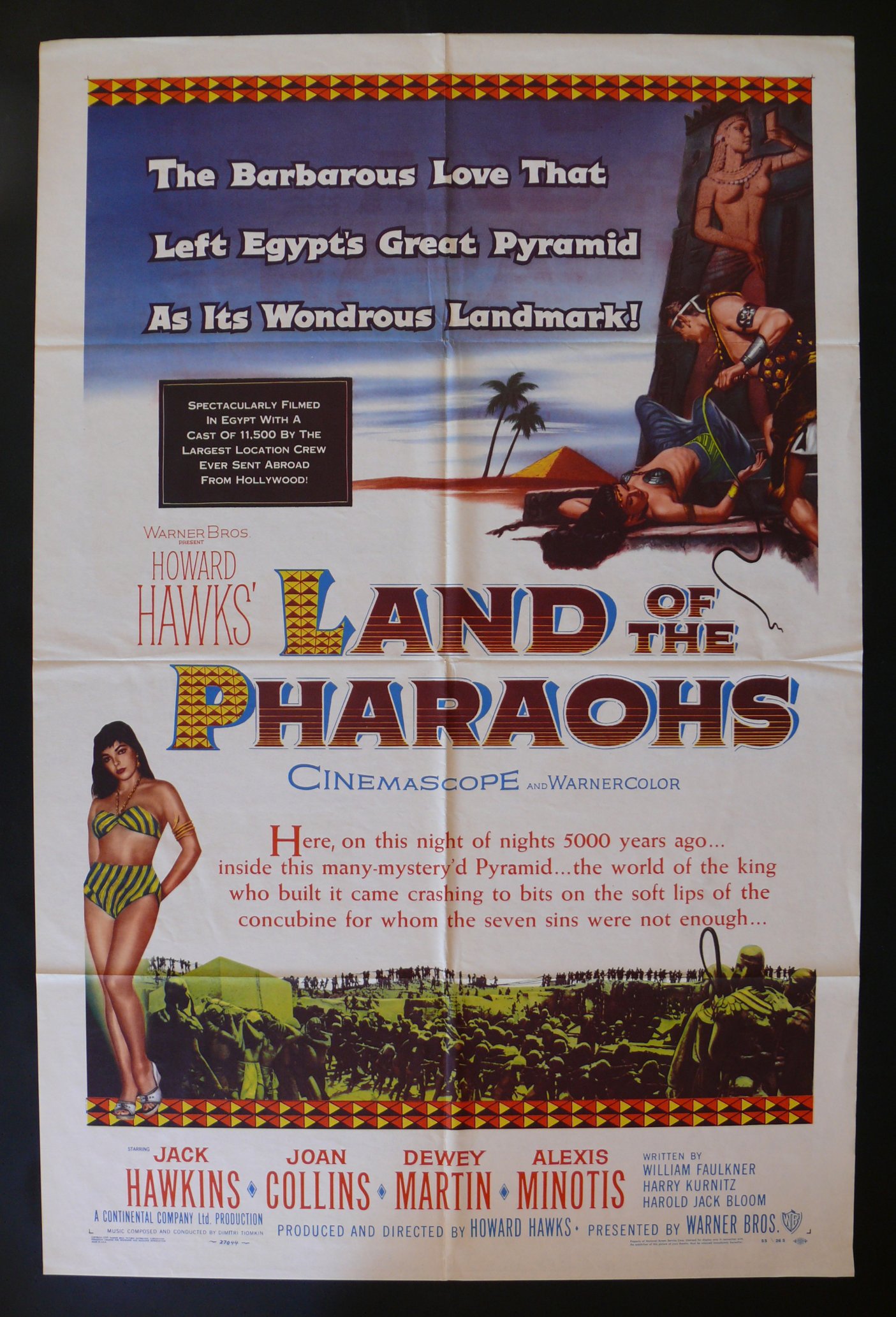
Land of The Pharaohs

Land of The Pharaohs (Howard Hawks, 1955)

One of the many films listed as Martin Scorsese's guilty pleasures, and one of the lesser films of the great Howard Hawks, Land of The Pharaohs is an epic film set in Ancient Egypt. First, I must admit that I love Hawks' latest films from Hatari! to El Dorado. His color films have this lavishtone and feeling. Second, I'm a sucker for epic movies of the 1950's. For example,  I loved Byron Haskins' The Naked Jungle. Even though if those films are considered as lesser works I just can't help it! I love those films!

Despite the many anachronisms, believe me I have a formation in History I will spare you the details, Land of The Pharaohs is a historical epic film. The grand spectacle depicting characters bigger and bolder than any other life is everything about decadence, gold, and opportunists. The overwhelming visual sets of epic proportions, the thousands of extras, the whole extravaganza of it all is the Hawksian facet of the too much. His following film was one of his greatest masterpieces, Rio Bravo, also a colored film but deeper and multilayered. Land of The Pharaohs was the only Cinemascope picture made by Hawks, and even if it feels like it is an experimentation in style, the film has these Hawksian dialogues and many sexual subtexts. It's also interesting to notice that he made a film set in Ancient Egypt times, a time where the women were well considered compared to many other times in History. It is a well known fact that Hawks was a man who loved women that stood up and could enter within the men's preoccupations. Princess Nellifer is the extension of this concept pushed on the other extreme.

Nonetheless, Land of The Pharaohs has a classic story even if Hawks inserted his own vision in the whole thing. The "auteur"'s touch is very present and as the critics of the French New Wave remarked, the Hawks presence is subtle but well felt.

The decadence of Hawks' extravaganza is more than worth a look and even if some elements may seem quirky, well it is, or cheesy, it is too, the picture is a lot of fun. A pure cinematic enjoyment full of visual beauty, read Joan Collins here, and a superb mise en scène. Its detractors must see the picture as a great entertainment piece of the sevneth art instead of the overachievement of a great director. It ain't Howard Hawks' greatest film and it is not one of his masterpieces but a very enjoyable film set in Ancient Egypt.

2010-11-16

El Dorado (1966)

TSPDT Greatest Films #841 El Dorado (Howard Hawks, 1966)


"Hired gunman Cole Thornton (John Wayne) turns down a job with Bart Jason as it would mean having to fight an old sheriff friend. Some months later he finds out the lawman is on the bottle and a top gunfighter is heading his way to help Jason. Along with young Mississippi (James Caan), handy with a knife and now armed with a diabolical shotgun, Cole returns to help."

Another review of another Western. The Western genre has been one of the most popular since the early days of American films. Losing some of its glare in the 1980's and the 1990's with the financial failure of Michael Cimino's Heaven's Gate in 1980 it never reached out as strong as it was in the first half of the 20th century. This failure not only scared producers to do big budget Westerns but also closed the door that auteurism American Cinema had wide open in the 1970's. Some of the greatest films of contemporary Cinema were made in the 1970's, just look at this critics' favorite picture of all time Taxi Driver.

A great cast of actors: John Wayne, Robert Mitchum, James Caan and a great director Howard Hawks makes this oftenly underapreciated film an intrying film to look forward to. I had low expectations when I sat to watch El Dorado: I never heard much praised about it and I was afraid to constantly compare it to Hawks' masterpiece, Rio Bravo. Well, both films have many similarities but which Hawks' picture hasn't some to the other? Look at the relationships between the male characters, strong friendships. The woman's names are often masculinized: Josephine is called Joey. It has John Wayne in it... Well, one can go on easily for a long time.

In a way, Hawks repeats himself and mostly retells a classic Western story with Hawksian characters in a Hawksian world. But in another way, he is one of Cinema's greatest storyteller, and this world is very interesting. Moreover, the ride may seem the same as another one but this is still a great ride. El Dorado, takes you on the path of real men, loyal men and sensible men too (talking in a very John Wayne way of things).

To understand its lack of popularity we have to look back at the context when the film came out in 1967, an Italian cult classic Western came out The Good, the Bad and the Ugly refreshing and revisionning the genre. The conservatism of El Dorado may have been a succes to older audiences but the visual extravaganza of The Good, the Bad and the Ugly was very appealing and brought something new and a new star to the genre. The liberalism of the Sergio Leone picture was of its time and the right-wing El Dorado/Hawks/Wayne didn't help on a political ground. The end of the 1960's was a decade of changes, politically, socially and Cinema (the reflection of reality) changed too. The old guard was giving its last films and the new guard just wanted to take all the place on the screens all over the world. New Waves were emerging everywhere and new names like Arthur Penn, Sergio Leone, Jean-Luc Godard, Mike Nichols, Roman Polanski, Francis Ford Coppola, Stanley Kubrick, Martin Scorsese, Robert Altman, and many more were coming to remplace the old "farts"(read this with respect to all these pioneers and masters) that were losing touch gradually John Ford, Howard Hawks, Billy Wilder, Orson Welles, Nicholas Ray, Robert Wise, etc.

With a step back El Dorado is an interesting film in Howard Hawks' filmography and fits perfectly in this oeuvre watched as a whole. I still have Hatari! as one of my personal favorites but I still need to see many of his films before really stepping my foot down defenitely.

2010-01-23

Merci YouTube!!! Part XIII

Howard Hawks' Scarface (1932) The original Scarface that shows all of Hawks directing skills. This is one of the most violent gangster films ever made by Hollywood.

Scarface
(1932) de Howard Hawks. Le Scarface original qui démontre tout le talent de metteur en scène de Hawks en plus d'être l'un des films de gangster les plus violents de l'histoire du Cinéma.


2009-11-08

Hatari!

Hatari! (Howard Hawks, 1962)

Ayant eu un parcours difficile auprès des nombreux studios pour qui il travailla, Howard Hawks n’a pas été apprécié à sa juste valeur à son époque. Reconnu vers la fin de sa carrière par les piliers de la Nouvelle vague française comme étant l’un des plus grands cinéastes américains. Leur lecture des films de Hawks a permis à donner à sa filmographie le lustre qui lui revenait. Plus près de nous, Quentin Tarantino place Howard Hawks comme étant son cinéaste préféré avec Sergio Leone. Cette influence se ressent surtout dans l’écriture de Tarantino qui utilise des dialogues rappelant les meilleures comédies de Hawks.

L’histoire de Hatari ! est plus que simple, on y suit un groupe d’hommes qui pendant trois mois doivent chasser des bêtes sauvages en Afrique pour peupler un zoo de Suisse. C’est lorsque la photographe, Dallas (nom féminin typique des films de Hawks qui aimait donner des noms masculins à ses héroines) venue d’Italie, que les choses se corsent. Le groupe composé de plusieurs caractères différents connait plusieurs défis et frictions.
Dans un premier temps, la scène d’ouverture nous présentant chacun des membres masculins du groupe est digne des grandes scènes classiques. Ils représentent l’homme qui tente de se saisir de la nature mais aussi de l’homme qui tente d’attraper la femelle (rhinocéros) pour l’avoir comme compagne. Je cite la meilleure phrase de cette scène : Je crois que c’est une femelle ; elle ne sait pas trop où aller et elle semble tourner en rond. De l’humour très typique de Howard Hawks, car il se moque bien des femmes et de leurs sentiments changeants et il clarifie ainsi que les hommes pensent en ligne droite et voient clair dans leurs sentiments. Cependant, le personnage de John Wayne est tout à fait à l’opposé de cette idée. Il ne se rend pas compte de son béguin pour Dallas et de son attachement à elle.

Le personnage central de John Wayne est très intéressant, il fait office de pater familial. Il veille sur chaque membre de la famille et essaie de désamorcer toute discorde qui pourrait survenir lors de leur travail. Du point de vue du jeu, il est rafraichissant de voir Wayne jouer sur le côté comique. Surtout lorsqu’il répond à brûle pour point à Dallas qui lui dit ; Un jour un taureau m’a déjà couru après ! Il lui répond ; Vous êtes sûre que ce n’était pas le contraire ? À part Dallas, le seul autre personnage féminin de la bande est Betty qui est la fille de l’ancien patron de chasseurs qui a été tué par un rhinocéros lors d’une chasse. Betty est convoitée par deux hommes ouvertement et par un ami d’enfance en secret, c’est finalement ce dernier qui remportera son cœur. Suite à cela, les deux autres concurrents se lient d’une amitié presque homosexuelle dont Hawks a inconsciemment peuplé ses films.

Un jour j’ai lu que François Truffaut a analysé ce film comme une démonstration de la méthode de réalisation d’un film de Howard Hawks. Un groupe restreint supervisé par John (Hawks) doit, comme pour les nombreux animaux, tourner tous les scènes qui peuplent un film et chacun des personnages doit écouter la figure d’autorité (le réalisateur) pour que chaque animal (scène) soit dans la boîte.

Les scènes de prise d’animaux sont impressionnantes notamment avec les rhinocéros. De plus, les paysages sont magnifiques. Un bon film d’aventures qui divertit et fait réfléchir sur le travail de l’un des plus grands cinéastes américains.

Cependant, dans la filmographie de Howard Hawks bien de ses films seraient à considérer de meilleure qualité pour ne nommer que His Girl Friday, Scarface (1932), The Big Sleep, Bringing Up Baby et le chef d’œuvre Rio Bravo. Personnellement, Hatari! est mon coup de coeurs dans la filmographie de Hawks. Ce film a un je ne sais quoi qui me fait rire et passer un bon moment. Je ne sais pas si ce sont les nombreuses scènes avec des éléphants ou le sentiment de légèreté et d'innocence qui en dégage, mais j'adore ce film!

2009-11-06

Merci YouTube!!! Part VIII

Bringing Up Baby de Howard Hawks. Véritable classique de la comédie et l'un des nombreux chef-d'œuvre de Howard Hawks.

Howard Hawks' Bringing Up Baby. A true cinematic classic and one of Hawks' masterpiece.


Related Posts Plugin for WordPress, Blogger...