Showing posts with label 1957. Show all posts

2015-12-07

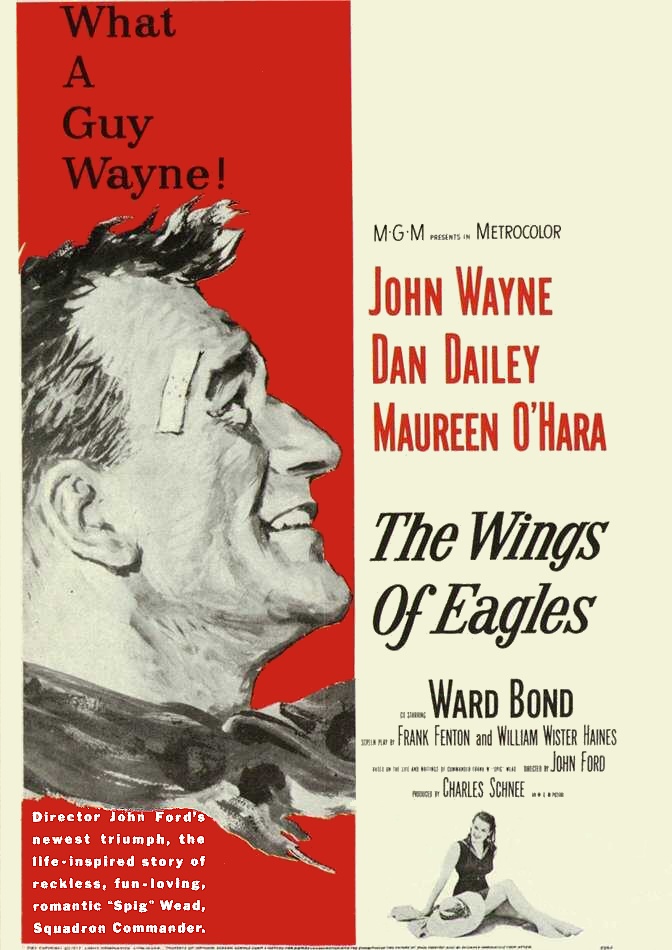
The Wings of Eagles

This post is part of the “Try It, You’ll Like It!” Blogathon, hosted by Sister Celluloid and Movies Silently, where we write about “gateway films” that might bring non-classic-film lovers into the fold!

The Wings of Eagles (John Ford, 1957)

A biography of Navy flier-turned-screenwriter Frank W. "Spig" Wead.

In the shitload of films John Ford and John Wayne made together, most of them were Westerns and this is mostly what the collaboration between the two men is now remembered. However, they also made many war films like They Were Expendable. The writer of this feature film was Frank Wead a retired Army man also a friend of John Wayne. So ten years after the death of Wead in 1947, Ford and Wayne made an homage to the once pilot and screenwriter with a movie based on his life.

2013-08-30

The Tarnished Angels

The Tarnished Angels (Douglas Sirk, 1957)
Adapted from William Faulkner’s novel Pylon, Douglas Sirk’s lavish black and white film stars regular Rock Hudson, Robert Stack, and Dorothy Malone. Reunited two years after the making of the masterpiece, yes I said it, Written on the Wind, this trio does it again for another great Sirk film.

2013-03-05

Night of the Demon

Night of the Demon aka Curse of the Demon (Jacques Tourneur, 1957)
This British cult film named by Martin Scorsese as the 11th most frightening film of all time is a superb black and white example of the mastery of Jacques Tourneur filming Horror films with his porper aesthetics and polyvalence. Having touch almost every genre in Films, Tourneur has been recognized mostly for his Horror films made with producer Val Lewton like Cat People, I Walked With a Zombie, and The Leopard Man. However, this film critic’s favorite Tourneur is the Film Noir Out of the Past, a masterpiece of the genre starring Robert Mitchum.

2012-07-26

12 Angry Men


12 Angry Men (Sidney Lumet, 1957)

A dissenting juror in a murder trial slowly manages to convince the others that the case is not as obviously clear as it seemed in court.

The first feature film directed by Sidney Lumet (Dog Day Afternoon, Before the Devil Knows You’re Dead, The Verdict) is one of the greatest huis clos dramas to ever be put on film. Starring Henry Fonda, Lee J. Cobb, Jack Warden, Martin Balsam, and eight other angry men. They are the twelve jurors who need to decide if a young Spanish-American is guilty or not of murder on his father. They are in the jury room for almost the entire film and the evolution of their decision is the center of the story. Adapted from a play by Reginald Rose, 12 Angry Men is a masterpiece of mise en scène and pacing.

At first, Fonda’s character is laid back and studies the opinions and reactions of his peers. But when he decides to get into the action he mesmerizes them one by one. This is not only a meditation on American justice, but also a human laboratory on human forces of power and influence on opinions.

It also works where Alfred Hitchcock’s Lifeboat film fails to be the perfect huis clos, the tension and the interactions between the characters is never slowed down for a plot detail or a camera setup. Lumet’s sober mise en scène becomes the best tool he has to tell this risky story. However, he masters it like the great storyteller he is. Just look at his film Network to understand how he knows to bring controversial material to the big screen without falling into the easiness of his subjects. 


The late American critic Andrew Sarris in his book The American Cinema: Directors and Directions 1929-1968  labelled Sidney Lumet in the category Strained Seriousness. It represents “talented but uneven directors with the mortal sin of pretentiousness. Their ambitious projects tend to inflate rather than expound.” What works with 12 Angry Men, is the fact that it is an ambitious project made with honest and very humble means.

All in all, 12 Angry Men might be Lumet’s masterpiece: a film that still holds its guard more than fifty years after it was made is the sign of real talent. Plus, it is a movie that has a great entertainment value and a keen story. Highly recommended.

2011-12-21

The Seventh Seal

The Seventh Seal aka Det sjunde inseglet (Ingmar Bergman, 1957)


Of the many great films directed by Ingmar Bergman The Seventh Seal is one of the most outstanding and celebrated. For those who don’t know please believe me or treat yourselves with Persona, The Virgin Spring, Wild Strawberries, Shame, Fanny and Alexander, Saraband, Winter Light, Cries and Whispers, The Magician, The Silence, Scenes From A Marriage, well I’m not gonna list them all here but just stand far from The Touch which you can read about in the Simply the Worst event at Reverse Shot where they celebrate the worst film of many notable directors.
I remember the first time I read about this film; in medieval Sweden a knight comes back to Scandinavia after a Crusade and meets Death. He proposes to play a game of chess with Death to postpone his eventual journey in the after world. Meanwhile, the knight travels with a showman and his wife. If, like me at the time you haven't seen the film, the poster, any still, and do not know the actors it inspires to an interesting picture.

First, this plot always intrigued me so it was natural that I’d do anything to watch it. It was in October 2002 at the University on a VHS player on a 14 inches TV and crappy earphones. This context gave to the film a special glow of a rare gem to finally been watched and experienced. It was the first Ingmar Bergman film I’ve ever watched. Needless is to say that it was a revelation. A revelation of Scandinavian Cinema, a great master, a great actor Max Von Sydow, and a riveting filmography.

The importance of The Seventh Seal is more than preeminent in the medium, ranked in the Top 250 of IMDb by regular users (a rating system I definitely don’t understand) listed as the 53rd spot of They Shoot Pictures Don’t They?’s 1000 Greatest Films, #35 by critics of the Sight & Sound 2002 poll and #31 on the Directors side. It can go on and on but it was one of the first films to open the door to classic films and foreign films in my early stages of cinephilia.

About the film, in the 1950’s Bergman was directing at the Stockholm Theater during winter and with the same cast he was directing films. During the summer of 1957 Bergman not only directed The Seventh Seal but also his masterpiece Wild Strawberries. It was a great year for Bergman and Cinema too. Interesting fact, despite his widely known pretention, Bergman was somewhat modest about how he liked his films. But his film he likes the most is The Seventh Seal, he said that it is the one that works the best. However, this false modesty isn’t palpable when you watch carefully Bergman’s films, the characters of his contemporary films represent the bourgeoisie and their problems. In The Seventh Seal, the knight represents some kind of bourgeoisie that stands above the showman and the band that follows him. It is interesting to see that it is the responsibility of the knight to protect the lower classes that will however one day meet its end no matter from which class or cast he is from.

There is something about this period in the films of Bergman that transpire something raw or crude and it is in part because of the kind of cinematography made with clear crude lighting and few effects. It is almost as if Bergman liked to show bare human feelings without any useless artifices in natural context and environment. A simplicity in the complexity of his plots and understanding of the storytelling that Cinema requires. By today’s standards The Seventh Seal looks much like a classic almost academic film made by a theatre director. However, the themes and reconstitution of the time is perfect and I wouldn’t trade this film for any contemporary one. Please note: I will defend this statement hardly: The Seventh Seal is a Masterpiece.

2011-12-04

Truffaut Double Bill: Les mistons & Antoine et Colette

Les mistons (François Truffaut, 1957)


François Truffaut’s first film, a brilliant homage to Jean Vigo’s Zéro de conduite about childhood, first and impossible love. The breezy approach, the smooth narration, the comic relief of the kids, the first moments of François Truffaut’s “mise en scène”, the sad denouement, and the bitter sweet conclusion of this short makes it a masterpiece of its own. Hugely overlooked because of the incomparable success of Les 400 coups, Truffaut’s Les mistons deserves way much praise than it actually received. Evoking his sensibility and his subtle humour, this 1957 short offers the critic’s first opportunity to make a film, the medium he is passionate about.


Antoine et Colette [segment of L’amour à vingt ans] (François Truffaut, 1962)

The first segment of L’amour à vingt ans, a film « porte-manteau » co-directed by Renzo Rossellini, Andrzej Wajda, Shinoda Imamura, and Marcel Ophüls, Antoine et Colette is a sequel to Les 400 coups (1959) and the prequel to Baisers volés (1968).

We are catching up with Antoine Doinel (Jean-Pierre Léaud), now seventeen and out of a reform school. He is working at Phillips, making records and living like an adult in his apartment. Doinel has made for himself a solitary life with one friend. Shortly, he’ll meet Colette and quickly fall in love with her. However, Colette doesn’t return his advances and she considers him as only a friend. Doinel will be almost adopted by Colette’s parents and he’ll even move in an apartment facing theirs. Their relationship is almost like if it was a family recomposed. For Doinel, this is like the parents he never had and it gives him the opportunity to spend more time with Colette.

This short will give the rhythm to the rest of the Antoine Doinel cycle. This quirky character, naive at times and childish at other moments will have to face the adult life he always wanted to live. Meanwhile, all his life he’ll be acting like a child, the Doinel of Les 400 coups that wanted to be an adult as fast as possible will always have to struggle to understand the world of adults. Antoine et Colette is the perfect link between Les 400 coups and Baisers volés. The melancholy and sadness that the Doinel films own and the bitter sweet savoury touch of the situations will be one of the trademarks of Truffaut/Léaud.

2011-05-24

The Bridge on the River Kwai


The Bridge on the River Kwai (David Lean, 1957)

The Bridge on the River Kwai is a widely popular and acclaimed film from one of the most famous British directors of all-time: David Lean. With 7 Oscars and a #83spot on the not-so-viable IMDb Top 250, the movie should at least ring a bell to anyone. As for its over-heroic characters or its La Grande Illusion wannabe war prisoner flick, The Bridge on the River Kwai sure lets you with an illusion of a great movie. Like François Truffaut said Le pont de la rivière Kwai est un film conçu pour épater l’Académie et empiler les statuettes dorées ornées d’un homme nu tenant une épée en guise de phallus. Well, I’ll translate this citation like this : The Bridge on the River Kwai was made to impress the Academy and pill up those little golden naked men holding their sword as a phallic substitute. The guy couldn’t be more right.


I have a profound aversion towards those films made for a moment, I even prefer the Tom Hanks/John Candy comedy Volunteers where they built a bridge for an important convoy of Viets to cross a river. The Bridge on the River Kwai tells the story of British soldiers captured and forced to built a bridge over the Kwai river. The many face to face between the two leaders wants to demonstrate how mentally strong they are and how they will fight for their men. Anyhow, I kept comparing the dynamic of the prison camp with the dynamic of La Grande Illusion, made twenty years earlier. Renoir’s film is so much deeper and richer than Lean’s spectacular film about courage and brainwashed Army concepts can’t keep the pace and level of the inventive “mise-en-scène” from Renoir just make The Bridge on the River Kwai look even lesser than it actually is.

However, as a whole, the movie is entertaining and the goal is achieved, heroism and courage sweat from the entire film. Although even if they are oversimplified and stereotyped every character still works. The whole story makes you hold your breath and there are moments of pure cinema, but the film isn’t as great as Lean’s other films, say Brief Encounter or Lawrence of Arabia.

David Lean is the kind of filmmaker capable of great and less than average pictures, a fellow critic, Kevyn Knox compared him to Steven Spielberg which I think are two similar filmmakers. They both made superb technical films with great budgets, great recognition, and lots of box-office entries while having a constant lack of soul in their filmmaking approaches.

2010-08-03

Antonioni's Il grido

Il grido (Michelangelo Antonioni, 1957)

Known for his films from 1960 (L'avventura) to his death in 2007, Michelangelo Antonioni is a deep meaningful italian director. For many his artistic peak was L'avventura or Red Desert, personnally Blow-Up is his best offer. But as a true cinephile I must admit that his pre-L'avventura work is worth a look and it even announces his masterpiece period.

Il grido is the story of a man, Aldo, rejected by Irma a woman recently widowed. He begins a new empty life with his daughter trying to fulfill his lost love with the meeting of many women. This is a film that carries the main themes of Antonioni's filmography: the failure of communication, the emptiness of a broken heart, and pessimism. That's right, Antonioni made many films on that subject and I think the tragic ending of Il grido explains easily the pessimism of Antonioni's oeuvre. I also observed that intentionnally Antonioni put a poster of Charlie Chaplin's The Kid, this may be a reinterpretation of those themes or elements by Michelangelo Antonioni...

Like the rest his entire work, the photography of Il grido is memorable and every frame is near perfect. The mise-en-shot is characteristic from Italian cinema and gives lot of exposure to the tragic scenery. However, the presentation is nice but the content and the story is so cold that we hardly get into the story and get involve with the characters. His 1960 offer, L'avventura is more fulfilling and delivers a better plot.

Far from calling Il grido a masterpiece, I think it is a film worth a look expescially for those who love Italian Cinema and Antonioni.

A review by Michaël Parent
Related Posts Plugin for WordPress, Blogger...