Showing posts with label short.. Show all posts

2015-05-04

Les maîtres fous (The Mad Masters)

Note : This review is my contribution to the Shorts! blogathon hosted by Movies Silently from May 2nd to the 4th of 2015. Please visit the links and enjoy the readings of the other great writers participating.
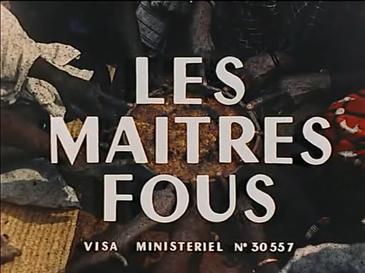

Les maîtres fous (The Mad Masters) (Jean Rouch, 1955)

The effects of colonialism are exposed in this film on indigenous Africans via specific rituals developed as a reaction to the colonial system. The film turns into a crazy elaboration on both the madness of such a political system and man himself.
Banned in Niger and British territories like Ghana, Jean Rouch’s Les maîtres fous is a docufiction about ethnology and colonialism. Rouch was himself a well known ethnologist and developed the genre ethnofiction. At the time when Rouch directed and presented his film nations were about to get free from their masters. Movements of nationalism and liberation were budding all over the world. In 1958, Niger for example gained its Independence.

Les maîtres fous presents the sect of the Haukas that initiates its participants with possessions and representations of the behaviors of their masters. In a way they try to emulate the actions of their oppressors and simulate and expiate their sufferings. As they do this afterwards the Haukas are shown working with big smiles and happiness despite the poor condition of hard work.


Another explanation of this tradition is an African interpretation of the rituals as it is a way to take their rivals power and eat it. For non-African people this interpretation seems difficult to understand but many rituals executed in Africa are old of hundreds, if not, thousands of years and are anchored deep into the collective mind of these people.

Jean Rouch with his docufiction seems to be exploiting a sensationalist behavior that gives a racist vision of colonialism. Well, let’s face it, colonialism was the act of Imperialist nations wanting to spread their culture and conquer the world with ideas, language, religion. It was also a way to get resources at almost no price with cheap labor. Sure racism has many masks but colonialism was one of them. Discarding the locals’ culture and imposing your own can’t be good for your politics and men.

But Rouch wants to show the reaction of the locals after many years of colonialism in their home land. No surprise the film was banned; it depicted without any filter the direct effects of nations on the verge of their independence living under the leaders of imperialist nations and making benefits on the hard work and land of their locals.

As a film of 36 minutes, Les maîtres fous was less disturbing that I thought it would be. It is straight to the point and narrated by Rouch himself. What’s interesting with documentaries, in this case a sixty years old one, is that it is a document depicting a slice of history very specific to a part of the world where few documents are available since history was more an oral tradition than our academic interpretation of the discipline. It is important that such short films and documentaries are preserved for generations to come to understand the past and the variety of ethnicity.


2013-12-17

Un chant d’amour aka A Song of Love


Un chant d’amour aka A Song of Love (Jean Genet, 1950)

For a long time banned and even disowned by its director Jean Genet later in his life because of its explicit content of homosexual eroticism. Un chant d’amour might be one of the most unexpected films to be on the They Shoot Pictures Don’t They’s 1000 greatest films of all time.

2013-09-16

Le Sang des bêtes (Blood of the Beasts)

Le Sang des bêtes (Blood of the Beasts) (Georges Franju, 1949)
This short film directed by French filmmaker Georges Franju is one of the most beautifully shot black and white surrealist pictures while coldly explaining the slaughter of horses, cattle, and sheeps.

2010-11-18

La boulangère de Monceau (1963)

La boulangère de Monceau (Eric Rohmer, 1963)


This nice little short also known as the first part of Rohmer's Six Moral Tales is told like a short story. The plot, a young man of Paris is captivated by a beautiful stranger he often met on the street. One day he decides to approach her and ask her to go out. But, their path won't cross again for a while. His life, is dedicated to the moment they will meet again, but time passes and he got bored of waiting so everyday he grabs a shortbread cookie in a little bakery. He agreeds to flirt with the little baker girl and slowly develops a relationship with her. The same day that the baker accepts a date, the stranger reappears...

Rohmer's moral tales are all narrated by the main character of each film and they have this literary feel to them. Their characters are often students or artists and the storyline is often about love and the beginning of relationships. La boulangère de Monceau is an excellent setting for the rest of the serie, it may have been your host's favorite one yet.

Obviously, this a film of the French New Wave and it feels a lot like one. The jump-cuts, the amateurish actors and the many wandering characters in many exterior scenes, well the film is set entirely in exteriors. The use of a beautiful black and white with many long and unedited shots and few multiple angles in the scenes. A trademark, or if you prefer, a trend very French New Wave. La boulangère de Monceau, has this something about it that gives you a good time and makes you ask for the following tales of Eric Rohmer.

2010-09-30

Réverbérations urbaines - Design Urbain Video Fest


On September 28 I was invited to the first edition of the Design Urbain Video Fest in Quebec City. The six shorts presented were the work of future Urban designers of The Laval University. Their task was to explore the intensity of the city. The result: six unique films made by four students each.

Here I put the link of the winner of one of the prizes, "The Gold Slick" aka Le slick d'or directed by Alex Dimas, Émilie Labrecque, Mélissa Renaud and Alexandre Van Kessel: Réverbérations urbaines. This collective choose to work on the familiar sounds and noises of the city with the medium of stop motion.

Enjoy!

Related Posts Plugin for WordPress, Blogger...