Showing posts with label 1950. Show all posts

2016-09-10

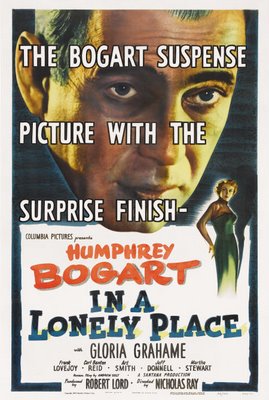
In a Lonely Place

Editor’s note : this review is a translation of one of the first reviews to ever appear on this blog back in 2009. Those were less than a 150 words long and were written immediately after the viewing of each film. This is as aforementioned a translation and a longer edit of this original film review.

In a Lonely Place (Nicholas Ray, 1950)

A potentially violent screenwriter is a murder suspect until his lovely neighbor clears him. But she begins to have doubts...

One of the many films of the 1950’s that is considered as part of the Film Noir genre with crisp black and white, legendary director Nicholas Ray, and Humphrey Bogart. Add to that Ray’s wife at the time, Gloria Grahame, and you have a great film on paper.

The opening scene is a piece of anthology by itself in Bogart’s filmography, his character Dixon Steele, a drunk screenwriter on a dry spell, is in a bar and gets to punch a man, insult another one, and gets into a fistfight. All of that at noon. He represents the wounded man that Bogie always succeeded to portray in films. The perception of this actor can be compared with this character as a man that is mysterious and a bit rude like a wild animal that struggles to be around his peers.

2013-12-17

Un chant d’amour aka A Song of Love


Un chant d’amour aka A Song of Love (Jean Genet, 1950)

For a long time banned and even disowned by its director Jean Genet later in his life because of its explicit content of homosexual eroticism. Un chant d’amour might be one of the most unexpected films to be on the They Shoot Pictures Don’t They’s 1000 greatest films of all time.

2012-11-09

Los olvidados


Los olvidados (Luis Buñuel, 1950)

A group of juvenile delinquents live a violent and crime-filled life in the festering slums of Mexico City, and the morals of young Pedro are gradually corrupted and destroyed by the others...

Labelled as a surrealist, Luis Buñuel startles with this down to earth film that can remind of the Neo-Realists active at the same time in Italy. Recalling the modern near-masterpiece of Fernando Meirelles City of God, Los olvidados was one of the many influences on François Truffaut for his breakthrough film 400 Blows.  Genuinely violent and crude, Buñuel’s landmark of a movie is bleak, dark, and very personal. Instead of romancing the scums like, let’s say, Slumdog Millionaire, Buñuel depicts a world where no one is spared and where hope isn't what waits for you at the corner of every street. He deals with every problem possible and even the good natured characters have a sense of naivety that in real life there are no happy endings.

Our two main characters are Jaibo and Pedro. While one (Jaibo) is a thief and a recently escaped prisoner, the other is a little bum that follows him but still has something good inside him. However, since he faces adversity and a complete ignorance from his mother, he is split between the influence of Jaibo and his will to behave. Illustrated with a superb dream sequence that shouts Buñuel this situation is well exploited. On the other side, Jaibo is the representation of bad behaviour and the viewer has no choice but to hate the disgusting acts of the young man. It is indeed a revolting picture and the fact that the movie was shown only three days because it shocked the Mexican government can easily tell that it was not that far from reality. Shot by a recurrent Buñuel collaborator, Gabriel Figueroa gives a genuine almost documentary look to the images with his great use of lighting and shadows.

My first encounter with Buñuel was his masterpiece The Discreet Charm of the Bourgeoisie, and after I discovered his early surrealist films. Los olvidados might be a little unsettling in his filmography, while being personal with the dream sequence, the pouring of milk on the legs, and some sensual elements, every Buñuel enthusiast will get a kick out of it. During his Mexican exile he made many films that may deserve much attention but Los olvidados is the pinnacle of his passage in Central America.

2012-10-24

Cinderella


Cinderella (Clyde Geronimi, Wilfred Jackson & Hamilton Luske, 1950)

When Cinderella's cruel stepmother prevents her from attending the Royal Ball, she gets some unexpected help from the lovable mice Gus and Jaq, and from her Fairy Godmother.

When the Disney Studios re-release one of their classic movies you must decide if you want it or not because they get them out of the vault for a limited time only. It might be considered a very greedy approach but also it brings a sense of urgency to get it before it’s no longer available. The collectors out there, like the writer of those lines, are interpellated by this mercantile aspect of DVD/Blu-Ray rarity. Back in 2008, I went on a vacation to Disney World and I brought as a souvenir and because it’s my childhood favorite The Jungle Book. Well, this year the ultimate fairy tale has been released in a slick Blu-Ray. Cinderella being my wife’s favorite, I surprised her the day it came out I gave her the film. Personally, I saw the main scenes: the transformation, the dancing and some other scenes but I never sat through the entire thing because it was a girl movie when I was young.

However, with time and a fair interest in Disney Classics, it was about time that this critic discovers Cinderella. Like aforementioned, this is every girl’s fairy tale. A charming prince is looking to marry the perfect maiden. Cinderella is an eligible young woman but living with her stepmother has been a real pain in the back. She is the slave of her stepsisters and stepmother. However, she always gets up happy, singing with the birds and playing with mice. Some of the greatest moments of the animated feature are the upgrade of the dress, and the appearance and performance of the Fairy Godmother. Every element in Cinderella is very charming and the plot is elevated with the comic relief of the animals that have equalled if not more important parts in the movie than humans.

This is one of the most beautiful films that Disney has made and even if some elements and values may be perceived as conventional, well it was released in 1950 by a very American studio and in Far Away. What do you expect? It sets the standard with Snow White as the classic fairy tale. I must conclude with the fact that I think that the early Disney classics are masterpieces and that their craft are great works of Art. Even if Walt Disney himself once said that the worst thing that could happen to him was that his films were only shown in Art Houses I think that they can be appreciated in any theatre and by a vast public. Labelling Cinderella as Art doesn’t input it to be reserved to a restricted public neither does it under evaluate it. It’s a question of giving its nobility to the film. Highly recommended.


2012-09-28

Rashômon


Rashômon (Akira Kurosawa, 1950)

A heinous crime and its aftermath are recalled from differing points of view.

If I remember correctly, Rashômon was the third Kurosawa film I ever saw back in 2002, right after Yojimbo and Sanjuro and just before The Seven Samurai. Since then I saw most of his well known films, some classics I have yet to discover but I can certainly advance that Kurosawa is one of my favorite directors of all time. Choosing which film is his best is an impossible task. Listing The Seven Samurai in my Top 10 doesn’t discredit the reach of Ikiru, Ran, Throne of Blood, High and Low, or Rashômon. It is a deliberate choice of one cannon instead of another one. In the case of my favorite directors it is a really tough choice to pick a movie and let all the others down. My relationship with Rashômon is very particular because I always thought that it was a lesser film compared to the aforementioned epic The Seven Samurai.

Since hundreds if not thousands of reviews have been written on the meanings and subtexts of this film, I would like to discuss of the place of it in Cinema History. First, it is a very Japanese movie set in traditional Japan involving samurais. A trademark of Kurosawa is the samurai stories. He is automatically related to those sword men. Then you have his greatest lead actor: Toshiro Mifune. Kurosawa was the director who gave him his first opportunity and he detected the talent of the intense and shy actor.

Shot within only three different locations, it gives a very theatrical aspect to the film. Theatre in Japan is a thing of tradition and to learn that Rashômon was the first real breakthrough of a Japanese film is interesting. We also feel that Kurosawa learned from his previous directorial credits and Rashômon was the hatching of his talent. The restriction of location is also palpable in Robert Altman’s Gosford Park, a film freely inspired by the subject of this piece. The constant rain also refers to the dramatic opening of the movie.

Then, you have the structure of the story which is told by four different witness of the crime: the victims, the witness, and the accused. The retelling of the story by the numerous characters is more or less cinematically linked to the Everest of cinema itself Citizen Kane where we are on a journey to discover who or what is Rosebud. In fact, Rosebud is the subtext for us to try to find who Charles Foster Kane is and we discover bits and parts of the character by the testimonies of the people who lived with him. In some way Rashômon is the Japanese Citizen Kane. This structure is also reused with vibrant colors in the wire-fu poetic Hero directed by Zhang Yimou.

The coming release of the Blu-Ray by Criterion Collection will bring back some attention on the masterpiece of one of the most gifted filmmakers from Japan. This honest and sometimes raw film about reality, crime, and storytelling deserves to be amongst the great titles Criterion gathers in its selective collection. A masterpiece I highly recommend.

2011-12-23

Rio Grande

Rio Grande (John Ford, 1950)

Of the cavalry trilogy made by John Ford and John Wayne together, Rio Grande (the other two films being She Wore A Yellow Ribbon and Fort Apache) might be the deepest in meanings and one of Ford's most beautiful black and white pictures.

Rio Grande depicts family values, social effort, and the common all-American priciples that a good old John Ford film should bring on the screen.

I usually admire Ford's Westerns and I really enjoyed the two other installements of this trilogy. However, there was something that just didn't do it for me with Rio Grande. I was probably not in the mood for this kind of movie when I watched it. I should get back to this one some time later and do a triple bill of the whole cavalry concept and a good review of the film. I apologized for this lack of consistency here.

2010-08-11

Winchester '73

Winchester '73 (Anthony Mann, 1950)
In the vein of Great Wersterns Winchester '73 is often overlooked. It's obvious that the Western spaghetti genre revolutionned or revisionnized the way Western were made. But before this revolution, the genre always been one of the most popular in American Cinema. Many directors made Westerns but they are quit a few that could handle it like John Ford or Howard Hawks. Sometimes, you can add Fritz Lang to this list but Anthony Mann is often forgotten. Bend of the River, Man From Laramie, Man of the West, The Far Country just to name a few and Winchester '73 will be observed here are Mann's most popular Westerns.

The title of the film refers to one of the best gun a man "cowboy" could own. We follow its path through different hands. From the man (James Stewart) who won it in a shooting contest to the worst bandit of its region. With Shelley Winters as the woman (romantic relief of the story), a young Tony Curtis as a soldier and Rock Hudson as the Indians wild chief.

As always James Stewart is the perfect American hero, he is the good son, the gentleman with the ladies, the cold blood competitor and the good "conscience" of the story. One quality he has more than any other cinematic icon of its time: he is human and has this fragile kind of personnality. He could be anyone, your friend, your neighbor, or even you. He was the son of America, in a good way. He reprensents justice, rightousness, truth, love, friendship, etc. His charcater wouldn't be the same without its presence.

With Anthony Mann he made many westerns and the combinaison seems to fit very well. Mann's camera waits patiently and captures the essence of the story, the scenery, the faces, and gives a great projection of what was the West. It was made of small heroes like Stewart that yes conquered the bad guys but also they don't become Presidents of the U.S.A. at the end of the story. Mann's approach has just the right sensitivity while staying dusty while the Indians attacks and capturing the dirty faces of the bad guys.

The imposing number of Westerns offered can maybe justify why Winchester '73 is often, too often overlooked in its genre but I'd like to take this opportunity to write out loud (if it's possible) how this film is a beautiful black white Western that deserves so much more praise and words from the cinephiles.


A review by Michaël Parent

2010-07-09

Stromboli, terra di dio

TSPDT Greatest Films #520 Stromboli (Roberto Rossellini, 1950)

The first collaboration of actress Ingrid Bergman and director Roberto Rossellini. It is during the production of Stromboli that Bergman had an extra-marital affair with Rossellini and got pregnant. At the time she got blacklisted by Hollywood.

Karin a young woman accepts to marry Antonio to escape from a WWII prisoner's camp. After the wedding they move to Antonio's hometown: Stromboli. A small island North of Sicilia where there's always a current menace of the eruptions of the volcano. In this story the volcano symbolizes the power and the wrath of god. The reason Karin married Antonio was to escape from the prisoner's camp, well she wanted freedom, but the island where she is confined is even worse than the camp.

Rossellini, who influenced largely some of the best directors of the French New Wave distincted himself for his approach; he worked without a script with only some personnal notes. It may be why there are many long takes. The long takes are also used here to emphasize the loneliness of Karin in her house and on the island. In some case it gives a sense of realism to the story but also it lets enough space and time for the actors to improvise in many scenes. With Stromboli, Roberto Rossellini created moments of intensity that only Italian Neorealism could have achieved.

This other lesson about war demonstrated by Roberto Rossellini, shows how society (or Italy) should stop being so selfish and think to try to built a better world for its future. The idea of the story is very subtil and unlike Germany Year Zero of Rome Open City the broad lines are fuzier in Stromboli but no less interesting or clever.


A review by Michaël Parent

2010-04-08

The Asphalt Jungle

The Asphalt Jungle (John Huston, 1950)


From the director who practically "invented" the Film Noir genre, without even knowing it was a genre at the time, John Huston delivers another classic noir with The Asphalt Jungle. The visual qualities of this 1950 thriller are awesome.


With The Maltese Falcon Huston made his debut as a filmmaker. In his first feature, the story was told from the point of view of the private who was looking to find the famous falcon. In The Asphalt Jungle, it's the side of the diamond bugglars and the other side of the law that is seen. Many characters interact with each other and except for the two women of the film few are innocent. The films of John Huston are all well written and well directed, the ones I've seen include The African Queen, The Treasure of The Sierra Madre, The Maltese Falcon, Moby Dick, and The Asphalt Jungle. The photography of The Asphalt Jungle is inspired and gives a lot of space to the faces of the many characters that habits this film.

Without being my favorite Film Noir or my favorite John Huston film, The Asphalt Jungle deserves a special mention because it is too often overshadowed by The Maltese Falcon.


2010-02-20

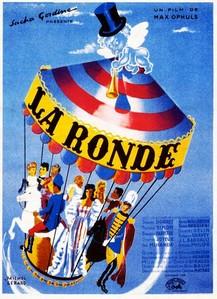
La Ronde un film de Max Ophüls - Retrospective

TSPDT Greatest Films #636 La Ronde (Max Ophüls, 1950)

Max Ophüls is considered by many as one of the best directors of all time, I am ashamed to say I have only seen Letter From an Unknown Woman and Lola Montès. Both are exquisite masterpieces, especially Lola Montès, his last film, praised as maybe the best film of all time.

La Ronde is a story told by Anton Walbrook who plays a debut XXth century "cupid"/ "metteur en scène" of love or as he says a lover of the art of love. He is the element that makes La Ronde go round. Told in ten sketches Walbrook's character joins the sketches together. At some point there's an allusion to a well known french expression; to live of love and fresh water: many characters ask for a glass of water only. And they are always more thirsty than hungry. As many of Ophüls films he likes to finish his films at the place they started. He is an amazing storyteller and all his films took us on unforgettable journeys.

The photography is sublime and the black and white is somtimes over lighted or low lighted which makes pretty contrasts to the images. One of the most Ophülsians aspects is the movement of camera that are fluids and sincere all over the film. It's a very haunting film very well scored by Oscar Strauss that transports us into 1900's Vienna.

A beautiful masterpiece that I wish I could have seen in a theater instead of my computer screen (damn you Region 6 DVDs). I will put more films from Max Ophüls on my Most Wanted film list because he was an important filmmaker.

2009-10-04

In A Lonely Place de Nicholas Ray Restrospective

TSPDT Greatest Films #301 In A Lonely Place (Nicholas Ray, 1950)

Tout récemment j'ai fait la découverte de deux films de l'un des plus grands Cinéastes américain; Nicholas Ray. En premier lieu, c'est son
Rebel Without A Cause qui me le fait connaître. Avec James Dean en tête d'affiche, ce film sublime ne m'avait pas attiré en premier lieu. Cependant, le visionnement de ce film m'a démontré la sensibilité franche de Ray et sa compréhension universelle du passage de l'enfance à l'âge adulte par le cheminement ingrat mais obligatoire qu'est l'adolescence. Rebel est un film qui n'a pris aucune ride avec le temps. À voir absolument!

Le second film que j'aborde est le chef d'oeuvre qui réunit Humphrey Bogart à Nicholas Ray; In A Lonely Place. Tourné en 1950 en plein dans l'explosion du film policier américain qui plus tard deviendra le genre reconnu aujourd'hui comme le Film Noir, In A Lonely Place est un tour de force tant par sa réalisation serrée que par son scénario imprévisible. Ray démontre une grande force dans son utilisation de la tension entre les personnages dans son récit. On peut comparer sa manipulation de l'auditoire, d'une certaine manière, à ce qu'Alfred Hitchcock réussit à faire avec ses meilleures œuvres.

C'est un film à voir tant pour son histoire qui évoque le genre Thriller que pour la maitrise de Nicholas Ray et que pour le jeu très nuancé de Bogart
Related Posts Plugin for WordPress, Blogger...