Showing posts with label 1955. Show all posts

2015-05-04

Les maîtres fous (The Mad Masters)

Note : This review is my contribution to the Shorts! blogathon hosted by Movies Silently from May 2nd to the 4th of 2015. Please visit the links and enjoy the readings of the other great writers participating.
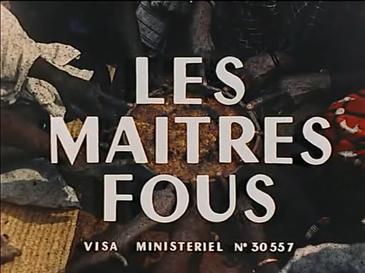

Les maîtres fous (The Mad Masters) (Jean Rouch, 1955)

The effects of colonialism are exposed in this film on indigenous Africans via specific rituals developed as a reaction to the colonial system. The film turns into a crazy elaboration on both the madness of such a political system and man himself.
Banned in Niger and British territories like Ghana, Jean Rouch’s Les maîtres fous is a docufiction about ethnology and colonialism. Rouch was himself a well known ethnologist and developed the genre ethnofiction. At the time when Rouch directed and presented his film nations were about to get free from their masters. Movements of nationalism and liberation were budding all over the world. In 1958, Niger for example gained its Independence.

Les maîtres fous presents the sect of the Haukas that initiates its participants with possessions and representations of the behaviors of their masters. In a way they try to emulate the actions of their oppressors and simulate and expiate their sufferings. As they do this afterwards the Haukas are shown working with big smiles and happiness despite the poor condition of hard work.


Another explanation of this tradition is an African interpretation of the rituals as it is a way to take their rivals power and eat it. For non-African people this interpretation seems difficult to understand but many rituals executed in Africa are old of hundreds, if not, thousands of years and are anchored deep into the collective mind of these people.

Jean Rouch with his docufiction seems to be exploiting a sensationalist behavior that gives a racist vision of colonialism. Well, let’s face it, colonialism was the act of Imperialist nations wanting to spread their culture and conquer the world with ideas, language, religion. It was also a way to get resources at almost no price with cheap labor. Sure racism has many masks but colonialism was one of them. Discarding the locals’ culture and imposing your own can’t be good for your politics and men.

But Rouch wants to show the reaction of the locals after many years of colonialism in their home land. No surprise the film was banned; it depicted without any filter the direct effects of nations on the verge of their independence living under the leaders of imperialist nations and making benefits on the hard work and land of their locals.

As a film of 36 minutes, Les maîtres fous was less disturbing that I thought it would be. It is straight to the point and narrated by Rouch himself. What’s interesting with documentaries, in this case a sixty years old one, is that it is a document depicting a slice of history very specific to a part of the world where few documents are available since history was more an oral tradition than our academic interpretation of the discipline. It is important that such short films and documentaries are preserved for generations to come to understand the past and the variety of ethnicity.


2015-03-27

The Criminal Life of Archibaldo de la Cruz


The Criminal Life of Archibaldo de la Cruz (Luis Bunuel, 1955)

The delirious journey of a mental disordered man, who is obsessed in making the perfect crime.

Another film from Luis Bunuel’s Mexican period, The Criminal Life of Archibaldo de la Cruz, works on many recurrent themes of the director’s filmography with the use of dreamt or fantasized sequences, sexual provocation and its politics, and freudian elements of childhood traumas.

As with Bunuel’s other films of this era, this is a visually interesting film with sumptuous camera movements, and an imagery of suggestive sexual elements. With its overture with the death of the governess and the revealing of her legs you have everything that you need to know about this film. The suggestion that Archibaldo de la Cruz desires death to women and links it with sexual desire. Since that movie was made in 1955 it is easily readable as the choices to suggest sexual desire and not attribute the deaths to Archibaldo was to represent a repress sexual desire but also to respect some censorship rules. In fact, the movie is much more efficient in its representation of sexuality and the imaginary criminal life of its subject.

This is a deep film in its meanings and sadly a lesser known film in the vast filmography of its director. Sure it is not as important as Los Olvidados in his Mexican period, but The Criminal Life of Archibaldo de la Cruz is essential as to its use of many surrealist elements like the mirrors and Bunuel’s foot fetish.

On my main reference list as a movie watching goal, this is the lowest ranked film in the Bunuel selection. However, this is one of the most underrated and this surpasses many titles that don’t even deserve their spot on the list. Sure it is not as celebrated as Un chien andalou or The Discreet Charm of the Bourgeoisie but I believe that once a cinephile starts digging deeper into a cinéaste he must get into the lesser known titles and discover the director’s films as a whole.

Coming soon in my Bunuel reviews; El (1952) and The Exterminating Angel both also from his Mexican period. I’ll also try to get my hands on his most virulent punch in the face of religion Simon of the Desert and the last title I’ll have to watch will be Tristana that never really interested me.

2014-08-21

Smiles of a Summer Night


Smiles of a Summer Night (Ingmar Bergman, 1955)

The lives of bourgeois lovers in Sweden during a summer of the first half of the 20th Century are inspired to let themselves live their passion. Based on a Shakespeare play, Smiles of a Summer Night was later an inspiration for Woody Allen’s A Midsummer’s Night Sex Comedy.
Interestingly enough is the fact that it is one of the few comedies that Ingmar Bergman ever directed. In interviews he often said that he was not in his element while working with this genre. However, Smiles of a Summer Night might be his more accessible work and one of the most enjoyable.

With a cast of Bergman regulars of the sexy Harriet Andersson, the ever great Gunnar Bjornstrand, and a very small bit by the beautiful Bibi Andersson. The lightness of the story and the whole tone of its debonair approach to love is refreshing and brings a sexy angle to the costume piece and the beautiful actresses in Ulla Jacobsson, Margit Carlqvist, and Ella Dahlbeck.
Speaking of actors in a Bergman film, one must say that they are directed by the hand of a master. When the chameleonic Bjornstrand is the central character in a picture we are in for a treat. It is one of the most underrated actors that worked with him and he could do anything. Simply put a beard on the man and he is the elder lawyer Egerman that married a virgin but still having a passion for the hot tempered actress he frequented as a mistress years ago.

Smiles of a Summer Night might seem like an UFO in Bergman’s filmography but his treatment of bourgeoisie and their love affairs was already a subject that he was acquainted to. There’s the thin line between keeping the face and humiliation that the men suffer all along the film and we discover again strong women in Bergman’s film that have the control over the heart of their lovers. This kind of comedy can be compared to an Ernst Lubitsch classic that could have been shot in Sweden but still carrying the same sophistication and je ne sais quoi.

As the final film I had to watch from Ingmar Bergman to complete my quest of watching all of the 1000 Greatest films of all time by www.theyshootpictures.com, I must admit having had a lot of fun and I could easily recommend this entry in Bergman’s filmography and in any list. It is a great relief when someone compare this with his other austere and heavy dramas.


2014-05-20

The Seven Year Itch


The Seven Year Itch (Billy Wilder, 1955)

This romantic comedy staring Marylin Monroe and Tom Ewell became one of the most iconic moments of Monroe’s career. The famous white dress blowing over the subway trap that unveils her legs to the audience and the male main character.

2013-12-02

Du rififi chez les hommes


Du rififi chez les hommes (Jules Dassin, 1955)

A band of French gangsters plan a heist to rob for 240 millions of francs worth of jewelries. This pretty film is regarded as widely influential on the French New Wave with its two jump cuts. It also was a clear influence on Stanley Kubrick’s The Killing and Quentin Tarantino’s Reservoir Dogs. The scene at the middle of the film setting in details the robbery was made without any dialogues and the omnipresent music of composer Georges Auric. It is rumored that the techniques pictured in Rififi was used many times by robbers from all around the world. 

2013-03-01

The Night of the Hunter

The Night of the Hunter (Charles Laughton, 1955)
This article is part of a series ofself- imposed movie reviews set in the participation of this film critic to the 1001 Movies You Must See Before You Die Club. It is an attempt at catching up the reviews that I’ve missed in my recent period of inactivity in the blogosphere.
The only directing credit of respected actor Charles Laughton, The Night of the Hunter is an uncompromised masterpiece of visual beauty, perfect acting, and sociological malaise. The choice of Robert Mitchum as the Reverend Harry Powell who preaches by marrying his former cellmate’s, Ben Harper (Peter Graves), wife Willa (Shelley Winters) and trying to get the stolen money the husband has been hanged for is perfect in this bizarre film. A difficult actor like Mitchum that had a mitigated reputation brings something that no other actor of the time would have had. His gravel voice, tire eyes, and debonaire attitude helps to add that he represents evil in an agent of God’s costume. Getting back on the plot, Powell is sure that Harper has told his children where he hid the money.

2012-12-06

All That Heaven Allows

All That Heaven Allows (Douglas Sirk, 1955)

An upper-class widow falls in love with a much younger, down-to-earth nurseryman, much to the disapproval of her children and criticism of her country club peers.

Melodrama, Technicolor, the 1950’s. Douglas Sirk! The formula is there and couldn’t get better. Remade in 1974 by Rainer Werner Fassbinder in his Ali: Fear Eats the Soul and in 2002 by Todd Haynes with his masterpiece Far From Heaven, Sirk’s All That Heaven Allows might be one of the most visually striking films that the German born director ever made. It’s a shame that I saw my first Sirk movie only two years ago, being such an enthusiast now. With recurrent lead actor Rock Hudson and Jane Wyman as a widow of the upper-middle-class who falls in love for her gardener who himself lives as a simple man living simply and growing trees. Their biggest problem is the disapproval of their relationship by Cary’s (Wyman) children and her circle of friends of the country club.

2011-10-07

Kiss Me Deadly

Kiss Me Deadly (Robert Aldrich, 1955)


Mike Hammer is a tough guy, a self-centered hard ass who’s only listening to himself and working for his own benefit only. In the vein of the great portrayals of Humphrey Bogart and Robert Ryan, the character of Hammer is greater than nature. The Film Noir elements that surrounds him seem out of place and the mystery shouldn’t be unravelled contrary to the classic film approach.

Kiss Me Deadly is the metaphor of the nuclear menace that should have been stopped before the Cold War. Hammer’s quest is unhealthy and even if the bodies are pilling around him and even the many direct warnings didn’t stop him from doing the unthinkable. He works like the mind of a mad scientist who wants to destroy the world for his own fame. The story of Kiss Me Deadly could have been completely out of synch and overly stupid but the effective and capable mise en scène of Robert Aldrich goes a long way.

Robert Aldrich’s debut film is a one of a kind Film Noir with superb visuals, a strong script, and solid performances. The inventive camera angles give the appropriate twist to the story’s twisted plot. German expressionism has always been an influence on Film Noirs but the technique used in Kiss Me Deadly is above anything seen before. Furthermore, it’s interesting to notice that Aldrich’s film became such an appraised classic that the critics of the French New Wave censed as one of the great American films of its time and that directors like Quentin Tarantino reused some elements in his earlier films, Reservoir Dogs and Pulp Fiction most notably.
One of the most important pattern in the Film Noir is the culture of the mystery. We need the tension from the journey to find the mystery. Just think of Chinatown or The Third Man without a final twist. In this case, the mystery is complete because the audience not only wants to discover the “something big and valuable” Mike Hammer is looking for but we want to know the motivations of the unsympathetic anti-hero that Hammer represents. His methods are unconventional and the viewer wants to find what motivates him to use them.
This cult film amongst cinephiles is a sure shot; I mean which film lover doesn’t like Film Noir? Plus, Aldrich’s oeuvre as underrated as it is should be revisited by many because it deserves better praise than it actually received. At least, Kiss Me Deadly received a great treatment by recently being released by the great folks of the Criterion Collection.

2011-10-03

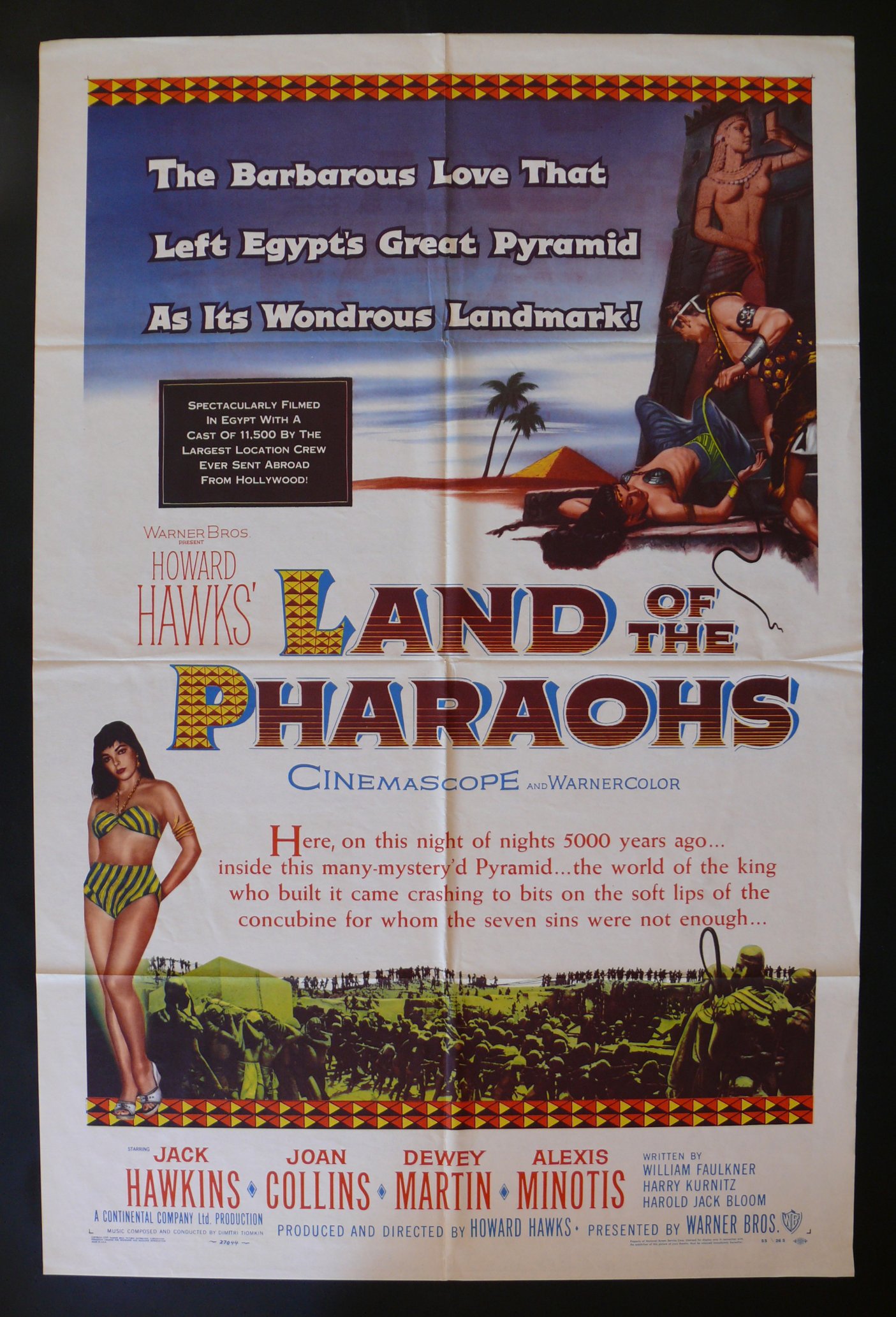
Land of The Pharaohs

Land of The Pharaohs (Howard Hawks, 1955)

One of the many films listed as Martin Scorsese's guilty pleasures, and one of the lesser films of the great Howard Hawks, Land of The Pharaohs is an epic film set in Ancient Egypt. First, I must admit that I love Hawks' latest films from Hatari! to El Dorado. His color films have this lavishtone and feeling. Second, I'm a sucker for epic movies of the 1950's. For example,  I loved Byron Haskins' The Naked Jungle. Even though if those films are considered as lesser works I just can't help it! I love those films!

Despite the many anachronisms, believe me I have a formation in History I will spare you the details, Land of The Pharaohs is a historical epic film. The grand spectacle depicting characters bigger and bolder than any other life is everything about decadence, gold, and opportunists. The overwhelming visual sets of epic proportions, the thousands of extras, the whole extravaganza of it all is the Hawksian facet of the too much. His following film was one of his greatest masterpieces, Rio Bravo, also a colored film but deeper and multilayered. Land of The Pharaohs was the only Cinemascope picture made by Hawks, and even if it feels like it is an experimentation in style, the film has these Hawksian dialogues and many sexual subtexts. It's also interesting to notice that he made a film set in Ancient Egypt times, a time where the women were well considered compared to many other times in History. It is a well known fact that Hawks was a man who loved women that stood up and could enter within the men's preoccupations. Princess Nellifer is the extension of this concept pushed on the other extreme.

Nonetheless, Land of The Pharaohs has a classic story even if Hawks inserted his own vision in the whole thing. The "auteur"'s touch is very present and as the critics of the French New Wave remarked, the Hawks presence is subtle but well felt.

The decadence of Hawks' extravaganza is more than worth a look and even if some elements may seem quirky, well it is, or cheesy, it is too, the picture is a lot of fun. A pure cinematic enjoyment full of visual beauty, read Joan Collins here, and a superb mise en scène. Its detractors must see the picture as a great entertainment piece of the sevneth art instead of the overachievement of a great director. It ain't Howard Hawks' greatest film and it is not one of his masterpieces but a very enjoyable film set in Ancient Egypt.

2011-08-01

Bride of the Monster

The following is my contribution to Forgotten Classics of Yesteryear's Monster Movie Mania Blogathon.


 Bride of the Monster (Edward D. Wood Jr., 1955)

This Science-fiction meets horror meets Monster flick extravaganza by the infamously worst director of all time, Ed Wood, tells the story of a mad scientist, played by the always frightening Bela Lugosi, who lives in a dark manor with a stupid assistant, Tor Johnsson, and a “monster”. The so-called monster is a giant octopus living in the swamp near the manor. This is also the story of a policeman who wants to find the truth about the many disappearances around the swamp and a stand-up woman on the same trail.

This film reveals a lot about how Wood worked and how he perceived Cinema and the society. The work of Ed Wood has often been criticized for his amateurism and flaws. Always perceived as the worst director of all-time, which by the way I think Michael Bay or Brett Ratner could easily hold that dishonour, Wood deserves some kind of respect because he made films the way he liked them and in his own very particular way. Like them or not he has left a name behind him and his films will stay.


First, you have the presence of the strong woman who wants to clear the mystery around the monster of the swamp. Wood emphasized those characters of stand-up women that wanted to participate in the action of the film instead of being relegated to the supporting props they are typically casted. It reminds me of how the great Howard Hawks used to cast upfront and bright women. He was one the first directors to actually use feminine characters in a very affirmative way especially when you look at His Girl Friday.

Let’s get back to Bride of the Monster, the world of Wood is very strange and some aspects of his vision are simplistic and even stereotyped. Especially the scenes with the policemen who look like stupid investigators, reading papers and bird lovers... Those characters are one dimensional. The professor is also a simple version of every professor or scientist found in our childhood perception of life. This perception of life by Wood is clearly influenced by comic books for his “mise en scène” and the kind of plot he worked with.

However, Bride of the Monster isn’t a turkey or a complete failure, within the genre it’s almost a comedy, you have action, jokes and very hilarious dialogues. Ed Wood’s film is a lot of fun and even if it’s not deep and meaningful as The Day the Earth Stood Still or The Thing From Another World it has this retro/kitsch signature of a good old Monster movie.

Bride of the Monster 

2010-12-11

Pather Panchali (1955)

Pather Panchali (Satyajit Ray, 1955)

When I discovered Pather Panchali it was the first Satyajit Ray film I've ever seen, and it was also the first Indian film I watched. I knew it was the first part of the Apu Trilogy and that it was considered as a true masterpiece. But I didn't knew that it was gonna be one of the most recognized "foreign" film. 
Its narration is very subtle and lets lots of space to the actors to actually live on the screen. I know there was a novel on which the trilogy is based but I also read somewhere that it is almost Satyajit Ray's autobiography.

Pather Panchali is the story of an Indian peasant family living with the grand mother, a son Apu and his sister. It depicts how Indians lived in the begininng of the 20th century. The discovery of modernity illustrated by the train and the fragility of life represented by the daughter's death.

The most important aspect of this filmmaking is how Satyajit Ray wants his film to be naturalistic and realistic. It possesses a documentary-like narration of objective camera and almost a non-existent plot. It depicts life itself and what is Cinema if it's not about life? Ray's films are hard to get and sometimes as Occidentals we are a little confused about what's going on the screen but for a glutton and curious cinephile like me Pather Panchali leads you in something completely different and very interesting.

2010-06-28

Lumière sur le brouillard... A reflexion on Alain Resnais' Nuit et brouillard

TSPDT Greatest Films #284 Nuit et brouillard (Alain Resnais, 1955)


The 32 minutes documentary on the jew's mass extermination by the troops of the Third Reich, directed by the French master Alain Resnais with the music of George Delerue is one of the most powerful films ever made.

A simplistic narration tells how those camps were organized and how they worked so well on their duty. Some images were shoot in 1955, ten years after the camps were closed we see the desolation of those mass murder barracks. The other images are mostly photographies and German films showing the conditions and the "life" of these microsocieties.

In 1955, Night and Fog shocked and touched its public. It was still hot in the memories of those who survived the war and the camps. Today, in 2010, these images are still touching and still means that the ghosts of totalitarism won't ever disappear.

Back when the film was made the holocaust was all about victimization of the jews and the cruelty and barbarism of the camps. 55 years later our vision must change, yes this was horrible and unforgettable. But, our perception of the holocaust should change, we have to try to understand how a nation could endorse mass murders and immorality like taking a race or a religion and trying to get rid of it by its extermination... It's ok to have compassion for the millions of lifes wasted, but I think one of the major problem of humanity is to always wanting to be right about something. There's never an absolute answer to anything and history is there to remind it to us.

As for religion, it's one of the many deep problems of humanity. I won't get onto that subject but without religious conflicts we would be in a world much more peaceful today...

Well, it's obvious that Night and Fog is a film that within only 32 munites makes us think and get onto more broader subjects than only what it brings. A must see.


A Review by Michaël Parent
Related Posts Plugin for WordPress, Blogger...