Aliens (James Cameron, 1986)
I may as well, be one of James Cameron's furiest detractors, I must admit that I had some fun way back watching True Lies and the first two Terminators. I should also say that I've never imposed to myself the torture of Titanic and Avatar, yet. I know, as a cinephile I should have seen those mainstream extravaganzas. For both, I don't really have the interest of watching them and having heard so much from them that this is sure I will get bored and predict every moment of them. But, one day, after I'll have seen all the Howard Hawks, Alfred Hitchcock, Fritz Lang, Jean-Luc Godard, and all the other filmmaker's films I have deep interest in I will have to see Cameron's movies.
2010-10-17
2010-10-13
King Kong (1933)
TSPDT Greatest Films #110 King Kong (Merian C. Cooper & Ernest B. Schoedsack, 1933)
Shadily and unecessary remade in 2005, the story of King Kong transcends time. It represents America on many levels. Like the lecture by Quentin Tarantino in the infamous scene of Inglourious Basterds. Where he highlights the connections between the story of King Kong and the story of black people slavery. This is one of the most interesting visions of Kong. Maybe one of the most accurate too...
A cast of filmmakers and explorers wants to go on a mysterious island where they can film mysterious and never seen before beasts. The filmmaker finds his lead actress in a blond Ann Darrow (Fay Wray). Once on the island, the crew discovers a giant door keeping the islanders safe from the terror of the jungle. The Americans, affraid of nothing and hungry for adventures and sensationalism cross the giant door. This is where they encounter King Kong, a giant gorilla that falls in love with Ann Darrow. The storyline is set mainly to execute fine top of the art special effects.
But many parts of the picture reflects how America sees herself in the 1930's. Its addiction for gigantism is reflected not only in the "kidnapping" of Kong but also when the poor ape climb on the phallic symbol of power of New York City; the Empire State Building. The bigger the better philosphy of America is shown here. The film expresses and reflects the complex of the rise of America as the greatest country in the world. Every nation that has become the leader in the world has done good and bad actions in its rise. In the 1930's with the popularity of American Cinema, the ending of the first World War not far (America hasn't been injured seriously in that war). The major event that has happened was the 1929 Krach of the stock market. But, still the image of America as the nation we know it was forged in those years. The gigantism complex has had its hold on the nations of all times: Ancient Egypt, Ancient Greece, Ancient Roma, etc. This is a very manly effect, like the phallic symbols, ex.: Washington Monument.
You can also find the complex of controllers of the nature, they want to empower every little bit of the Earth. But to all this there is a moral, things you can't control is love and especially nature. And King Kong is victim of his love for Ann Darrow and it's his nature that will lead him to his tragic death.
King Kong is a monument on itself and proves that without any computer animated images you can tell a story about giant apes and prehistoric monsters and do it right. Sometimes I think that filmmakers tend to put all their craft on visual effects and forget that what we really want to see is a good story and a good film. The films of the 1930's describe what Cinema trully is: good entertainment and great stories.
Shadily and unecessary remade in 2005, the story of King Kong transcends time. It represents America on many levels. Like the lecture by Quentin Tarantino in the infamous scene of Inglourious Basterds. Where he highlights the connections between the story of King Kong and the story of black people slavery. This is one of the most interesting visions of Kong. Maybe one of the most accurate too...
A cast of filmmakers and explorers wants to go on a mysterious island where they can film mysterious and never seen before beasts. The filmmaker finds his lead actress in a blond Ann Darrow (Fay Wray). Once on the island, the crew discovers a giant door keeping the islanders safe from the terror of the jungle. The Americans, affraid of nothing and hungry for adventures and sensationalism cross the giant door. This is where they encounter King Kong, a giant gorilla that falls in love with Ann Darrow. The storyline is set mainly to execute fine top of the art special effects.
But many parts of the picture reflects how America sees herself in the 1930's. Its addiction for gigantism is reflected not only in the "kidnapping" of Kong but also when the poor ape climb on the phallic symbol of power of New York City; the Empire State Building. The bigger the better philosphy of America is shown here. The film expresses and reflects the complex of the rise of America as the greatest country in the world. Every nation that has become the leader in the world has done good and bad actions in its rise. In the 1930's with the popularity of American Cinema, the ending of the first World War not far (America hasn't been injured seriously in that war). The major event that has happened was the 1929 Krach of the stock market. But, still the image of America as the nation we know it was forged in those years. The gigantism complex has had its hold on the nations of all times: Ancient Egypt, Ancient Greece, Ancient Roma, etc. This is a very manly effect, like the phallic symbols, ex.: Washington Monument.
You can also find the complex of controllers of the nature, they want to empower every little bit of the Earth. But to all this there is a moral, things you can't control is love and especially nature. And King Kong is victim of his love for Ann Darrow and it's his nature that will lead him to his tragic death.
King Kong is a monument on itself and proves that without any computer animated images you can tell a story about giant apes and prehistoric monsters and do it right. Sometimes I think that filmmakers tend to put all their craft on visual effects and forget that what we really want to see is a good story and a good film. The films of the 1930's describe what Cinema trully is: good entertainment and great stories.
2010-10-12
Donnie Darko
Donnie Darko (Richard Kelly, 2001)
Seing a film that has a big aura cult around it always has two inclinations. First, you have the urge to finally watch a film that has so much praise and love. You hear and read so much about that you are already sure to see a nice picture. Cult films, have this blind love about them, the people who defend them will love the film even if its story lacks of structure or if the film has passed the test of time. The second inclination is the fact that all this expectation and good word about a film often disappoint the viewer, like the time I show Pulp Fiction to my girlfriend. I told her so many good things about this film that she was waiting for something that she didn't saw...
Donnie Darko is in my opinion a cult succes for a good but not great film. Half way through the film I didn't knew what to think about it, but at the end when everything unravels and when every pieces of the puzzle fells into its right place I kinda liked what I saw. Even if the ending is a little too heartwhelming in my opinion I think that the bizarre parts of the story get their redemption at the end.
The way I feel about Donnie Darko is like the way I feel about Blue Velvet one of my favortie film of all-time. This is clearly a film about American suburbs and conformism and those are come of the themes aborded in Lynch's film. However, on the metaphorical and symbolism, the 1986 film surpasses by far the one of 2001. By the way, this is not a comparison between the two films because both are very different it's just their atmospheres and settings that feels the same.
Donnie Darko (Jake Gyllenhaal) is a teenager that has mental problems. He has an imaginary friend he calls Frank, that influence him on doing mischiefs. One day there is a new girl (Jena Malone as Gretchen) in town and he quickly falls in love with her. Their love is mutual, it gives him a stability in his life, but he still has his imaginary friend and it conducts him to the eve of Halloween to an event that will change the life of many people of his town forever. The story is told with intertitles that create a countdown until Halloween. But the viewer don't know what will happen on the trick or treat day. Donnie seems to know what will happen and he dares it very much. Weird and unexplained events populate this story and sometimes it just embarass the viewer that will always get a wrong track on the outcome of the plot. Taken scene by scene the story has many levels and touches many genres. The greatest scene of the film is when we have somekind of an unedited camera movement that pass on every important character of the film with only a sad song (I don't remember his name) that fits perfectly well in that scene.
On the acting side, the Gyllenhaals give good but not great performances, Jake is always over the top and his creepy look is always on the edge of being plain funny. Maggie is ok but her part is more supporting than anything else. I was surprised to see Patrick Swayze and a very good and sexy Producer Drew Barrymore (I would have taken more of her in Darko). Funny thing too a young Seth Rogen as one of the bullies...
For Donnie Darko, I had expectations and I think they were satisfied but not in the way thought they would be. I don't know why I thought Donnie Darko was a cheesier film than what I saw. I liked it but I didn't loved it. I think a second view could give me a better perspective of the whole film as an ensemble. I have to give to Richard Kelly the praise that his scenario is rich and that he knew how to distract his viewer from the way he intend to put him through.
Seing a film that has a big aura cult around it always has two inclinations. First, you have the urge to finally watch a film that has so much praise and love. You hear and read so much about that you are already sure to see a nice picture. Cult films, have this blind love about them, the people who defend them will love the film even if its story lacks of structure or if the film has passed the test of time. The second inclination is the fact that all this expectation and good word about a film often disappoint the viewer, like the time I show Pulp Fiction to my girlfriend. I told her so many good things about this film that she was waiting for something that she didn't saw...
Donnie Darko is in my opinion a cult succes for a good but not great film. Half way through the film I didn't knew what to think about it, but at the end when everything unravels and when every pieces of the puzzle fells into its right place I kinda liked what I saw. Even if the ending is a little too heartwhelming in my opinion I think that the bizarre parts of the story get their redemption at the end.
The way I feel about Donnie Darko is like the way I feel about Blue Velvet one of my favortie film of all-time. This is clearly a film about American suburbs and conformism and those are come of the themes aborded in Lynch's film. However, on the metaphorical and symbolism, the 1986 film surpasses by far the one of 2001. By the way, this is not a comparison between the two films because both are very different it's just their atmospheres and settings that feels the same.
Donnie Darko (Jake Gyllenhaal) is a teenager that has mental problems. He has an imaginary friend he calls Frank, that influence him on doing mischiefs. One day there is a new girl (Jena Malone as Gretchen) in town and he quickly falls in love with her. Their love is mutual, it gives him a stability in his life, but he still has his imaginary friend and it conducts him to the eve of Halloween to an event that will change the life of many people of his town forever. The story is told with intertitles that create a countdown until Halloween. But the viewer don't know what will happen on the trick or treat day. Donnie seems to know what will happen and he dares it very much. Weird and unexplained events populate this story and sometimes it just embarass the viewer that will always get a wrong track on the outcome of the plot. Taken scene by scene the story has many levels and touches many genres. The greatest scene of the film is when we have somekind of an unedited camera movement that pass on every important character of the film with only a sad song (I don't remember his name) that fits perfectly well in that scene.
On the acting side, the Gyllenhaals give good but not great performances, Jake is always over the top and his creepy look is always on the edge of being plain funny. Maggie is ok but her part is more supporting than anything else. I was surprised to see Patrick Swayze and a very good and sexy Producer Drew Barrymore (I would have taken more of her in Darko). Funny thing too a young Seth Rogen as one of the bullies...
For Donnie Darko, I had expectations and I think they were satisfied but not in the way thought they would be. I don't know why I thought Donnie Darko was a cheesier film than what I saw. I liked it but I didn't loved it. I think a second view could give me a better perspective of the whole film as an ensemble. I have to give to Richard Kelly the praise that his scenario is rich and that he knew how to distract his viewer from the way he intend to put him through.
2010-10-11
Howl's Moving Castle
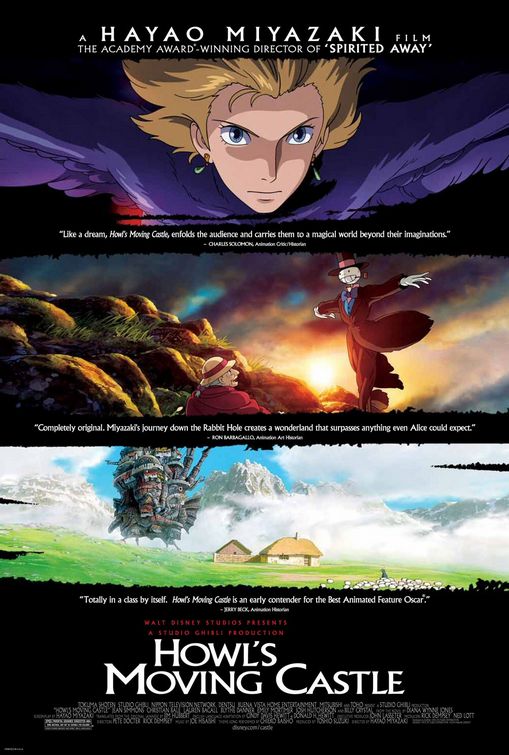
Howl's Moving Castle (Hayao Miyazaki, 2004)
Not being a fan of mangas at the first place didn't tend me to discover the work of Asian animation. Having only seen Hayao Miyazaki's Alice in Wonderland inspired Spirited Away in the context of my journey through the 1000 Greatest Films of They Shoot Pictures Don't They?. I liked Spirited Away but I wasn't blown away by it. Since I decided to make parallel quests to the "1000GF TSPDT" I wanted to explore the 35+/- films I haven't seen yet voted by the users of IMDb. There are more than one Animation listed there, especially the ones from Miyazaki: Spirited Away, My Neighbor Totoro , Princess Mononoke and Howl's Moving Castle. So the later one was the first I decided to watch, well the plot seemed the most interesting and I had to start somewhere I guess.
The story: a young woman, Sofi is a hat tailor that works hard for the factory of his deceased father. One day she meets a strange but attracting sorcerer. But later that night, a witch put a spell on her and she pass from 18 to 70 years old. But she must not tell anyone. The next day she quits the town and embarks on a journey on the moving castle of the sorcerer Hauru. Helped with a scarecrow, a demon fire named Calcifer, and a little boy Markl.
As we are in an animation film, I must say that Miyazaki's visuals are very colored and candy for the eye. The colors are saturated and the contrast are strong in the colors. I kind of find them very cheesy and maybe too poppy... I'd like to see a darker palette but Asian animation is all about blazing colors. However, with that aside some of the visuals are stunning and they fit perfectly well with that kind of fantastic story.
I would have loved Howl's Moving Castle as a child, because I was very entertained by stories that take the character from its normal human life and change it drastically into some "crazy" but lovable universe. It's like when I was reading comic books as a child I always liked how a story can take you anywhere in a world completely different from our reality. And I think that is well executed with Howl's Moving Castle and it changes from the lately vast offering of animation movies that just don't have the same hold onto their stories and constantly use the same patterns over and over again.
Not being a fan of mangas at the first place didn't tend me to discover the work of Asian animation. Having only seen Hayao Miyazaki's Alice in Wonderland inspired Spirited Away in the context of my journey through the 1000 Greatest Films of They Shoot Pictures Don't They?. I liked Spirited Away but I wasn't blown away by it. Since I decided to make parallel quests to the "1000GF TSPDT" I wanted to explore the 35+/- films I haven't seen yet voted by the users of IMDb. There are more than one Animation listed there, especially the ones from Miyazaki: Spirited Away, My Neighbor Totoro , Princess Mononoke and Howl's Moving Castle. So the later one was the first I decided to watch, well the plot seemed the most interesting and I had to start somewhere I guess.
The story: a young woman, Sofi is a hat tailor that works hard for the factory of his deceased father. One day she meets a strange but attracting sorcerer. But later that night, a witch put a spell on her and she pass from 18 to 70 years old. But she must not tell anyone. The next day she quits the town and embarks on a journey on the moving castle of the sorcerer Hauru. Helped with a scarecrow, a demon fire named Calcifer, and a little boy Markl.
As we are in an animation film, I must say that Miyazaki's visuals are very colored and candy for the eye. The colors are saturated and the contrast are strong in the colors. I kind of find them very cheesy and maybe too poppy... I'd like to see a darker palette but Asian animation is all about blazing colors. However, with that aside some of the visuals are stunning and they fit perfectly well with that kind of fantastic story.
I would have loved Howl's Moving Castle as a child, because I was very entertained by stories that take the character from its normal human life and change it drastically into some "crazy" but lovable universe. It's like when I was reading comic books as a child I always liked how a story can take you anywhere in a world completely different from our reality. And I think that is well executed with Howl's Moving Castle and it changes from the lately vast offering of animation movies that just don't have the same hold onto their stories and constantly use the same patterns over and over again.
2010-10-10
Prénom Carmen (1983)
Prénom Carmen (Jean-Luc Godard, 1983)
Personnally adapted from the opera Carmen, Prénom Carmen (First Name: Carmen) tells the story of a young woman, Carmen (Maruschka Detmers), who participate in many robberies with a group that ressembles of a group of rebels or mercenaries. When in an assault to rob a bank she promply falls in love with of the guards; Joseph (Jacques Bonnaffé). To live their lives together they must escape and they go hide outside of Paris at her internate uncle's (Jean-Luc Godard) house. But with the time passing by, their passion changes and their relationship becames a Love/Hate one. Carmen will betray Joseph and exclude him from all the plans of her group of robbers.
The many scenes including the two lovers remembers Carl Th.Dreyer's Gertrud, the two characters take still poses that reflects the evolution of the relationship. It reveals how the film should be read and how Godard was thinking it too. In 1983, Godard was more than in complete possession of his Art, he was Cinema. Every frame and every editing of Prénom Carmen is dense and full of meanings. Godard's mastery, editing, is fully exploited here and many scenes are sliced up so well with the concertos intermissions and the many changes of scenery.
Prénom Carmen is the kind of film you let yourself immerse into it. However, it's also the kind you must watch again and rewatch again, because the many meanings and levels of the story just gets better everytime. One last thing, the copy of Prénom Carmen I had in hand was not in the ultimate condition, but I had a recommendation of the 3-discs Jean-Luc Godard Boxset from Lions Gate. It comes with Détective and Passion two other notable 1980's films from Godard.
2010-10-09
Suddenly (1954)
Suddenly (Lewis Allen, 1954)
Film noir is one of my favorite genre, some will say it's not even a genre because their creators were not aware of making them at the time. They were making thriller/cop/betrayal and mostly B-Movies.
Suddenly directed by Lewis Allen with Frank Sinatra and Sterling Hayden. The story is, Tod (Hayden) a cop is in love with the single mother widow Ellen Benson (Nancy Gates) living with the father of her later husband. They live in the town called Suddenly aka Anytown USA, where the President is supposed to stop with the five o'clock train. In the history of the Town it's the most important event it never happened. A visit by the President includes strong security measures and many precautions. The CIA is there and prepares the "secret" coming of the President. But veteran John Baron (Sinatra), has other plans...
The synopsys of Suddenly won't be detailed muchmore because there are many twists in the plot. The tension is palpable and the action is well executed. Sometimes the acting is way too far but from a film of the 1950's we can forget this flaw and adjust to it. It keeps the viewer on the edge of his seat and it makes Suddenly a very good effort from a good but not great director. Meanwhile, Lewis Allen was a Key Noir filmmaker and his other films are worth a look. Suddenly is far from being a masterpiece but it has its strenght and it delivers!
Film noir is one of my favorite genre, some will say it's not even a genre because their creators were not aware of making them at the time. They were making thriller/cop/betrayal and mostly B-Movies.
Suddenly directed by Lewis Allen with Frank Sinatra and Sterling Hayden. The story is, Tod (Hayden) a cop is in love with the single mother widow Ellen Benson (Nancy Gates) living with the father of her later husband. They live in the town called Suddenly aka Anytown USA, where the President is supposed to stop with the five o'clock train. In the history of the Town it's the most important event it never happened. A visit by the President includes strong security measures and many precautions. The CIA is there and prepares the "secret" coming of the President. But veteran John Baron (Sinatra), has other plans...
The synopsys of Suddenly won't be detailed muchmore because there are many twists in the plot. The tension is palpable and the action is well executed. Sometimes the acting is way too far but from a film of the 1950's we can forget this flaw and adjust to it. It keeps the viewer on the edge of his seat and it makes Suddenly a very good effort from a good but not great director. Meanwhile, Lewis Allen was a Key Noir filmmaker and his other films are worth a look. Suddenly is far from being a masterpiece but it has its strenght and it delivers!
2010-10-08
High and Low
High and Low (Akira Kurosawa, 1963)
An executive of a shoe company becomes a victim of extortion when his chauffeur's son is kidnapped and held for ransom.
2010-10-06
Sauve qui peut (la vie)
Sauve qui peut (la vie) (Jean-Luc Godard, 1980)
Since a month or so I've been discovering the films of Jean-Luc Godard. I have known his most notable work since ten years or so. Like many I watched À bout de souffle as an introduction to his work, after I've seen his most Hollywoodian film; Le Mépris/Contempt. Then I felt in love again with his work while watching Pierrot le fou and shortly after Week-End. But apart those widely known films, one cinephile must see all of his films. Why? you must ask! Watch them and then you'll answer to that question, because I haven't seen them all yet...
Godard is one of the most prolific director of all time touching and influencing so many filmmakers, artists, critics and people. Without him the seventh art wouldn't be the same! He dared to break barriers where there were and to put some where there weren't. He imposed many obstacles just to make himself be better and better. Even if the public didn't always responded positively to his films, the fan base was there and everywhere on the planet he started New Waves of Cinema; Tchekoslovakia, Brasil, America, Quebec, etc.
In the 1980's he was more of a low-profile "cineaste" and the spotlight was no longer his friend. This break came approximately in the events of the year of May 68. He choose to stay away from the system that has risen him as a star.
His 1980 film, Sauve qui peut (la vie), is three persons' lives and relationships, there is Mr. Godard (Dutronc) a filmmaker, Isabelle (Huppert) a prostitute, and Denise Rimbaud (Baye) a film editor who wants to have some fresh air and goes on a vacation. Many Godardian themes are exploited here and especially with the story of Isabelle he tackles this "profession" once again. The film is a pretext to study the different sexual relations that exist between humans and how they are the last reflexion of who and how someone behave and really is. Sexuality is for many the last step where the masks of our controlled conformist society are forgotten. Godard in a vile way shows how people are adept of degradant sexual habits and how he perceives the majority of the population has empty sexual relationships.
Apart from being completely contempting, Sauve qui peut (la vie) is far from being a total waste of time. It hits hard but it is very up to date with the discussions on how teenagers are oversexualized and how sex is available at one click from Google and how people still have major couples problems because of their failure to communicate and/or infidelities, etc. The propos of Sauve qui peut (la vie) is very deep and I will certainly read more about it to complete this review with more knowledge and a more profound analysis of its themes.

Since a month or so I've been discovering the films of Jean-Luc Godard. I have known his most notable work since ten years or so. Like many I watched À bout de souffle as an introduction to his work, after I've seen his most Hollywoodian film; Le Mépris/Contempt. Then I felt in love again with his work while watching Pierrot le fou and shortly after Week-End. But apart those widely known films, one cinephile must see all of his films. Why? you must ask! Watch them and then you'll answer to that question, because I haven't seen them all yet...
Godard is one of the most prolific director of all time touching and influencing so many filmmakers, artists, critics and people. Without him the seventh art wouldn't be the same! He dared to break barriers where there were and to put some where there weren't. He imposed many obstacles just to make himself be better and better. Even if the public didn't always responded positively to his films, the fan base was there and everywhere on the planet he started New Waves of Cinema; Tchekoslovakia, Brasil, America, Quebec, etc.
In the 1980's he was more of a low-profile "cineaste" and the spotlight was no longer his friend. This break came approximately in the events of the year of May 68. He choose to stay away from the system that has risen him as a star.
His 1980 film, Sauve qui peut (la vie), is three persons' lives and relationships, there is Mr. Godard (Dutronc) a filmmaker, Isabelle (Huppert) a prostitute, and Denise Rimbaud (Baye) a film editor who wants to have some fresh air and goes on a vacation. Many Godardian themes are exploited here and especially with the story of Isabelle he tackles this "profession" once again. The film is a pretext to study the different sexual relations that exist between humans and how they are the last reflexion of who and how someone behave and really is. Sexuality is for many the last step where the masks of our controlled conformist society are forgotten. Godard in a vile way shows how people are adept of degradant sexual habits and how he perceives the majority of the population has empty sexual relationships.
Apart from being completely contempting, Sauve qui peut (la vie) is far from being a total waste of time. It hits hard but it is very up to date with the discussions on how teenagers are oversexualized and how sex is available at one click from Google and how people still have major couples problems because of their failure to communicate and/or infidelities, etc. The propos of Sauve qui peut (la vie) is very deep and I will certainly read more about it to complete this review with more knowledge and a more profound analysis of its themes.
2010-10-05
Pi
Pi (Darren Aronofsky, 1998)
Widely inspired by David Lynch's first feature/masterpiece, Eraserhead, Darren Aronofsky's Pi is a multi-layered black and white nightmare. After having been blast away by his The Wrestler, stunned by his Requiem For A Dream I don't know how to handle Pi. I may be need to see his The Fountain to fully apreciate and understand the complexity and real/unreal meaning of is 1998 debut.
The story; a mathematician wants to resolve an equation that will solve the logic behind the stock market and behind everything in the universe. We follow this dense and weird path of this strange character, his relations with his neighbors, his sponsors, a sect of Jews and some ants.
I warn you this is an uncommon and uneasy film, but with multiple viewings the quality of what it has to present just gets deeper and deeper. Just like Lynch's Eraserhead, it is destined to be a cult classic film.
Looking forward to the december release of Black Swan I wanted to catch up on the work of one of the most promising directors of the 21st century with the viewing of Pi. I recommend this film to open minded cinephiles only which I am but nonetheless I prefered his The Wrestler and his Requiem For A Dream way more than his Pi.
Widely inspired by David Lynch's first feature/masterpiece, Eraserhead, Darren Aronofsky's Pi is a multi-layered black and white nightmare. After having been blast away by his The Wrestler, stunned by his Requiem For A Dream I don't know how to handle Pi. I may be need to see his The Fountain to fully apreciate and understand the complexity and real/unreal meaning of is 1998 debut.
The story; a mathematician wants to resolve an equation that will solve the logic behind the stock market and behind everything in the universe. We follow this dense and weird path of this strange character, his relations with his neighbors, his sponsors, a sect of Jews and some ants.
I warn you this is an uncommon and uneasy film, but with multiple viewings the quality of what it has to present just gets deeper and deeper. Just like Lynch's Eraserhead, it is destined to be a cult classic film.
Looking forward to the december release of Black Swan I wanted to catch up on the work of one of the most promising directors of the 21st century with the viewing of Pi. I recommend this film to open minded cinephiles only which I am but nonetheless I prefered his The Wrestler and his Requiem For A Dream way more than his Pi.
2010-10-04
Five Easy Pieces
Five Easy Pieces (Bob Rafelson, 1970)
Of that group of filmmakers, actors, producers Jack Nicholson was one of the center actor. He wrote and acted in many films now classics of that era. On his side Bob Rafelson was mainly a producer and his most known and successful film is Five Easy Pieces. Sadly, for his directorial career Rafelson was a cocaine addict and it took all of his credibility apart from him.
Five Easy Pieces is the story of a musician from a wealthy family who has to work on oil-rigs away from the family he left. One day he learns that his father is very ill and decides to move back to make peace with the ones he abandoned. His existence is rhythmed by his excess of wrath, frustration and his impulsions. On the "mise en scène" I had a feeling like if I was watching a 1970's Ingmar Bergman film made in the US. Something like Autumn Sonata I guess. The colors have a brownish feel and the natural lighting gives to the story a "true" touch to it. Unlike many American films Five Easy Pieces has that gloss of real humans that can act like you and me and do good as to do bad. There's nothing black or white here and it gives somewhat a good vibe to the entire film.
The major flaws are that the film feels outdated and amateurish at moments. There are many errors of continuity and some takes give evidence of poor editing.
On the other side, Nicholson's acting elevates the quality of the film and once again he is on the top of his game.
Five Easy Pieces is a very good film from one of the most crucial eras of American filmmaking.
Subscribe to:
Posts (Atom)