Showing posts with label john ford. Show all posts

2016-09-14

How Green Was My Valley

Editor’s note : this review is a translation of one of the first reviews to ever appear on this blog back in 2009. Those were less than a 150 words long and were written immediately after the viewing of each film. This is as aforementioned a translation and a longer edit of this original film review.

How Green Was My Valley (John Ford, 1941)
At the turn of the century in a Welsh mining village, the Morgans, he stern, she gentle, raise coal-mining sons and hope their youngest will find a better life.

Oft maligned as the greatest steal of all time at the Academy Awards, wining Best Picture and Best Director over Orson WellesCitizen Kane, John Ford’s How Green Was My Valley, that was supposed to be William Wyler’s film, is part of one of the most prolific era of Ford’s career. Along Stagecoach, The Long Voyage Home, Young Mr. Lincoln, The Grapes of Wrath, Tobacco Road, and Drums Along the Mohawk were all made between the time span of 1939 and 1941. This is almost as many films as Stanley Kubrick did in his entire career. Joking aside, Ford’s How Green Was My Valley is quite unique and personal in his career.

2015-12-07

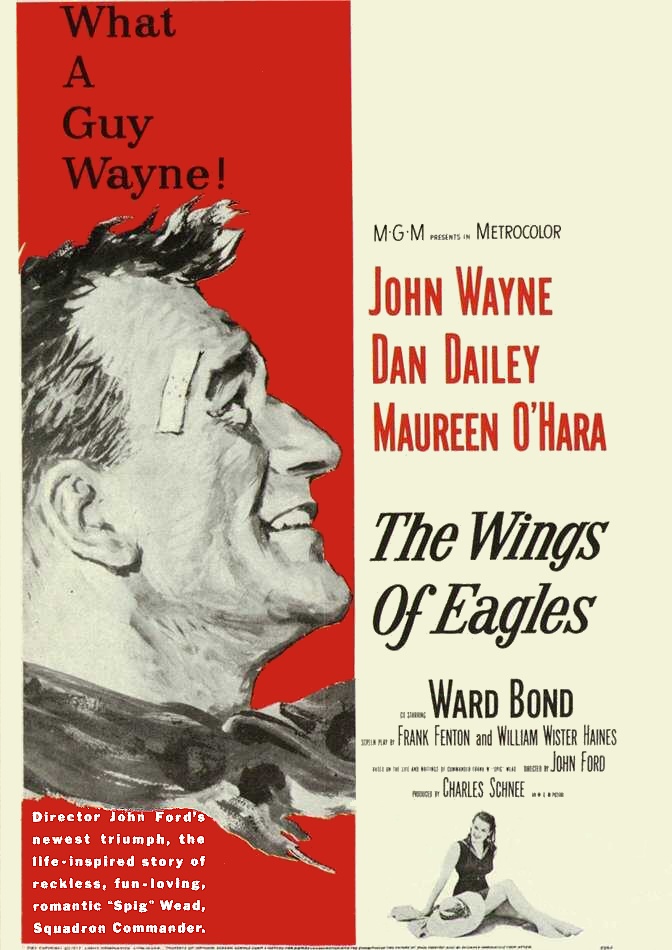
The Wings of Eagles

This post is part of the “Try It, You’ll Like It!” Blogathon, hosted by Sister Celluloid and Movies Silently, where we write about “gateway films” that might bring non-classic-film lovers into the fold!

The Wings of Eagles (John Ford, 1957)

A biography of Navy flier-turned-screenwriter Frank W. "Spig" Wead.

In the shitload of films John Ford and John Wayne made together, most of them were Westerns and this is mostly what the collaboration between the two men is now remembered. However, they also made many war films like They Were Expendable. The writer of this feature film was Frank Wead a retired Army man also a friend of John Wayne. So ten years after the death of Wead in 1947, Ford and Wayne made an homage to the once pilot and screenwriter with a movie based on his life.

2014-07-12

7 Women

Note: this review is a contribution to the John Ford Blogathon hosted by the great folks over at Krell Laboratories and Bemused and Nonplussed.


7 Women (John Ford, 1966)

Of the bunch of John Ford films that I've seen, a total of sixteen, I tend to prefer the tone of his non-Westerns because it takes him out of his "comfort zone" of the American myth and get him into the world of the likes of Tom Joad, Ireland, and in this case Northern China. Ford's final film to the silver screen was 7 Women, a lesser known entry in his oeuvre that was much more celebrated in Europe especially in France with Les Cahiers du Cinema highly praising it and its auteur. While being a catastrophic commercial and critical event in North America it forced him to retire from film making.

This being his last picture in 1966, the Film industry was on the eve of one of its greatest revolutions with the coming of Bonnie and Clyde, Easy Riders, and the revitalization of the 1970's that let much more space for the director as the creative force of the movie they are directing. One could say that it was a more European approach to the seventh art. But I digress, Ford was working with smaller budgets and less freedom over his work during the shooting of his last films. 
However he managed to have a script that was carrying many elements that were dear to him when telling a story. The Catholic mission being the setting of the story, the dedication to a moral duty by the women, the hard headed Dr. Cartwright (Anne Bancroft) that represents contrarity in this balanced world by the strong and very strict Agatha Andrews (Margaret Leighton), the head of the mission, the younger of the women, Emma (Sue Lyon), looking for a role model and flinching between the two "mothers" aforementioned. Are the most forefront characters of this almost entirely female cast. Except for Charles Pether (Eddie Albert) the mission teacher that dreamed to be a reverend and that brought along his middle aged pregnant wife in this far country.

Much like his position on racism that he tries to finally solve with Cheyenne Autumn, 7 Women seems to be his redemption with his projection of the Woman in society. While in his Westerns they are more related to supporting roles. With this film, he makes them the stars of his swan song. This is almost unexpected but also very revealing of the aging master's late redemption with his earlier detractors.

The film has this Fordian dilemma between moral values and moral dedication, it also shows much like The Man Who Shot Liberty Valance how words don't compensate for actions. He also believes in the theory of every one's role in a closeted society. 

When talking about Catholicism, there's a great debate about the level of sacrifice and how one must sin to achieve to help others. No human is a Saint until he dies. This is illustrated in many ways by the most human characters of the movie but also the negative aspects of the purist spirit that put into the action are completely wasted. 

This is an intriguing and also quite enjoyable entry into Ford's filmography even if more than far from his habitual films. The presence of The Graduate's Mrs. Robinson (Anne Bancroft) and Lolita's Lolita (Sue Lyon) also brings an interesting aspect because they were actress not remembered for many roles. 
This might appeal more to John Ford enthusiasts, sure because its unique but also because it brings an important aspect of the director and the man sitting in this chair.

2014-03-24

Young Mr. Lincoln


Young Mr. Lincoln (John Ford, 1939)

A family traveling through New Salem, Illinois in their wagon need groceries from Lincoln's store and the only thing of value they have is a barrel of old books including a law book, "Blackstone's Commentaries." After thoroughly reading the book, Abe (Henry Fonda) opts for the law after receiving encouragement from his early, ill-fated love, Ann Rutledge (Pauline Moore).

2013-11-27

Two Rode Together


Two Rode Together (John Ford, 1961)

Marshal McCabe (James Stewart) and First Lt. Jim Gary (Richard Widmark) are hired to bring back siblings and parents that have been kidnapped by the Comanches many years ago. They will meet Chief Quanach Parker (Henry Brandon) and make a trade for a young boy and the Squaw (Linda Cristal) of Stone Calf (Woody Strode). 

2012-11-08

The Quiet Man


The Quiet Man (John Ford, 1952)

A retired American boxer returns to the village where he was born in Ireland, where he finds love.

The most celebrated director of all time, John Ford, had to find a studio ready to finance the project he cherished the most: The Quiet Man. Having to direct a box office sure shot in 1950, Rio Grande for Republic Pictures, Ford brought his casts of regulars (John Wayne, Maureen O’Hara, Ward Bond, Victor McLaglen, Francis Ford) in Ireland the land of his ancestors. Shot in a sheer Technicolor giving to O’Hara’s red hairs a beautiful look and letting the wonderful sceneries of Ireland execute its charm on the screen.

Coming from America, Sean Thornton (Wayne) is an ex-Boxer with a secret wants to buy back the house where he was born. It doesn’t take much time for him to fall in love with soon enemy Red Danaher’s(McLaglen) sister Mary Kate (O’Hara), his neighbours. Since, he left America to turn his back on boxing he decided to be a passive man and let the violence away from his life. However, his marriage with Mary Kate will suffer from this way of thinking.

Ford realizes his dream film filled with many personal elements, the tone set between the visual comedy, the melodrama, and the Fordian film isn’t always very clear. Ford is an Irishman and being able to go back his roots in a film like he did with How Green Was My Valley was in some level his way to attain heaven just like Thornton says in the first half of the film. His vision of a small community, Catholicism, fighting Irishmen, drunk men, and many other elements already omnipresent in his films are fully exposed as the epicentre of the movie. And the theme of the man who must understand and pass over his own pride to be able to fully achieve himself just like Wayne’s character in The Searchers is pretty obvious too.

A surprise is the aesthetic flashback of boxing that probably inspired Martin Scorsese for his Raging Bull. Even if there are moments of pure bliss in The Quiet Man, it is an uneven movie that entertains and also still connect with Irish people but that lacks the lustre of the aforementioned The Searchers. A final comment would be to paraphrase Martin Scorsese and Richard Schickel on the fact that there is too much Irishmen drinking and fighting in this film that cannot be considered a comedy or a melodrama completely. Recommended but not a must see even if it a film that has been praised for sixty years.


2012-05-30

The Searchers - Fake Poster and Criterion Cover


As every film geek out there, I am in complete admiration with the Criterion Collection releases and the cover of their juicefully packed DVD/Blu-rays. So as a tribute and/or homage here is my first attempt at a Fake Criterion cover.

2012-03-17

The 15 greatest Alter egos in the History of Cinema

John Ford and John Wayne
One of the most successful association in movie History. The two John made their trademarks as Western filmmakers and a few War films. This is one of the reasons why they are on this prestigious list. And a film list is not a real film list if there are no mention of John Ford or John Wayne. Come on!

Films together: Stagecoach (1939) The Long Voyage Home (1940) They Were Expendable (1945) Fort Apache (1948) 3 Godfathers (1948) She Wore a Yellow Ribbon (1949) Rio Grande (1950) The Quiet Man (1952) The Searchers (1956) The Man Who Shot Liberty Valance (1962)


Akira Kurosawa and Toshiro Mifune
Kurosawa and Mifune might have been the best ambassadors of their country in the world especially with the spread of the Samurai genre. Interesting fact: Kurosawa wanted to make Samurai films like John Ford did Westerns. If you ask me he made himself clear that he is the John Ford of Japan.

Films together: Drunken Angel (1948) Stray Dog (1949) Rashomon (1950) The Idiot (1951) The Seven Samurai (1954) Throne of Blood (1957) The Lower Depths (1957) The Hidden Fortress (1958) The Bad Sleep Well (1960) Yojimbo (1961) Sanjuro (1962) High and Low (1963) Red Beard (1965)


Michel Hazanavicius and Jean Dujardin
The most hip duo since the buzz around The Artist that began at the Cannes Film Festival last May and that culminated with the crowning of The Artist, Hazanavicius, and Dujardin at the Oscars. It is interesting to discover that it is far from being the first collaboration of the two Frenchmen.

Films together: OSS 117: Le Caire nid d'espions (2006) OSS 117: Rio ne répond plus (2009) The Artist (2011)


Federico Fellini and Marcello Mastroianni
This might not the most popular choice here but with only 8 1/2 Mastroianni impersonated the great Fellini and give one of the greatest performances ever shot on film.

Films together: La Dolce vita (1960) 8 1/2 (1963) City of Women (1980)


Tim Burton and Johnny Depp
The most obvious choice for contemporary film buffs. Those two have made it clear that they like to work together with their upcoming The Dark Shadows.

Films together: Edward Scissorhands (1990) Ed Wood (1994) Sleepy Hollow (1999) Charlie and the Chocolate Factory (2005) Corpse Bride (2005) Sweeney Todd: The Demon Barber of Fleet Street (2007)


Steve McQueen and Michael Fassbender
I've just discovered Hunger lately and it is a revelation to me. Fassbender gives great performances one after another but his pairings with McQueen are tremendous.

Films together: Hunger (2008) Shame (2011)


Alfred Hitchcock and James Stewart
Of the many leading man Hitchcock had in his films, Stewart is most common man and easy to relate to actor that worked with him. I could have gone with Cary Grant but Stewart stars in my favorite Hitchcocks.

Films togeter: Rope (1948) Rear Window (1954) The Man Who Knew Too Much (1956) Vertigo (1958)


F.W. Murnau and Emil Jannings
German Cinema of the pre-Second World War would never have been the same without those two greats.

Films together: The Last Laugh (1924) Faust (1926) Tartuffe (1926)


Martin Scorsese and Robert De Niro
Do I really need to explain myself here? There is no one single film they made together that I wouldn't watch right away. They embrace the definition of alter egos and I hope that some day they find some time to make another film together something like a last goodbye or even a documentary/interview with fragments of their films together, thoughts etc.

Films together: Mean Streets (1973) Taxi Driver (1976) New York, New York (1977) Raging Bull (1980) The King of Comedy (1983) Goodfellas (1990) Cape Fear (1991) Casino (1995)


John Huston and Humphrey Bogart
Bogie had such a presence in films that Huston exploited like no other director, except Howard Hawks and Nicholas Ray maybe, with his raw personality and created a kind of character just for Bogis with the creation of the Film Noir in The Maltese Falcon.

Films together: The Maltese Falcon (1941) The Treasure of the Sierra Madre (1948) Key Largo (1948) The African Queen (1951) Beat the Devil (1954)


David Fincher and Brad Pitt
Fincher is slowly becoming one of the most respected filmmakers today, their first two collaborations are already considered as classics for contemporary film enthusiasts.

Films together: Se7en (1995) Fight Club (1999) The Curious Case of Benjamin Button (2008)


Werner Herzog and Klaus Kinski
The most destructive duo of this list, just watch Herzog's documentary My Best Fiend about Kinski to fully understand their insane relationaship. It is almost unbelivable that they made more than one film together.

Films together: Aguirre: The Wrath of God (1972) Stroszek (1977)  Nosferatu the Vampyre (1979) Fitzcarraldo (1982) Cobra Verde (1987) My Best Fiend (1992)


Ingmar Bergman and Erland Josephson
With the recent lost of Josephson the World of Cinema lost one of the most talented actors. He worked on twelve films with Ingmar Bergman and always gave tremendous performances. Everytime I see Josephson on the screen I immediately connect him with Bergman. Especially with Scenes of A Marriage that contains many Bergman moments almost autobiographical.

Films together: It Rains on Our Love (1946) Brink of Life (1958) Hour of the Wolf (1968) The Passion of Anna (1969) Cries and Whispers (1972) Scenes of A Marriage (1973) Face to Face (1976) Autumn Sonata (1978) Fanny and Alexander (1982) After the Rehearsal (1984) In the Presence of A Clown (1997) Saraband (2003)


Jean Renoir and Jean Gabin
One of the greatest master of Cinema, Jean Renoir, collaborated with Jean Gabin on four films but they represented the Frenchmen for the World. La Grande Illusion and La Bête Humaine brought both to international recognition.

Films together: The Lower Depths (1936) La Grande Illusion (1937) La Bête Humaine (1938) French Cancan (1954)


Christopher Nolan and Christian Bale
Probably the most popular alter ego in the world of Cinema right now with The Dark Knight Rises coming in theatres this summer. All their films together have immense success at the Box Office as with the critics. Let,s hope they did as they usually do with the new Batman; a superb job.

Films together: Batman Begins (2005) The Prestige (2006) The Dark Knight (2008)

2011-12-23

Rio Grande

Rio Grande (John Ford, 1950)

Of the cavalry trilogy made by John Ford and John Wayne together, Rio Grande (the other two films being She Wore A Yellow Ribbon and Fort Apache) might be the deepest in meanings and one of Ford's most beautiful black and white pictures.

Rio Grande depicts family values, social effort, and the common all-American priciples that a good old John Ford film should bring on the screen.

I usually admire Ford's Westerns and I really enjoyed the two other installements of this trilogy. However, there was something that just didn't do it for me with Rio Grande. I was probably not in the mood for this kind of movie when I watched it. I should get back to this one some time later and do a triple bill of the whole cavalry concept and a good review of the film. I apologized for this lack of consistency here.

2011-03-31

Top films of John Ford by LMdC


The ultimate American director of all time. His realism and his understanding of the American pathos and how its society must relies on true hearted values made this grit character a really sentimental man below his common man peel. Like Orson Welles once said, John Ford is the poet of American Cinema his simple prose and his almost transparent aesthetic made his better films so true you could think you were watching true events. A legend in filmmaking History.

1. The Man Who Shot Liberty Valance
2. The Searchers
3. The Grapes of Wrath
4. She Wore A Yellow Ribbon
5. My Darling Clementine
6. Stagecoach
7. Two Rode Together

8. Fort Apache
9. Young Mr. Lincoln

10. The Long Voyage Home
11. Drums Along the Mohawk
12. How Green Was My Valley
13. They Were Expandable


Sadly, those are the only John Ford films I had the chance to see, so keep around because this Top will get updated when my viewings evolve.

2011-03-16

The Long Voyage Home

The Long Voyage Home (John Ford, 1940)


Of the many John Ford films reviewed here, The Long Voyage Home is probably the most underrated so far. This masterpiece from Ford's most prolific period (The Grapes of Wrath, Stagecoach, Young Mr. Lincoln, Drums Along the Mohawk, How Green Was My Valley) diserves a better place in his career as in film History.

During the Second World War, the American navy was often represented in the films of John Ford. This is the kind of subject he loved to work with: His archetypal ensemble character plot could fit perfectly in the micro society of ship's crew. This ensemble cast will represent a social group that must work as a united team or a family where everyone as to behave and work hard with their strength to reach greater will. The crew of the ship illustrate this concept.

The visual side of the film was assured by the mastery camera work of cinematographer Gregg Toland, who is notorious for his work on Citizen Kane. His vision made The Long Voyage Home very unique in its visual beauty. The uses of low camera angles, dark lighting, and inventive framing that all characterized Citizen Kane and even the famous sealings are present inside of the boat. I'm not trying to say that Citizen Kane wasn't as inventive as a André Bazin could have wrote but Orson Welles himself always said that you're never the first to do something... Here Gregg Toland may or may not be the first to use all these new techniques but he sure was one of the few who mastered them that well. Clearly, Toland weas probably influenced by the films of the German expressionists like Murnau's silent films. Toland's work may have influenced the way film noirs were shot in the 1940's and in the 1950's. Many film historians will brag that Citizen Kane was probably the first film noir if not the major influence with all its particular style.

However, let's get back to The Long Voyage Home, of the more than a hundred feature films John Ford directed many are considered as untouchable masterpieces, The Searchers, Stagecoach, The Grapes of Wrath, Rio Grande, etc. But you don't often see The Long Voyage Home on his best films list. This is a little known film that diserves its place amongst the best of his greater films. A gem amongst one of the greatest careers of this Hollywood director.

Coming soon my personal Top 10 of John Ford's films!

Until then please read my other Ford's films reviews:

How Green Was My Valley (1941) *in french only*
They Were Expendable (1945)
Fort Apache (1948)
She Wore A Yellow Ribbon (1949)

2010-12-09

Fort Apache (1948)

TSPDT Greatest Films #920 Fort Apache (John Ford, 1948)


The first chapter of John Ford's heroic trilogy on the American cavalry, Fort Apache represents everything about a classic Fordian offering. With his two favorite lead players; guy next door Henry Fonda and the ultimate American father; John Wayne. It's very interesting to see a film where Henry Fonda portrays the antagonist. Once Upon A Time In the West is probably his most famous performance as a bad guy. In a Ford picture, supporting roles are very important, here you have Shirley Temple as Colonel Thursday's daughter Philadelphia, and many Ford regulars like Pedro Armendariz, Ward Bond, and John Agar to name a few. These roles played by regular Ford players are important because they all have a very distinctive mission in the community that cavalry reprensents. The community and the strenght of the people together is the central theme of John Ford's entire oeuvre. The cavalry itself represents this concept and its success relates on the bond, the gentleness of the entire group and the order of this fellowship.

The new Colonel Owen Thursday (Henry Fonda) is sent to Fort Apache to reinstore peace with the tribes living on the reserva near the border of Mexico. He is dreading this assignment and on his way there he says to his daughter that the War in Europa was more interesting. This stubborn character is fueled by a thirst of military honour. His arrival marks the interruption of a dancing night (recurring Fordian mise-en-scène sign of civilized community) illustring his inability to have human relationships and to represent, the strict but, comprehensive leading "father" figure this group diserves. His hate towards this assignment leads him to demand "strictness of military procedure that the men have never found necessary" (Robert Kolker, A Cinema of Loneliness).

The second dance of the film is a long musical sequence that serves the narrative of the film in many ways. First, it holds our breath on the return of Captain York from his encounter with the Indian chief. But also, the evolution of the dance represents the symbol of unity and how the cavalry community should hold together and move on the same rythm and music with synchronized footsteps and tight order.

The characters in Fort Apache all have Irish names, Ford was a proud Irish man and he widely populated his films with Irish people. We found many other recurring aspects Ford's films in Fort Apache, the humouristic supporting cast parts, whiskey drinkers, splendid Monument Valley shots, heroic music, and the sad but realistic racism towards Indians. Realistic because it was the perception Ford had about Indians and sadly many Americans had too. Later in his career John Ford will correct this situation with another Western that tries to replace these errors: Cheyenne Autumn.

In John Ford's filmography, Fort Apache represents one of the many great films he directed. Like Robert Kolker wrote in his book A Cinema of Loneliness; Fort Apache was one of the films that inspired the form of Stanley Kubrick's Paths of Glory. I recommend both films even if their conclusions differ from one another: Ford vision of life was that humans must live in community to reach for a perfect society and everyone must participate. On the other hand, Kubrick's vision is way more nihilistic and he concludes with the inevitable impotency of Colonel Dax in his request in front of the Generals and the heaviness of these buffons. Kubrick's film is more based on antimilitarism in a time of the Cold War. His film tries to denonciate the State, the Army, and how it litteraly uses young men has cannon flesh (chair à canons).

2010-11-28

They Were Expendable (1945)

TSPDT Greatest Films #451 They Were Expendable (John Ford, 1945)


During the Pacific War, John Ford wanted to support the troops with the one thing he mastered the best; filmmaking. He got in the Pacific Islands with color films to shot the battles of the US Navy. The ended up being the documentary Battle of Midway on those battles that earned him a permanent title of Captain for the US Navy. The filmmaking and the storyteller he was wanted todo even more, he directed They Were Expendable. A film about the self involvement of the US Navy into this war.

As many of his Westerns, Cavalry trilogy or any genre he would approach, with success I may say, Ford shows the collective effort and family-like involvement human beings must accomplish to realize their mission. This spirit of group is even stronger here in a film about the Navy. Every character has his strenght and should use it the best he can. This is not a film made for propaganda but to commemorate and honor those men who give their lives and soul for these battles. My favorite scene in the film involves Rusty Ryan (John Wayne) and Sally Harris (Donna Reed), the moment when they go dancing and they sit on the hamac. This is a very sentimental but also very well filmed with dark lighting and beautiful shots of the couple. It shows how Ford can film battle sequences with reality but he also can create a scene that recreates a real romance.

I did knew what to expect from The Were Expendable but it goes right into one of my favorite Ford films so far. Still, there are so many I haven't watched yet that it will be too soon to make a Top list of his films. Maybe in 2011 you'll have the chance to discover this list...

2010-11-26

She Wore A Yellow Ribbon (1949)

TSPDT Greatest Films #437 She Wore A Yellow Ribbon (John Ford, 1949)
I think I should dedicate this Blog to Westerns, lately this is the genre I've been reviewing the most... Well, I have so many Westerns to watch yet that you should be aware that this won't be the last Western reviewed here! It ain't the first either.

She Wore A Yellow Ribbon is the second part of John Ford's cavalery trilogy along with Fort Apache and Rio Grande. Many Ford regulars play it this collective Fordian classic: John Wayne, Harry Carey Jr., Ben Johnson, John Agar. The collective cast of Ford would have been complete with Ward Bond and Maureen O'Hara, just kidding 'though.

Captain Nathan Brittles (John Wayne) takes one last patrol before his retirement. This last assignment is perilous first because Indians are abonding on their way, and second because they have women aboard. His dearest wish is to make peace with the Indians and accomplish to safer the territory. This is a very Fordian film, with the collective effort of the cavalry, the Monument Valley as the background, the regular actors, and the drunk characters. It also has the typical comedic elements many Ford films present and the strong interactions between male characters, as picking each other in a very manish and friendly way. John Wayne, plays a character 20 years older than he actually is and he succeeds to make us believe in him and he is even crying a little (only time I 've seen this big log cry in a film). This is another film that extend Ford's dialogue with Cinema with his recurring auteuristic themes: the collectivity working together in an effort to create a better world for tomorrow. In She Wore A Yellow Ribbon, the world of tomorrow is today's America that the couple created in the film will build with their children and grand children. Capt. Brittles is the father figure that manages and overview with his wisdom like the old man in the Indian tribe.

Despite its annoying trumpets and saturated techinicolor, She Wore A Yellow Ribbon is one of John Ford most characteristic film. It reflects the ensemble of his rich and long oeuvre.

2009-10-14

Le Panthéon


Le Panthéon des cinéastes les plus influents de l'histoire du Cinéma est une suite à mon article sur les 25 plus grands selon mon décompte personnel. Ce que je définis en tant que Panthéon des réalisateurs sont les grands qui ont marqué l'histoire du Cinéma et qui ont amené à un niveau supérieur le langage cinématographique et, de plus, ont laissé un héritage incontestable à des générations de cinéphiles.

Les membres de ce Panthéon sont:

Alfred Hitchcock (1er)

Orson Welles (2e)
John Ford (3e)

Jean Renoir (4e)

Stanley Kubrick (6e)

Billy Wilder (12e)

John Huston (14e)

Howard Hawks (15e)


Cette liste est probablement discutable et certaines omissions et/ou modifications sont certainement à noter. Cependant, je n'ai pas encore vu de films de plusieurs Cinéastes de grande importance. Néanmoins, je désire ajouter quelques noms qui ont été exclus par faute de place et parce que je ne désirais pas monter une liste trop longue.
*Il n'y a pas un ordre particulier pour cette liste.

Michael Powell & Emeric Pressburger

David Lean

Nicholas Ray
Otto Preminger

Douglas Sirk

Frank Capra

Preston Sturges
Related Posts Plugin for WordPress, Blogger...