Showing posts with label Alfred Hitchcock. Show all posts

2017-11-02

Psycho (1960)

Psycho (Alfred Hitchcock, 1960)
>Psycho (1960) on IMDb
   
A Phoenix secretary embezzles $40,000 from her employer's client, goes on the run, and checks into a remote motel run by a young man under the domination of his mother.

Psycho is probably the film that represents Alfred Hitchcock the most in popular culture. With the proto-slasher killer and the now legendary shower scene where Janet Leigh gets butchered naked. Psycho is now encrusted in the common minds as Hitchcock’s masterpiece and his trademark of Horror.  Well that is part right and part wrong. First, Hitchcock was not a dedicated horror filmmaker has much as a storyteller that mastered thrills and suspense. Is Psycho his masterpiece? We can count at least five films as his masterpieces; Rear Window, North By Northwest, Vertigo, Psycho, and The Birds. However, is Psycho his ultimate masterpiece? Some might say yes to that answer but recently, 2012, Vertigo was recognized as the greatest film of all time by the Sight and Sound poll held each decade since 1952. However, is you ask me, and I believe that if you are reading those lines you are asking me, Psycho might be the most personal masterpiece Hitchcock ever directed. With the floating sexuality from the beginning of the traveling in the hotel bedroom where Marion Crane (Janet Leigh) and Sam are having an affair to the shower scene, sex is present. Then you have the thrill, the build-up to the first murder, the fear of the policeman that suspects Marion of getting away in a hurry and follows her to the point where seh trades car, Hitchcock was affraid of cops since a childhood memory that his father asked the police to jail him for a moment so he would behave. There are themes of Hitchcock’s obsessions that are recurring but also completely succesful in their execution.

Let’s now discuss the thing that is almost synonymous with Psycho, the shower scene. In his discussions with François Truffaut, Hitchcock admitted that it was the only reason he wanted to do the film. I doubt that a bit since the film is so perfect in every one of its elements that, yes the scene is outstanding and his use of montage, jump cuts, traveling into Leigh’s eye to show us she looked at the money before life gets out of her, and the shot of the knife entering the flesh that was shot in reverse so that the knife never penetrates the wet skin, but still the build up leading to that scene is a lesson in cinema. That scene took many days to shot and the use of many angles makes it geometric and puts us into the shower side by side with Marion. As if we were taking the shower with her and witnessing the scene getting soaked. When the killer gets in and attacks then kill Marion, the story shifts from the point of view of Marion to Norman Bates (Anthony Perkins) that comes and washes meticulously the crime scene. This long afterwards of cleaning and getting rid of the body and the car is also as interesting as the assassination scene itself. When he gazes the car slowly sinking into the swamp, the montage from the car to his face has a comic mesure that makes us his acolytes.

Janet Leigh
Anthony Perkins
Birds
Horror
Cinematography

Saul Bass 

2015-10-30

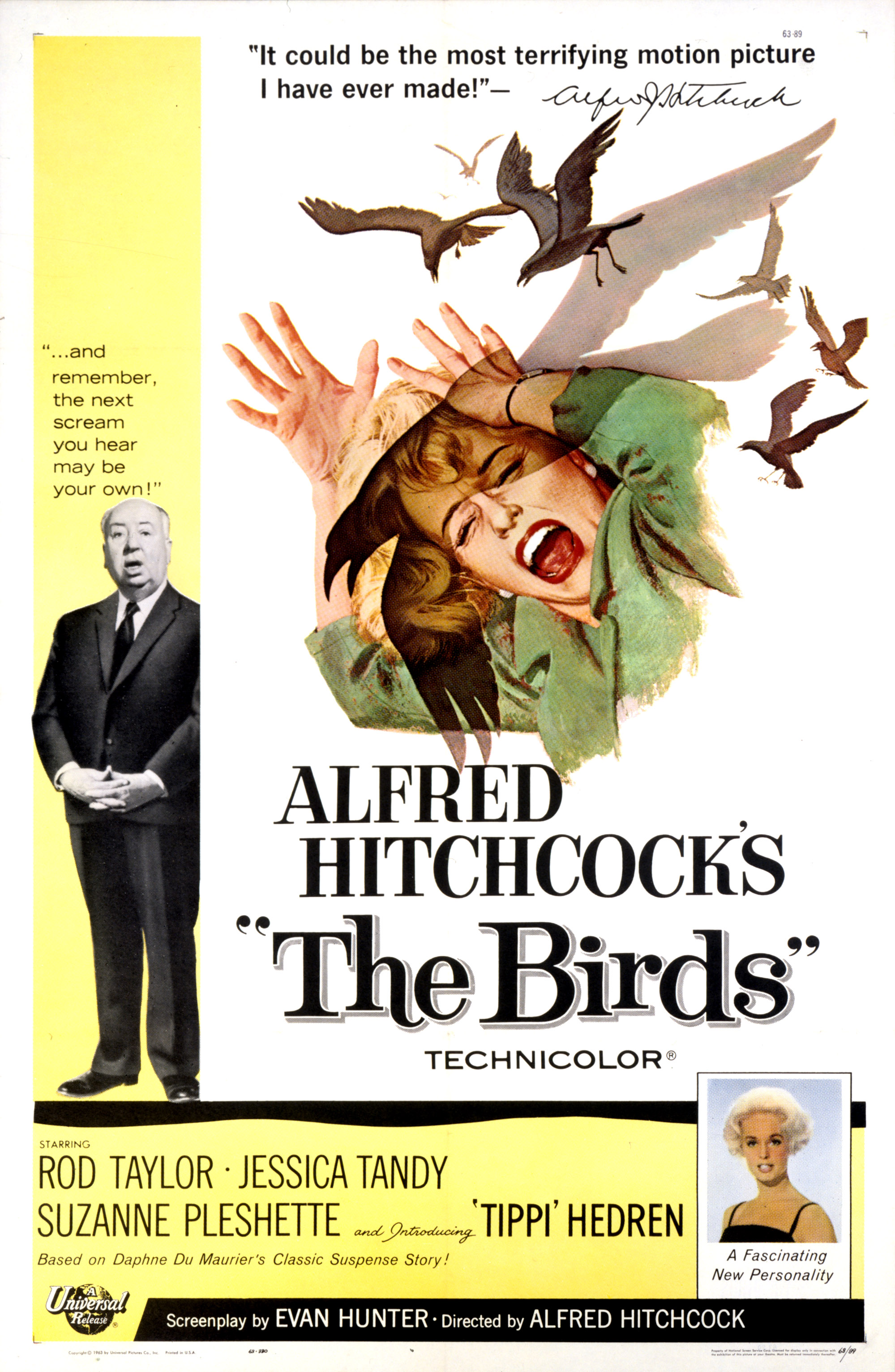
The Birds


Note : this review is a contribution to The Universal blogathon hosted by Silver Scenes.

The Birds (Alfred Hitchcock, 1963)

A wealthy San Francisco socialite pursues a potential boyfriend to a small Northern California town that slowly takes a turn for the bizarre when birds of all kinds suddenly begin to attack people there in increasing numbers and with increasing viciousness.

2013-07-03

The Movie Suggestion of the Day – July 3rd 2013

This is a not so daily feature that presents in a few lines a movie and why I choose it to be the movie viewing of the day.
As many readers know my hometown is Québec City and today July 3rd we celebrate our 405th Anniversary.
The movie of the day is Alfred Hitchcock’s I Confess entirely shot in my city and displaying some of the most beautiful features. I think it is a superb publicity for our enchanting and very European settings.

What do you think of this suggestion? Did I forgot another movie that would be perfectly suited for this day?

2012-12-17

Recommended Reading: Alfred Hitchcock: A Life in Darkness and Light


Alfred Hitchcock: A Life in Darkness and Light (Patrick McGilligan, 2003)

Of the hundreds of books, biographies, analysis, essays about the most respected and famous film director of all time Patrick McGilligan’s biography might be the most complete and essential to the Hitchcock enthusiasts out there.

In a very apt English McGilligan presents the facts of the life and career of Hitch. From his early works in England to his major pictures like Psycho, every detail of every picture is included. This is not a complaisant biography that praises and shows the man in his entire splendor. On the other hand, it evokes some of the gossips and disputable behaviors of the man without giving them total credits since some aren’t proved to be exactly true.

Paired with François Truffaut’s interview book on the man, we have the two essential writings that we need to fully understand and appreciate the master’s career. 900 pages of pure pleasure.

2012-11-29

North by Northwest

North by Northwest (Alfred Hitchcock, 1959)

A hapless New York advertising executive is mistaken for a government agent by a group of foreign spies, and is pursued across the country while he looks for a way to survive.

After the famous shower scene of Psycho, the scene of the chase of the crop duster after Cary Grant is the most recognizable Hitchcock moment. With this film, Hitchcock wanted to check many things on his long list of elements he liked and wanted to include in a film. First, the presence of Cary Grant his favourite leading man with whom he didn’t had much to ask except; be Cary Grant, a natural comic actor with a bad temper as being a prima donna. But his presence in the credits was instant box office success and he represented everything Hitchcock wanted to be: handsome, athletic, and popular amongst women.

2012-06-21

Marnie


Marnie (Alfred Hitchcock, 1964)

Mark marries Marnie although she is a habitual thief and has serious psychological problems, and tries to help her confront and resolve them.

Starring Tippi Hedren as the title role and Sean Connery has Mark the man who falls in love with her and wants to “cure” her, Marnie is one of Alfred Hitchcock’s most psycho sexual Freudian challenges. Lately, I’ve had a conversation with John LaRue of The Droid You’re looking For about Hitch’s misogynist approach to women. As an explanation of this conception of Hitchcock I recalled many elements that may have inclined him to be that way. As John recalled me he mentioned the mommy factor which is omnipresent in the films of Hitchcock.

With Marnie, we rediscover lots of recurring themes of Hitchcock’s obsessions: the cold blond woman stealing from her bosses and escaping (Psycho), the private detective who looks into the past of the woman (Vertigo), the final confrontation with the mother (Psycho again). The character of Mark is very interesting in the fact that he thinks he can cure Marnie, love her, and make her love him back. By forcing their marriage and the consumption of it Mark thinks Marnie will be “normal”. But the simplicity of his interventions can’t pair the deep psychological scars she wears.

While the Freudian analysis are used as plot points it accentuated the flaws of the film and the second half mainly represents the view of Hollywoodian simplicity on psychoanalysis. Hitchcock wanted so much to master the Freud material that he got caught up in his strange film. The setting of the first half and the tension of the opening evokes something that the story doesn’t finally delivers. Hopefully, Hitchcock handles like the master he is the elements aforementioned that he is comfortable with. On the down side, it’s once again the Freudian themes that fails on him just like his other film Spellbound.


Following a masterpiece like The Birds isn’t an easy task. It was even harder since the 1963 film was a genre movie and Marnie felt more on the psycho drama of Hitchcock revisiting is recurrent themes. However, the over atmosphere and feeling around Marnie is pretty unique and far from being a bland film from Hitch it is still one his finest approach to melodrama and the repressed problems of childhood.


On a more gossiping note, it is widely known that after Grace Kelly left the show-business to marry Prince Rainier of Monaco Hitchcock was looking for her replacement because the lady Kelly has been the perfect Hitchcock blond. When he discovered Tippi Hedren, Hitchcock supposedly felt deeply in love with her. She however, repelled him because she wasn’t interested at all. It is also a fact that Hitchcock told the bird trainer that he needed the birds to practically attack Tippi to get the most genuine feeling of fear from her. It was a revenge from Hitchcock who was re known to be a strong practical joker. So the story of Marnie, a woman who repels men and won’t have sex with them otherwise being forced might represent a subconscious desire of Hitchcock after his previous humiliation from his star.

Finally, this lesser appreciated film has somewhat earned its letters of noblesse amongst the Hitchcock enthusiasts including this reviewer. It takes rank number 17 (not intentionally here) in my personal top of Hitch's films I think this is an interesting Hitchcockian melodrama. I recommend this film.

2012-03-17

The 15 greatest Alter egos in the History of Cinema

John Ford and John Wayne
One of the most successful association in movie History. The two John made their trademarks as Western filmmakers and a few War films. This is one of the reasons why they are on this prestigious list. And a film list is not a real film list if there are no mention of John Ford or John Wayne. Come on!

Films together: Stagecoach (1939) The Long Voyage Home (1940) They Were Expendable (1945) Fort Apache (1948) 3 Godfathers (1948) She Wore a Yellow Ribbon (1949) Rio Grande (1950) The Quiet Man (1952) The Searchers (1956) The Man Who Shot Liberty Valance (1962)


Akira Kurosawa and Toshiro Mifune
Kurosawa and Mifune might have been the best ambassadors of their country in the world especially with the spread of the Samurai genre. Interesting fact: Kurosawa wanted to make Samurai films like John Ford did Westerns. If you ask me he made himself clear that he is the John Ford of Japan.

Films together: Drunken Angel (1948) Stray Dog (1949) Rashomon (1950) The Idiot (1951) The Seven Samurai (1954) Throne of Blood (1957) The Lower Depths (1957) The Hidden Fortress (1958) The Bad Sleep Well (1960) Yojimbo (1961) Sanjuro (1962) High and Low (1963) Red Beard (1965)


Michel Hazanavicius and Jean Dujardin
The most hip duo since the buzz around The Artist that began at the Cannes Film Festival last May and that culminated with the crowning of The Artist, Hazanavicius, and Dujardin at the Oscars. It is interesting to discover that it is far from being the first collaboration of the two Frenchmen.

Films together: OSS 117: Le Caire nid d'espions (2006) OSS 117: Rio ne répond plus (2009) The Artist (2011)


Federico Fellini and Marcello Mastroianni
This might not the most popular choice here but with only 8 1/2 Mastroianni impersonated the great Fellini and give one of the greatest performances ever shot on film.

Films together: La Dolce vita (1960) 8 1/2 (1963) City of Women (1980)


Tim Burton and Johnny Depp
The most obvious choice for contemporary film buffs. Those two have made it clear that they like to work together with their upcoming The Dark Shadows.

Films together: Edward Scissorhands (1990) Ed Wood (1994) Sleepy Hollow (1999) Charlie and the Chocolate Factory (2005) Corpse Bride (2005) Sweeney Todd: The Demon Barber of Fleet Street (2007)


Steve McQueen and Michael Fassbender
I've just discovered Hunger lately and it is a revelation to me. Fassbender gives great performances one after another but his pairings with McQueen are tremendous.

Films together: Hunger (2008) Shame (2011)


Alfred Hitchcock and James Stewart
Of the many leading man Hitchcock had in his films, Stewart is most common man and easy to relate to actor that worked with him. I could have gone with Cary Grant but Stewart stars in my favorite Hitchcocks.

Films togeter: Rope (1948) Rear Window (1954) The Man Who Knew Too Much (1956) Vertigo (1958)


F.W. Murnau and Emil Jannings
German Cinema of the pre-Second World War would never have been the same without those two greats.

Films together: The Last Laugh (1924) Faust (1926) Tartuffe (1926)


Martin Scorsese and Robert De Niro
Do I really need to explain myself here? There is no one single film they made together that I wouldn't watch right away. They embrace the definition of alter egos and I hope that some day they find some time to make another film together something like a last goodbye or even a documentary/interview with fragments of their films together, thoughts etc.

Films together: Mean Streets (1973) Taxi Driver (1976) New York, New York (1977) Raging Bull (1980) The King of Comedy (1983) Goodfellas (1990) Cape Fear (1991) Casino (1995)


John Huston and Humphrey Bogart
Bogie had such a presence in films that Huston exploited like no other director, except Howard Hawks and Nicholas Ray maybe, with his raw personality and created a kind of character just for Bogis with the creation of the Film Noir in The Maltese Falcon.

Films together: The Maltese Falcon (1941) The Treasure of the Sierra Madre (1948) Key Largo (1948) The African Queen (1951) Beat the Devil (1954)


David Fincher and Brad Pitt
Fincher is slowly becoming one of the most respected filmmakers today, their first two collaborations are already considered as classics for contemporary film enthusiasts.

Films together: Se7en (1995) Fight Club (1999) The Curious Case of Benjamin Button (2008)


Werner Herzog and Klaus Kinski
The most destructive duo of this list, just watch Herzog's documentary My Best Fiend about Kinski to fully understand their insane relationaship. It is almost unbelivable that they made more than one film together.

Films together: Aguirre: The Wrath of God (1972) Stroszek (1977)  Nosferatu the Vampyre (1979) Fitzcarraldo (1982) Cobra Verde (1987) My Best Fiend (1992)


Ingmar Bergman and Erland Josephson
With the recent lost of Josephson the World of Cinema lost one of the most talented actors. He worked on twelve films with Ingmar Bergman and always gave tremendous performances. Everytime I see Josephson on the screen I immediately connect him with Bergman. Especially with Scenes of A Marriage that contains many Bergman moments almost autobiographical.

Films together: It Rains on Our Love (1946) Brink of Life (1958) Hour of the Wolf (1968) The Passion of Anna (1969) Cries and Whispers (1972) Scenes of A Marriage (1973) Face to Face (1976) Autumn Sonata (1978) Fanny and Alexander (1982) After the Rehearsal (1984) In the Presence of A Clown (1997) Saraband (2003)


Jean Renoir and Jean Gabin
One of the greatest master of Cinema, Jean Renoir, collaborated with Jean Gabin on four films but they represented the Frenchmen for the World. La Grande Illusion and La Bête Humaine brought both to international recognition.

Films together: The Lower Depths (1936) La Grande Illusion (1937) La Bête Humaine (1938) French Cancan (1954)


Christopher Nolan and Christian Bale
Probably the most popular alter ego in the world of Cinema right now with The Dark Knight Rises coming in theatres this summer. All their films together have immense success at the Box Office as with the critics. Let,s hope they did as they usually do with the new Batman; a superb job.

Films together: Batman Begins (2005) The Prestige (2006) The Dark Knight (2008)

2012-02-19

Vertigo

Vertigo (Alfred Hitchcock, 1958)

The definition of vertigo is a sensation of dizziness or abnormal motion resulting from a disorder of the sense of balance. In Alfred Hitchcock's picture, Vertigo is translated as John "Scottie" Ferguson's (James Stewart) fear of heights. Scottie was a police detective and is now retired. A wealthy man asks him to follow his wife (Kim Novak) and check on her because he thinks that she is contemplating suicide. Sadly, Madeleine (the wife) commits the irreparable even with Scottie's close surveillance. While following this woman, Ferguson falls obsessively in love with her. Shortly after her tragic death he meets a woman who practically looks exactly like Madeleine. This is where Scottie's "disorder" comes in action, he is still madly obsessed with Madeleine and he will try to "recreate" her with Judy.

This relationship is already doomed at day one. It smells bad if you prefer and we clearly sense that Scottie is intoxicated by Madeleine's persona. Their love story is unwholesome and the way Scottie acts when trying to convert Judy into Madeleine is desperately sad and exposes how childish he reacts to this lost. He does whatever he can to get what he can't have anymore. Evenmore, he doesn't get it, he obviously doesn't need it. It just accentuates his sickness and dooms him.


Just like the somewhat outdated flashes, Scottie seems to keep falling from the first scene of the film until the final moments. One of the most interesting aspect of this story is how the obsession of the main character becomes our own obsession as the viewer. We really want to watch Scottie getting over his fear and his state of depression by making up with Judy's presence. Hitchcock accomplishes he most subtle tricks of metaphorical meanings by placing common objects and right framing in his movie. Many scenes involve mirrors and depending on what he wants to tell with his images. Hitch makes some claustrophobic effects or double reflection of the characters in the mirror. Few Hitchcock films have been so abstemious in their visual but few have been mastered has well either.

The plot of Vertigo is a free adaptation of Boileau-Narcejac's Entre les morts. It was in direct reaction to Hitchock's lost of the rights of the novel Les diaboliques to Henri-Georges Clouzot written by the same duet of authors. Hitchcock said later in interviews that Clouzot's film was the only picture he wish he had made. To be honest, I think Hitchcock surpassed Clouzot but the later's near-masterpiece is one heck of a movie. It is one of the films, Les diaboliques (1955), I always highly recommend to anyone who likes French Horror films of the 1950's along with Eyes Without A Face by Georges Franju. However, Hitchcock never literally adapted a novel to the screen he was a very literate man and he added many elements of fellow Englishman Oscar Wilde's The Picture of Dorian Gray to the plot of Vertigo. Added to his successful storytelling techniques and the culmination of his Art, Vertigo is one of the many pinnacles of Hitchcock's 1950's work.

In Vertigo we found many classic Hitchcock elements: the doppelganger played by Kim Novak in the two women Madeleine and Judy, the icy blond "à la" Grace Kelly, James Stewart's acting almost child-like, the bay-area locations and the landmark signature settings. For many reasons Vertigo is considered as Hitch's masterpiece and it is always into the top 5s of the greatest films of all time. However, I don't think it is the "master of suspense"'s greatest achievement, even if it is one of his most contemplative and deep films I think it is surpassed by Rear Window, Psycho and North by Northwest just by the fact that those films are more personal entertainment for Hitch. The themes of those films connect more with his storytelling techniques and they feel more like his major work. Vertigo is still a masterpiece but just a bit under the trio aforementioned.

Rating:

2012-02-13

Top films of Alfred Hitchcock by LMdC


1. Rear Window (1954)
2. North by Northwest (1959)
3. Psycho (1960)
4. Vertigo (1958)
5. Shadow of A Doubt (1943)
6. The Birds (1963)
7. Notorious (1946)
8. The 39 Steps (1935)
9. The Lady Vanishes (1938)
10. Rebecca (1940)
11. Rope (1948)
12. Suspicion (1941)
13. Saboteur (1942)
14. Strangers On A Train (1951)
15. To Catch A Thief (1955)
16. The Trouble With Harry (1955)
17. Marnie (1964)
18. Mr. & Mrs. Smith (1941)
19. Dial M for Murder (1954)
20. The Man Who Knew Too Much (1934)
21. Stage Fright (1950)
22. The Wrong Man (1956)
23. Spellbound (1945)
24. Sabotage (1936)
25. Lifeboat (1944)
26. I Confess (1953)
27. The Man Who Knew Too Much (1956)
28. Under Capricorn (1949)
29. Jamaica Inn (1939)
30. Blackmail (1929)
31. Foreign Correspondent (1940)
32. Family Plot (1976)
33. Topaz (1969)
34. Torn Curtain (1966)
35. Secret Agent (1936)
36. Murder ! (1930)
37. Young and Innocent (1937)
38. Frenzy (1972)
39. Rich and Strange (1932)
40. The Lodger (1926)
41. The Paradine Case (1948)

I still need to see: The Pleasure Garden (1925) Downhill (1927) Easy Virtue (1927) The Ring (1927) Champagne (1928) The Farmer’s Wife (1928) The Manxman (1929) Juno and the Paycock (1930) The Skin Game (1931) Number Seventeen (1932) Aventure Malgache (1944) Bon Voyage (1944)
Related Posts Plugin for WordPress, Blogger...