Showing posts with label 1969. Show all posts

2014-10-07

Kes


 Kes (Ken Loach, 1969)

A young, English working-class boy spends his free time caring for and training his pet falcon.

Billy (David Bradley) is a fifteen years old boy abused by his half brother and ignored by his mother. He has no expectations of life, doesn’t like school and no real friends until he develops an interest in falconry. The story has been told many times in Cinema, just look at François Truffaut’s 400 Blows or Claude Jutra’s Mon oncle Antoine.

What makes Ken Loach’s film standout is the British angle of the film with the reality of England. He is a child facing abandon, a difficult life, and he has a sentiment of being alone. Until he finds a passion and become interested in something that makes sense in his life. Something that makes him interesting for his English teacher and makes him feel worth something.

Loach documentary style of filmmaking involves the viewer in this child’s life. Filmed with a eye for observation but also an introspect vision of the daily life of the young Billy. The dark tones of the film, the greys, the browns, and the natural lighting give a visual that is not that appealing but the sequences with the falcon are lighted with natural sunshine juxtaposed with a joyous tune of flute that reveals a subtle sensibility in this quite sad film.

A recurrent comment of Kes is the Yorkshire accent of the actors. Sometimes, it was presented with subtitles to help American viewers understand. As it is for me, my mother language is French and English is my second language and I didn’t had much problem understanding the accent. At first, it took me a minute or two to adjust my ear but I didn’t missed much. So I suggest that you don’t let this little detail retain you from watching this English classic. Especially, if you liked and enjoyed Cannes’ Palme d’or winner The Wind That Shakes the Barley also from director Ken Loach. The later is a succinct and efficient sociologist that can dress a clear portrait of realities of his mainland.

With the latest years, Kes has become more and more recognized with a Criterion Collection treatment and a very obvious homage in The Royal Tenenbaums. As it climbs rankings in many lists, Kes is a great film but not a masterpiece even if it let a clear staple. A nice gem.
 

2011-09-07

Satyricon


Fellini’s Satyricon (Federico Fellini, 1969)


The films of Federico Fellini always have been intriguing and mysterious because every first viewing of his films I feel like I’m entering in a different world than mine. Not only the imagery but also the narrative and the acting. It is always like the feeling of being in a dream-like universe. The first film from Fellini I saw was his Casanova with Donald Sutherland. It’s time for an anecdote: when I came back from my one month trip in Italy in 2006 my flight from Paris to Montréal had a special passenger: Mr. Donald Sutherland. The funniest thing about this little moment was that I knew who he was and I loved his presence in Casanova, Don’t Look Now, 1900, etc. But everyone was shouting this is Jack Bauer’s father! For Odin’s sake’s this man is a living legend don’t insult him by saying that he is the father of the flavour of the moment! Recognize the man at least!

I discovered many Fellini films before I started this blog, so this is why this is one of the first reviews about his work. Satyricon was the first film of Fellini I ever bought, the Antic Roman settings and the name of the movie (I am a fan of the band of the same name) were the two magnets that got me and my hard earned money. Opposed to many Italian and American peplums that tried to recreate with precise details the past, Fellini’s Satyricon is the perception of the Roman Empire by Fellini himself. This is his fantasy about this time and age. It may sound a little pompous but for the neophytes out there Federico or affectively Fefe had an incredible imagination and his creations are inimitable. This creativity is characterized by a childish approach to everything, many of his imagery is taken from his memories and his impressions as a kid on how he used to perceive and see life.

Far from being his most accessible work, Satyricon did not have standard narration neither does it have appealing characters. It looks like a freak show set in Ancient times. It is raw, bizarre, and beautiful at the same time. But like many unique films, this Fellini is a masterwork of cinematic brilliance and mise en scène. Even if it’s not considered as a major work from his oeuvre I still think that film has a special aura of greatness and weirdness. Moreover, Satyricon is a very personal film made by the genius vision of Federico Fellini.

2011-05-03

Easy Rider


Easy Rider (Dennis Hopper, 1969)
A man is looking for America but couldn’t find it anywhere... What a plot line! Dennis Hopper’s directorial debut, Easy Rider was a big commercial success at the box office but also at Cannes. Made with only 40 000$ it grossed 60 million dollars. The film reflected the changes and the problems America was facing in the late 1960’s, it also hooked the many young folks who were experiencing those liberating years while in the same time (around 1968) the US government was seriously entering into the Vietnam War.

The setting of Easy Rider is pretty simple, two hippie bikers Peter Fonda as Captain America or Hyatt and Dennis Hopper as Billie make a prosperous drug deal in some place that looks like New Mexico. From this point, with the money earned from the deal they will go on a road trip on their motorcycle to the Mardi Gras to do their dreams. On the road they will meet a hippie hitch-hiker that will bring them in his community where the people is trying to live from their crops and be independent from the rest of the world. Some kind of garden of Eden, especially represented with the sequence with the naked bath in the river. This whole sequence in the community is utopian and those little idealist “tribes” were temporaries escapes from the modern changing world. The main characters leave because this whole scene has some weariness and the simplicity of this life probably just doesn’t fit with their journey.

After a while our two bikers continue their trip in America and they’ll encounter a young lawyer (Jack Nicholson) after a stay in a little town’s jail. The lawyer, an open minded drunk will follow them and bring some explanations to the common hostilities towards the two hippies.

The freedom represented in Easy Rider, has many layers: the freedom of the two hippies from their moral obligations and their freedom of image (hairs, clothes, bikes, etc.). The film itself brought in American film the anti-heroes that will lead the way to the 1970’s films of the Martin Scorsese, Robert Altman, Hal Ashby, Bob Rafelson, Michael Cimino, and the many directors of this decade. The low costs of the making of the film versus the profits opened the doors of the studios and also to the theatres for the filmmakers with a message and a soul. Something, earlier in the 1960’s, only the old guard of filmmakers could attain with their director’s cut in big studios.

Easy Rider was a phenomenon and also a revolution in filmmaking, Hopper was the leader of this revolution. Sadly, his subsequent films didn’t had the same critical praise and commercial successes. He practically died in the 1970’s with strong drugs addictions and multiple cases of wife beatings. He almost had a tragic end like his idol, James Dean, with who he starred with in Nicholas Ray’ s masterpiece Rebel Without A Cause. Well, Dennis Hopper had a miserable childhood and he always had anger problems. His film demonstrate that he had an exceptional talent and his script, co-written with producer Peter Fonda (son of Henri and father of Bridget) and Terry Southern, shows how he understood his generation and its issues. His camera accentuates the almost documentary vision of his script. The few dialogues and the metaphors of the motorcycles give to the film a Western-like blended with Road movie genre. The Western genre has always been a true American aspect of the Cinema. The “propos” of the film is mainly about America, especially about the Young or the New America. This revisionist version of a modern day Western/Road movie makes it even more appealing to the audience.

The leftist revolution in American movies was coming in part from the French New Wave that brought new liberties in filmmaking and many communist/maoist ideas especially from Jean-Luc Godard. In Easy Rider we are not in the presence of a political movie like if you are watching a Godard film but its revolution and new freedom is palpable.

Easy Rider is a turning point in American Cinema and probably in its History, without it you can forget about the second Golden Age of this art. With Hopper’s film, the Cinema got closer to the common issues of American young adults, with the introduction of drugs, violence, sex and the free spirited thoughts of this era.

2010-10-28

True Grit (1969)

True Grit (Henry Hathaway, 1969)


Famously known has the only film John Wayne has won an Oscar in his entire career, True Grit. A revenge story of a young woman (Kim Darby) who wants to kill the man responsible for the death of her father. But, she is a financial record keeper, and moreover, a woman, so she must hire a man that will track the fella with her. This man is Marshall Cogburn (John Wayne) an old bachelor living with a fat cat and an old chinese man. In their journey they will be helped by Texas ranger La Boeuf (Glenn Campbell). The revenge story is the perfect set-up for Wayne to portray a warm father figure, a role he could certainly portrays because he had two daughters in real life.

2010-01-17

Ma Nuit chez Maud de Eric Rohmer - Retrospective

TSPDT Greatest Films #282 Ma Nuit chez Maud (Éric Rohmer, 1969)


To pay a tribute to one of the most important figures of the French New Wave and of the French film history, Eric Rohmer who just past away this week I choose to discover and analyze one of his better works; Ma Nuit chez Maud (1969). Being the third chapter of his six moral tales, Maude's is for many his best film. I'm ashamed to say that before saturday January 16 2010 I haven't seen one of his films. This short essay will try to pay tribute and erase my lack knowledge about Rohmer's films.

Ma Nuit chez Maude starts with the main character, Jean-Louis, played by Jean-Louis Trintignant as a 34 years old engineer converted to catholicism who believes in true love. He will confront his ideas with one of his best friends Vidal and the newly encountered Maude (who are by the way atheists) about their visions on life, love, friendship, Pascal, and marriage. In the beginning, Jean-Louis says he's gonna marry Françoise but slowly falls in love with Maude and her straightforward attitude.

The narrative of the film stands close to Antonioni's style, who is a big influence on Rohmer's films, with clean and shaky black and white images, long takes; especially with the openning sequence which is silent for nearly five minutes. The scenes are long and the characters slowly enter and exit the image. This is clearly a French New Wave film but many aspects of it are taken from the Italian Neorealism especially. Rohmer tried to minimize the narrative effects on his story to take his Film as near as possible to reality. That's something, the Italian Neorealists wanted to do, especially Antonioni and Rossellini. On the other hand, Rohmer was openly a supporter of the work of Hitchcock and Hawks as the other directors of the French New Wave. Some narrative elements of Ma Nuit chez Maude are directly taken from those two masters who never hesitated to insert long silent sequences into their films. The esthetic and the camera angles are clearly influenced by the films of Alfred Hitchcock. The story of the film may seem a little flaw with its slow rythm but when it all comes into place it fits perfectly. I think it may have influenced Sofia Coppola on her Lost in Translation.

I didn't really got into Ma Nuit chez Maud in the first place. But after a little refexion and some time I think it's a very deep film that enters your mind and works on it. In this case, I think it's a great movie especially when afterward it continues to grow within you. I'm proud of letting myself immerge into Eric Rohmer's filmography.

Reposez en paix Monsieur Rohmer!

A film Retrospective by Michaël Parent

2009-12-01

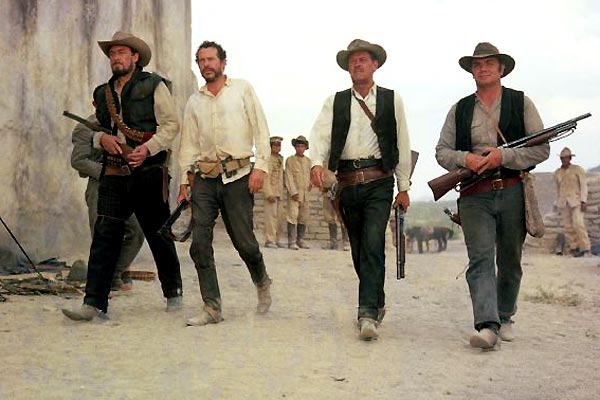
The Wild Bunch

TSPDT Greatest Films #51 The Wild Bunch (Sam Peckinpah, 1969)


Les 25 ans de la disparition de Sam Peckinpah sera remémorée tout le mois de Décembre 2009 sur le Blogue The Agitation of the mind. Par des essais sur ses films principaux je participerai à cet hommage.


Le chef-d’œuvre de Peckinpah ; The Wild Bunch est le premier film observé ici. Sorti un an après Once Upon A Time In The West de Sergio Leone, et durant l’engouement des Westerns spaghettis. The Wild Bunch fut très mal accueilli puisque dans l’ombre des films de Leone. Peckinpah, était sur la liste noire des réalisateurs et ce fut son premier en trois ans. De plus, les studios avaient procédés à des remaniements dans le montage de Peckinpah en coupant plusieurs minutes du film qui devait faire à l’origine 145 minutes. Il fallut attendre 35 ans plus tard pour apprécier la vision du réalisateur dans sa forme intégrale. Comprenant plusieurs grandes stars de l’époque dont William Holden, Ernest Borgnine, Robert Ryan et Warren Oates. Plusieurs grands du Western comme John Wayne et John Ford critiquèrent amèrement The Wild Bunch pour sa vision révisionniste du Far West. Cependant, d’entre toutes ces raisons c’est la violence contenue dans le film qui n’en fit pas un préféré du public et des critiques. Cette violence est dénoncée par sa présentation dérangeante (un peu comme la scène d’ouverture où l’on voit des enfants regarder deux scorpions se faire dévorer par des centaines de fourmis) et par le fait qu’elle n’est pas du tout spectaculaire. Peckinpah, a intentionnellement présenté la violence de cette manière pour la rendre réaliste et pour qu’elle ne soit pas banalisée dans le récit.

Une bande de desperados décide de voler un train rempli d’armes pour les revendre à un général mexicain. Ils veulent, par le fait même, prendre cet argent et se rendre là où la loi ne pourra les punir pour leurs crimes et vivre en paix. Peckinpah nous présente ces hommes qui veulent changer et ranger leur pistolets mais qui finalement vont refuser d’évoluer dans leur époque qui elle est en train de changer.

Ce Western épique dépeint le Far West de façon violente et sans romantisme. Il brise le mythe du Western traditionnel où son héros est dépeint sans tache et faisant le bien. Le voile de mystère du Far West dont parlait John Wayne, est levé et on ressent que les protagonistes du film sont des hommes, qu’ils tuent, qu’ils boivent et qu’ils vont voir des prostituées mexicaines. Ce nihilisme apporte au film une dimension de profonde réalité hors du commun pour un Western de cette époque. Par contre, cette bande de desperados a un code d’honneur qui les unit, et ce, malgré tous les crimes qu’ils peuvent commettre. Ce sont des individus dominants qui faisaient leur propre loi dans un monde où il n’y en avait pas. Nous observons dans The Wild Bunch ce qui arrive à ces desperados quand l’Ouest change.

On ressent dans ce film une nostalgie face à la conquête de l’Ouest qui trouve une fin de par l’arrivée des fusils mitrailleuses rendant le traditionnel six coups désuet. En plus de l’apparition d’une automobile qui évoque le passage du cheval à cette dernière. Même ces bandits seront remplacés par les armées et les criminels qui gouvernent nos États.

Sur le plan visuel, The Wild Bunch est tout à fait magnifique. De belles prises de vues et des scènes filmées avec une sensibilité rarement égalée sont la force visuelle de ce film. Peckinpah prend de longues prises et laisse le temps au spectateur de bien contempler chaque image selon sa volonté. Il s’inspire largement du travail du Japonais Akira Kurosawa tant pour le positionnement de sa caméra que pour son utilisation des différents acteurs. Il laisse les personnages prendre l’ampleur qu’il leur faut tout en gardant son récit axé sur le personnage principal qui est le Far West dans ses derniers moments. La finale du film se veut une métaphore du changement dans l’approche du Western et dans le Cinéma en général. À cette époque, Easy Rider de Dennis Hopper, Midnight Cowboy de John Schlesinger et notamment le Night of the Living Dead de George A Romero allaient changer la face du Cinéma et amener la seconde « Golden Age » du Cinéma dans les années 70.


English Version


To commemorate the 25 years of the death of Sam Peckinpah, the Blog The Agitation of the Mind will present essays and articles on the films of Peckinpah. With some essays of my own I will participate to this commemoration.

Peckinpah’s masterpiece, The Wild Bunch is the first film to be analyzed here. Released a year after Sergio Leone’s Once Upon a Time in the West and during the big explosion of the spaghetti western genre, The Wild Bunch was very dissonant compared to these other Westerns. Peckinpah was black listed at the time and it was he’s first film in 3 years. Moreover, the studio cut in the editing and reduce the film that was originally destined to be a 145 minutes epic. It took 35 years for the public to finally discover Peckinpah’s version of The Wild Bunch. Even with a cast of stars like William Holden, Robert Ryan, Ernest Borgnine, and Warren Oates it wasn’t at its release a popular film. First, John Wayne and John Ford were detractors of the film for its revisionist approach to the Western genre. However the main reason it wasn’t popular was for its depicted violence. This violence is denounce and disturbing, like the opening sequence with the children who are watching two scorpions being killed and ate by many dozens of ants, and by the fact that this violence is not spectacular at all. Peckinpah intentionally depicted his violence this way to avoid it to seem common and pleasant in the story.

The film is about desperados who want to steal a load of guns from a freight train and make a big amount of cash by selling them to a Mexican general. With their gain they want to retire to Mexico and take a peaceful life. They want to change from their lives of killing and stealing but at the end they refuse.

This epic Western presents the Far West in an uncommon way and without the romantic glam that came with it. It breaks the classical themes where the hero is the good man who wants to make things right. The myth of the Far West which John Wayne wanted to keep clean is brought in a realist way with its protagonists who kill, steal and fuck with Mexican prostitutes. Meanwhile, they still have their loyalty for each other even with all the crimes they committed. They are strong individuals who made their own laws where there weren’t any. These men are confronted by their biggest enemy: the change of the West.

This is a nostalgic film with the end of the Far West; the end of its myth and of its era. The machine guns and the cars will replace the old guns and the horses of the good old Far West. Even the desperados will be replaced by the governments of our countries.

On the visual, The Wild Bunch is extremely wonderful. Inspired by Akira Kurosawa, Sam Peckinpah always put his camera at the right place and let the time and space to let the public get deeply involve into each scene. The grand finale is a metaphor on the vision and the approach the way films will be after The Wild Bunch. It changed the face of Cinema, followed by the coming of the second Golden Age of American Cinema in the 70’s.
Related Posts Plugin for WordPress, Blogger...