Showing posts with label Je me souviens. Show all posts

2015-02-25

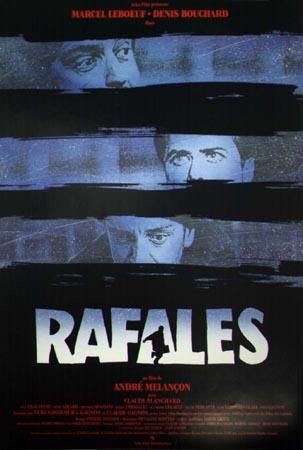
Rafales


Rafales (André Melançon, 1990)

On Christmas eve a journalist (Denis Bouchard) witnesses a theft in a mall and later tracks one of the thieves (Marcel Leboeuf) and ends up being taken as his hostage at the radio station he works for.

Populated with the constant sound of the wind blowing during a snow storm on December 24th in Montréal, Rafales french for gusts is at first a powerful thriller that easily transcends borders of the french speaking Province of Québec.

With Marcel Leboeuf as Gérard Crépeau a garage employee involved in a theft that was orchestrated by his brother Normand (Guy Thauvette) and Pouliot (Claude Blanchard) the boss of the garage might feel like a standard robbery gone bad until Gérard shoots the mall’s Santa Claus and flies away with the money and meet Louis-Philippe Trépanier (Denis Bouchard). Normand is arrested and Pouliot does an act of treason.

Prior to the robbery, Trépanier sees Gérard and Normand argue about the crime they are about to commit, he is in a toy store and picks up toys for his kids. He sees Gérard’s gun and starts to follow him. There’s a strange fascination in the way that Trépanier watches Gérard, who is the most fragile character in the movie. Trépanier is an opportunist and sees a scoop in the tracking of the thief. While he has the chance to alert policemen he doesn’t do so at the first place.

In fact, with the conclusion of the film we understand that he was using Gérard for his own purpose and his career. In a way, it was Gérard who was the hostage in the radio station broadcasting live the negociation with the police. Rémy Girard, aka the Québec actor that is cast in every Québec film ever made, is the manager of the station and saw the potential in Trépanier’s actions taking advantage even in accepting to pass commercials during the aforementioned live broadcast.

One of the most human moments is when Gérard lifts an aging Russian woman (Kim Yaroshevskaya) and talks about her past and then moments of his childhood. It is one of those moments that can be a home run or a total pathetic pathos moment. In this case it is perfect and its purpose is also well used.

Dedicated to the late John Cassavetes who had just passed out months before the opening of Rafales, director André Melançon made a strong film with a mise en scène that demonstrates his great mastery at storytelling keeping lots of silences especially with nearly 20 minutes in the opening and almost no dialogues outside of the radio station.

Having watched more than 2000 films in my life and written about at least 500 of them it is now less often that I feel left being impressed or ecstatic. With Rafales, it is the case where I think I sat in front of something that was quite unique. This is a very good film and one of my favorite films from my part of the world; the Province of Québec.

2014-02-10

J'ai mon voyage!


J’ai mon voyage! (Denis Héroux, 1973)

Jean-Louis Cartier (Jean Lefebvre) from France decides to quit Quebec City to go live in Vancouver with a fifth wheel. The Cartier family of Danielle (Dominique Michel), François (René Simard) , and Luc (Régis Simard) embark on a road trip that will take them into the wilderness of the West Canada that Jean-Louis romances in his letters to his parents in France.

2012-09-07

Tit-Coq


Note: this a new series of reviews I'm installing on Le Mot du Cinephiliaque. Since I was born and raised in the Province of Québec I've decided to present and review some of the films that populate my culture and that represents the Cinema of here. The feature will be called after our license plate motto: "Je me souviens" for "I remember". 


Tit-Coq (René Delacroix & Gratien Gélinas, 1953)

After returning home from war, an ill-tempered young soldier must deal with his sweetheart having married another man. 

One of the greatest plays ever written in Quebec by Gratien Gélinas who also co-directs and stars as the title character, it is his most acclaimed work. Of course, the film version of the play is shot in the same way that the writing is played on the stage.

Tit-Coq (Gratien Gélinas) is a French Canadian soldier and we follow his story before and after going to the Second World War. Before being sent in Europe, he falls in love with Marie-Ange (Monique Miller) but being a bastard weights on his head. His fiancée promises him that she’ll wait for him to return after the war. However, when he comes back, Marie-Ange married another man and he falls into complete desperation.

I believe this is a hard film to find and not a masterpiece but still a very good depiction of the French Canadian of the time and a story that is very moving and that can be compared to a Classic Tragedy. Gélinas was one of the many writers who understood the people of the Province of Quebec. It proved to be a very popular film and the Toronto International Film Festival honoured it in 2000.

While doing my researches for this post I discovered that at first Gélinas wrote Tit-Coq  in 1947 to adapt it to film but he didn’t had the financing and this is why it began on the stage doing more than 500 representations. In the 1940’s Quebec’s Cinema wasn’t very much developed and financing was harder. Just as the lack of studios except for the public television producers there wasn’t many options for storytellers.  

Having had to read and write about the play in College, it was interesting for me to discover many years later the movie that was adapted with the original material. This is a very good Historical Film to discover about the Quebec sentiment and one of our great writers. Recommended.


2012-08-09

À l'ouest de Pluton

Note: this a new series of reviews I'm installing on Le Mot du Cinephiliaque. Since I was born and raised in the Province of Québec I've decided to present and review some of the films that populate my culture and that represents the Cinema of here. The feature will be called after our license plate motto: "Je me souviens" for "I remember".

À l'ouest de Pluton (Henry Bernadet & Myriam Verreault, 2008)


A mosaic look at a day in the lives of twelve Quebec high schoolers strikingly captures the unique nature of the teenage years.

This little known movie entirely shot in Quebec City, Loretville to be more precise, the suburb I grew up in, is a superb independent work of cinema. Far from being the regular coming of age story. We follow a group of teenagers doing what teenagers do in their evenings and interacting between themselves, their parents, and teachers. There is nothing very extraordinary going on in À l’ouest de Pluton. This is life at its simplest and raw form.

The story is almost nonexistent since we kind of follow the teens and that it has a natural and almost documentary feeling of the camera of the filmmakers. In an interview, they said that it was an important collaboration with the young non actors. They were always making adjustments on the situations, the action, the dialogues to make it feel more real and less staged.

The cast is almost entirely formed of non actors and they are pretty much all very natural in their roles. Well, they seem to be themselves and not play a part. It reminds the films of Abbas Kiarostami or some foreign filmmaker that pictures life and the little moments of banality that populates the most common moments of our existence more than the typical Hollywoodian clichés of High School movies. It can also be linked with one of the best films of the genre and one of the most unique films of the 1990’s Richard Linklater’s Dazed and Confused.


The documentary approach here can relate to the great masterpieces of fellow Quebecer filmmakers Denys Arcand, Pierre Perreault, and Michel Brault. The first films from Québec to really distinguish themselves were documentaries. We often forget about that and I suspect Verreault and Bernadet to have made a reference and being influenced by those greats.

This little gem of independent Quebecer Cinema gives hope for a better and greater Cinema than the simplest comedies released summer after summer in Québec that doesn’t even deserve some words posted on an humble blog. A film that makes me very proud of the Cinema of Québec. Highly recommended

2012-08-08

Bon Cop, Bad Cop


Note: this a new series of reviews I'm installing on Le Mot du Cinephiliaque. Since I was born and raised in the Province of Québec I've decided to present and review some of the films that populate my culture and that represents the Cinema of here. The feature will be called after our license plate motto: "Je me souviens" for "I remember".

Bon Cop, Bad Cop (Erik Canuel, 2006)

When the body of the executive of hockey Benoit Brisset is found on the billboard of the border of Quebec and Ontario, the jurisdiction of the crime is shared between the two police forces and detectives David Bouchard from Montreal and Martin Ward from Toronto are assigned to work together. With totally different styles, attitudes and languages, the reckless David and the ethical Martin join force to disclose the identity of the Tattoo Killer, a deranged serial-killer that is killing managers of hockey.

This local box-office success, is a mix of comedy and action. This is an attempt to accomplish a Quebecer version of Die Hard sans Bruce Willis and the originality that the first film of the franchise set to raise the bar of action films. This attempt at coupling a French Quebecer cop with an English speaker policeman like a screwball comedy is another recipe we’ve been served hundreds of time. The only way the film works is because the lead, Patrick Huard is a famous and widely loved comedian in the Province of Québec.

The co-star, Colin Feore, playing the straight man and the Ontarian, gives a much better performance than the overrated Huard. The later never hide the fact that he wanted to someday win nothing less than an Oscar. He also directed two films (Les trois petits cochons, Filière 13), his presence in Ken Scott’s Starbucks is more memorable and demonstrates more subtlety and depth.

As for the story, this is a classic almost racist attack of the differences between the Quebecers and the Ontarians. Sometimes the material can be interesting but most of the time it is more on the old jokes that’s been in the air since the 1960’s in Quebec.

In remember seeing Bon Cop, Bad Cop in theaters and having almost not laugh or even chuckle at all during the film. Being a fan of comedies and a good public, it was not a good sign. This is a tired recipe that was made to please a specific public considering that people would get the jokes and the many forced situations. However, most of the general public liked the film which made it one of the greatest successes of the Quebec film industry. Approach with caution.

2012-06-23

The Best Films of the Province of Québec


Celebrating the St. Jean Baptiste, June 24th, in Québec is like our 4th of July for Americans or our Bastille Day for the French. For this event, I wanted to give you a list of the most respected films made in our North-eastern Province of North America. The feature Je me souviens that I’ve been pursuing for the past months, in fact it is more on hiatus than anything for now, celebrates the films of Québec. In the nest months I will be continuing my travel into the heritage of the Cinema of my home. Completing those lists will be one of my blogging goals of the second half of 2012.

Here are three lists of the best films made in the Province of Québec (click on the links to read the reviews of the films):


The public’s list
  1. Le déclin de l'empire américain (Denys Arcand, 1986)
  2. Jésus de Montréal (Denys Arcand, 1989)
  3. Un zoo, la nuit (Jean-Claude Lauzon, 1987)
  4. Mon oncle Antoine (Claude Jutra, 1971)
  5. L'homme qui plantait des arbres (Frédéric Back, 1987)
  6. Les bons débarras (Francis Mankiewicz, 1980)
  7. Léolo (Jean-Claude Lauzon, 1992)
  8. J. A. Martin, photographe (Jean Beaudin, 1976)
  9. Being at Home with Claude (Jean Beaudin, 1991)
  10. Les ordres (Michel Brault, 1974)
The critics’ list
  1. Mon oncle Antoine (Claude Jutra, 1971)
  2. Les ordres (Michel Brault, 1974)
  3. Les bons débarras (Francis Mankiewicz, 1980)
  4. Le déclin de l'empire américain (Denys Arcand, 1986)
  5. Pour la suite du monde (Pierre Perrault, Marcel Carrière et Michel Brault, 1963)
  6. À tout prendre (Claude Jutra, 1963)
  7. Jésus de Montréal (Denys Arcand, 1989)
  8. Le chat dans le sac (Gilles Groulx, 1964)
  9. Au clair de la lune (André Forcier, 1982)
  10. L'eau chaude, l'eau frette (André Forcier, 1976)
The Quebecor critics’ list
  1. Mon oncle Antoine (Claude Jutra, 1971)
  2. Le déclin de l'empire américain (Denys Arcand, 1986)
  3. Les bons débarras (Francis Mankiewicz, 1980)
  4. Jésus de Montréal (Denys Arcand, 1989)
  5. Les ordres (Michel Brault, 1974)
  6. Un zoo, la nuit (Jean-Claude Lauzon, 1987)
  7. Léolo (Jean-Claude Lauzon, 1992)
  8. J. A. Martin, photographe (Jean Beaudin, 1976)
  9. Pour la suite du monde (Pierre Perrault, Marcel Carrière et Michel Brault, 1963)
  10. Au clair de la lune (André Forcier, 1982)
Source: Les Rendez-vous du cinéma québécois.

 What do you think of those lists? How many films have you seen? Which ones?

2012-03-09

Les doigts croches

Les doigts croches (Ken Scott, 2009)

This is Ken Scott's first directorial effort after his work as a screenwriter for Maurice Richard and La grande séduction. With an all Québécois star cast of Roy Dupuis(Maurice Richard), Patrice Robitaille (Québec-Montréal), Claude Legault (Les 7 jours du Talion, 10 1/2), Jean-Pierre Bergeron, Paolo Noël, and Aure Atika, Les doigts croches is one of the most under appreciated comedies of 2009. Charles (Roy Dupuis) wants to do the robbery of the century with his old time chums. Their plan is perfect, but they must get caught the night of the robbery except one of them. When the rest gets out of jail to get their share, they have two conditions: first to walk the entire Saint-Jacques-de-Compostelle road and to have changed. They must become honest citizens in the face of the law.

This off-beat film of low-key comedy gives a fresh breath to the genre that defines itself by pedestrian scatological and sometimes penises jokes only. Ken Scott writes his scripts with keen humor and a naive charm of innocence and down to earth characters. The fauna of robbers itself could have made a hilarious cast. However, Ken Scott uses every one of them with intelligence and respect of his own style of writing.

The main problem of Scott's script might be the lack of dramatic turn of events when the gang does its pilgrimage in Spain. To have tighten its script and the interactions between the characters could have helped to raise the bar and attain a higher level of acheivment. But overall, Les doigts croches remains one of the most successful comedies made in Québec with a superb cast of loveable losers.

2012-03-08

Borderline

Borderline (Lyne Charlebois, 2007)

Adapted from Marie-Sissi Labrèche's novel, Borderline is the story of a woman who suffers from the syndrome of being "borderline". This is a state of mind that makes these people emotionally fragile. They have a problem differencing their inside and outside emotions, they are extremely insecure and very impulsive persons. Not being a specialist in psychology stops me from defining this syndrome with much more depth. The movie can however be enjoyed without having to study psychology to fully understand the state of mind of the protagonist here.
 

Kiki (Isabelle Blais) is preparing her the dissertation of her Master and she is haunted by the ghosts of her past: her interned mother, the grand mother who raised here, her multiple lovers, and her absent father. We are the witness of her struggle since she was a child to accept and live her life with her condition. The work of many women on the film Blais, Charlebois, Labrèche is very palpable and they all had to uncover a part of their own to give to Borderline the raw and real feeling to it. Isabelle Blais' performance is more than extraordinary, she has all the depth and the subtlety that Kiki needed to be materialized on screen. Never overplaying or being vulgar, her presence is strong and confident in this fragile role.

The non-linear structure of the film places the life of Kiki like a well mounted puzzle that even if seen hundreds of times has its success. Lyne Charlebois' directing managed to be a reminiscent of Ingmar Bergman's understanding of women in masterpieces like The Silence or Cries and Whispers. The "mise en scène" is to the point and very unique. An unsettling film filled with amazing performances that opens minds and eyes on understanding and love.

2012-03-07

Elvis Gratton: Le king des kings

Elvis Gratton: Le king des kings (Pierre Falardeau & Julien Poulin, 1985)
This compilation of many short films directed by Pierre Falardeau and Julien Poulin sure made its way into the cultural references of every Québécois out there. You can't say "Yeah!" like Elvis Presley without having the people around you doing it in chorus afterward "à la" Gratton. For those who will watch this today will find it extremely outdated. Well it was even at the time it came out. Don't get me wrong here, it was made on purpose to look like a white thrash/redneck low-life joke. The title role, Robert "Elvis" Gratton (Julien Poulin) is a caricature of the middle to low-class Québécois of the time. On one side it is made as an ironic comedy whilst it strongly denounciates the bold irritations of its creators.
It is worth noticing that Poulin and Falardeau were notable nationalist or as we call them in Québec separatist who think that the nation of the province should have its own country and Independence. As I already stated before I won't analyze politics or either defend ideologies. However, I am exposing the creators' values and visions of their world at the time. The story is a series of sketches put together without any real narrative structure except the recurrent characters. Made prior to the release of the feature film the three sketches were shot between 1981 and 1985. The story is centered on the racist, vulgar swearer that Gratton represents. It is not a kind representation of the middle-class citizen and it involves a lot of contempt and maybe a little bit of self-derision to the audience to fully appreciate him in its whole.
Following Elvis Gratton, Falardeau made many political films some hits and some misses. We will be reviewing the better of his offerings eventually on this blog. They include Octobre (not an Eisenstein remake), Le party, and 15 février 1839. The popular phenomenon of Elvis Gratton may have become bigger than it really deserves to be but it is still a comedy institution in Québec's cinematic landscape.

Rating: Ratings

2012-03-06

Québec-Montréal

Note: this a new series of reviews I'm installing on Le Mot du Cinephiliaque. Since I was born and raised in the Province of Québec I've decided to present and review some of the films that populate my culture and that represents the Cinema of here. The feature will be called after our license plate motto: "Je me souviens" for "I remember".

Québec-Montréal (Ricardo Trogi, 2002)Being a part of what I call some kind of a "Québec Nouvelle Vague", Ricardo Trogi is a X generation director that directed three films that had a major success so far within the public and the critics: Québec-Montréal, Horloge biologique, and 1981. The first film by Ricardo Trogi is one of my favorite film from Québec, it depicts the story of different groups of people traveling from Québec City (my hometown by the way) to Montréal for different reasons. With a cast of young and unknown actors at the time with now respected names like: Patrice Robitaille (Horloge Biologique), Isabelle Blais (Borderline), Jean-Philippe Pearson, François Létourneau, Julie LeBreton, Stéphane Breton, Pierre-François Legendre, Tony Conte,. Benoit Gouin, and many others Québec-Montréal earned its respect of a low-budget, road-movie that works and that makes you believe in those characters.

The different stories are told simultaneously during the journey from Québec to Montréal. First, the young couple of Julie (Julie LeBreton) and Pierre-François (Pierre-François Legendre) that quarrels all the time about everything. You sure have a couple of friends like that in your entourage I'm pretty confident about that. Then you have the three guys or dudes that are going to take the plane in Montréal to head to the south for a all included resort. In that car you have Rob (Patrice Robitaille), J-P (Jean-Philippe Pearson), and Rivard (Stéphane Breton) discussing about a girl Rivard used to got out with and that J-P always secretly loves. In an other car you have Cossette (François Létourneau) who goes to Montréal for affairs with his collegue Katherine (Isabelle Blais) who he is madly in love with but is to shy to make a move. Finally, there's the hilarious Michel "Mike" Gauvin (Benoit Gouin) who goes to Montréal for his business. What is interesting here is the fact that not every story comes referenced in the other and the only thing that relate all these people is the trip they embark on.

The interprets of the many roles of this film are just right and since they are in the X generation category they portray their characters with reality. You d'ont have a fifty-something guy who plays a young man. Even the direct, Trogi himself is from this generation of young talent widely influenced by the works of Quentin Tarantino, the Coens, and their contemporaries. The subtle "mise en scène" let's to the viewer the time to connect and relate to the many characters. Just the journey of traveling between those two cities is a part of our cultural landscape but the location don't really influence it here, it could be any road: it's the human interactions that are exposed and exploited. The regional canvas identifies it for us Québécois.

In sum, this is one of the most interesting films from Québec not only to discover the talented cast but also because it represents a youth and a generation in the making of the film and also the portraying of the characters. A must see.

Rating: Ratings

2012-03-02

Les Boys

Note: this a new series of reviews I'm installing on Le Mot du Cinephiliaque. Since I was born and raised in the Province of Québec I've decided to present and review some of the films that populate my culture and that represents the Cinema of here. The feature will be called after our license plate motto: "Je me souviens" for "I remember".
Les Boys aka The Boys (Louis Saïa, 1997)

This sport/comedy film about a team of amateur Hockey players sponsored by the tavern of the corner, Stanley's (Rémi Girard) is a cult film in Québec. The cult status of George Roy Hill's film Slap Shot dubbed in Québec is also one of the most popular films here along with the Disney flick The Mighty Ducks "trilogy". First because of the subject matter: Hockey our national sport and one of the most cultural interest in our people but also because comedies dubbed in Québécois directly talks to us here. Les Boys was such a hit that it was the only film in the world that beat James Cameron's super-mega-giga hit Titanic on its openning weekend here. Hollywood producers were calling their distributors asking: Who are those Boys? It was such a hit that it got three subsequent sequels. In our little Province of eight millions of habitants the film beat numerous records.


The charm of this film comes from the fact that the regular viewer could easily identifies himself with the guy next door players that were united by the team but also for their friendship and loyalty towards Stanley their friend and sponsor. Stanley had to accept a loan from a shylock but we he can't pay Méo (Pierre Lebeau) anymore he must rely on the team. With once again a bunch of well known and liked actors of Québec; Rémi Girard (Incendies, Les invasions barbares, Le déclin de l'empire américain), Marc Messier (Lance et compte), Patrick Huard, Serge Thériault, Michel Barrette, Paul Houde, Yvan Ponton (Slap Shot), Pierre Lebeau, Luc Guérin and many others.

This is far from being a great film and it is passably good, however we cherish this film because it depicts stereotypes of ourselves and we like the self-depreciation, the comedy, and the lovable losers portrayed. It is probably unfunny for those who don't understand French because a dubbed version or even a sub-titled of this wouldn't give justice to the effect of the dialogues and the pedestrian talking of the characters.


Rating:

2012-03-01

Les invasions barbares

Note: this a new series of reviews I'm installing on Le Mot du Cinephiliaque. Since I was born and raised in the Province of Québec I've decided to present and review some of the films that populate my culture and that represents the Cinema of here. The feature will be called after our license plate motto: "Je me souviens" for "I remember".


Les invasions barbares aka The Barbarian Invasions (Denys Arcand, 2003)
The sequel to Arcand's Le déclin de l'empire américain, Les invasions barbares was received as well if not even better by the public and the critics. In 2004, it was nominated for the Best Foreign Language Film and the Best Original Screenplay at the Academy Awards. It won the Oscar for the first category while losing in the second to Sofia Coppola's masterpiece Lost in Translation.

With Le déclin(...) Arcand made his name with a film filled with an ensemble cast of despicable characters of intellectual Baby boomers whining about their live and how they succeed more than one and another. It is also the depiction of the battle of the sex in the 20th Century. In Les invasions barbares, Arcand reunites his superb cast while adding the wealthy son (Stéphane Rousseau) of Rémy (Rémy Girard) who wants to pay for the treatment of his dad dying of cancer a proper end for his life. The point is the social commentary about the public Canadian Health system that piles sick people into small rooms dying without the respect human beings deserve. The film is far from only denouncing social problems in our society, it also depicts a dying man's retrospective on his life by discussing his better and his lesser actions. It is also a meditation on the right to die with pride. The structure of the film is more traditional than Le déclin(...) and it falls more into sentimentality than Arcand usual sarcasm. It might feel as a draw back for Arcand but it is also a side effect of the aging director and the mass appeal that the movie wanted to offer to keep the audience in the Theaters.

Far from being Québec's greatest film or even Arcand's best offering, it was a huge success for Québécois Cinema. I must be honest and admit that I was quite proud to see Denys Arcand and his wife/producer Denise Robert go pick up their Oscars seven years ago. It is sad that since Les invasions barbares, Denys Arcand only made one film: L'âge des ténêbres (2007) that will be reviewed in the happening of Je me souviens.

Rating: Ratings

2012-02-29

Je me souviens


Never forget where you come from. This is the subject of this new feature on Le Mot du Cinephiliaque. Having already begun with Denys Arcand's most respected work Le déclin de l'empire américain and another little gem he has directed in the 1970's Gina. This series of reviews will highlight and present the films that represent our part of the world. Some films aren't masterpieces and sometimes they even might be cultural phenomenon more than great works of art. However, they represent what we are as a society and what reflects of this population. This is far from being a separatist or political post. Politics is the last thing I want to discuss here and I prefer if morale or philosophy is dialogued more than opinions and editorials about nationalism. This is a blog about Cinema and it will always stay like this.

The Films:

Ti-Coq (Gratien Gélinas & René Delacroix, 1953)

Pour la suite du monde (Pierre Perrault, Michel Brault et Marcel Carrière, 1963)

À tout prendre (Claude Jutra, 1963)

Le chat dans le sac (Gilles Groulx, 1964)

Deux femmes en or (Claude Fournier, 1970)


 Mon oncle Antoine (Claude Jutra, 1971)

La vraie nature de Bernadette (Gilles Carle, 1972)

La mort d'un bûcheron (Gilles Carle, 1973)

Les ordres (Michel Brault, 1974)


 Gina aka Stone Cold Revenge (Denys Arcand, 1975)

J.A. Martin, photographe (Jean Beaudin, 1976)

L'eau chaude, l'eau frette (André Forcier, 1976)

Les bons débarras
(Francis Mankiewicz, 1980)

Crac (Frédéric Back, 1980)

Les Plouffe (Gilles Carle, 1981)

Au clair de la Lune (André Forcier, 1982)

Bonheur d'occasion (Claude Fournier, 1983)

Le crime d'Ovide Plouffe (Denys Arcand, 1984)

 Elvis Gratton (Pierre Falardeau & Julien Poulin, 1985)
 
Le déclin de l'empire américain aka The Decline of the American Empire (Denys Arcand, 1986)

L'homme qui plantait des arbres (Frédéric Back, 1987)


Un zoo la nuit (Jean-Claude Lauzon, 1987)

Dans le ventre du dragon (Yves Simoneau, 1989)

Jésus de Montréal (Denys Arcand, 1989)

Being at home with Claude (Jean Beaudin, 1991)

Léolo (Jean-Claude Lauzon, 1992)

Octobre (Pierre Falardeau, 1994)

La liste noire (Jean-Marc Vallée, 1995)

Les Boys aka The Boys (Louis Saïa, 1997)

Emporte-moi
(Léa Pool, 1999)

Le Nèg' (Robert Morin, 2002)

 Québec-Montréal (Ricardo Trogi, 2002)

Séraphin: Un homme et son péché
(Charles Binamé, 2002)

 Les invasions barbares aka The Barbarian Invasions (Denys Arcand, 2003)

La grande séduction (Jean-François Pouliot, 2003)

Sur le seuil (Éric Tessier, 2003)

Les Aimants (Yves P. Pelletier, 2004)

C.R.A.Z.Y. (Jean-Marc Vallée, 2005)

Horloge biologique (Ricardo Trogi, 2005)

Maurice Richard (Charles Binamé, 2005)

Bon Cop, Bad Cop (Érik Canuel, 2006)

Cheech (Patrick Sauvé, 2006)

Congorama (Philippe Falardeau, 2006)

L'âge des ténêbres (Denys Arcand, 2007)

Bluff (Simon-Olivier Fecteau & Marc-André Lavoie, 2007)

Continental, un film sans fusil (Stéphane Lafleur, 2007)

À l'ouest de Pluton (Henry Bernadet & Myriam Verreault, 2008)

 Borderline (Lyne Charlebois, 2008)

1981
(Ricardo Trogi, 2009)

J'ai tué ma mère (Xavier Dolan, 2009)

Polytechnique (Denis Villeneuve, 2009)

De père en flic (Émile Gaudreault, 2009)

 Les doigts croches (Ken Scott, 2009)


 Incendies (Denis Villeneuve, 2010)

Les 7 jours du Talion (Podz, 2010)

Les amours imaginaires (Xavier Dolan, 2010)

Café de Flore (Jean-Marc Vallée, 2011)

Monsieur Lazhar (Philippe Falardeau, 2011)

Nuit#1 (Anne Émond, 2011)

Starbuck (Ken Scott, 2011)


------------------
Any suggestions, comments, questions, complaints... Please give me a feedback!

2012-02-28

Gina

Note: this a new series of reviews I'm installing on Le Mot du Cinephiliaque. Since I was born and raised in the Province of Québec I've decided to present and review some of the films that populate my culture and that represents the Cinema of here. The feature will be called after our license plate motto: "Je me souviens" for "I remember".
Gina aka Stone Cold Revenge (Denys Arcand, 1975)

Following the review of one of Denys Arcand most celebrated films, comes this very 1970's revenge film that is so much more than just a I Spit On Your Grave film. It might have been influenced in some ways by Sam Peckinpah's Straw Dogs without stealing anything out of it. But the strenght of storytelling might be of the same kind.
Well, Arcand's setting is directly taken from his background of documentary feature directing. There's actually a documentary shooting crew visiting the manufacture of the little town. The actual images are from Arcand's censored documentary Au cotton. His direct camera slowly sets the story in place where the inhabitants of the little town of Mauricie county are enjoying a typical winter of the 1970's. They ride their snowmobiles, play in the snow, and go to work. Until the arriving of cabaret dancer Gina, a woman from the city with lots of sex appeal. Shortly after her arrival a band of bikers in snowmobile molest Gina and humiliate her. Then begins the revenge of Gina upon her aggressors.

Even if the vengeance story has been exploited nomerous number of times, the setting of the Quebecois winter and the approach of Arcand's direct camera and multilayered script give it a fresh lecture here. It is also very interesting to see Denys Arcand's work prior to his major success of Le déclin de l'empire américain. It is a raw film depicting many elements strucured in a uneven way. However, the naive charm of this transition between documentary and fiction film is quite interesting in the career of Arcand here. One must consider this as a learning project. Personnally, it is my favorite film by Denys Arcand, even if I'm not that fond of documentary or revenge flicks the charm of the exercise and the actual unperfectness of this film makes it a very interesting piece.

Rating: Ratings
Related Posts Plugin for WordPress, Blogger...