Showing posts with label german cinema. Show all posts

2016-04-12

Mother Kusters’ Trip to Heaven


Mother Kusters’ Trip to Heaven (Rainer Werner Fassbinder, 1975)

Frau Kusters (Brigitte Mira) is preparing dinner late one seemingly ordinary afternoon in her seemingly ordinary kitchen in Frankfurt, Germany. Mrs. Kusters wants to add canned sausages to the stew, her annoying daughter-in-law thinks otherwise. The point, we soon find out, is moot: Mr. Kusters has murdered the personnel director at the soap factory where he works before committing suicide.

2016-03-16

Berlin Alexanderplatz – Part I ‘’The Punishment Begins’’


(Rainer Werner Fassbinder, 1980)

Adapted from the Alfred Döblin novel of the same name, the short series of 15 ½ hours is an achievement in storytelling and book adaptation. With the boldness of Herr Fassbinder and his fascination for the History of Germany in the first half of the 20th Century Berlin Alexanderplatz holds a cult status amongst cinephiles.

2016-03-14

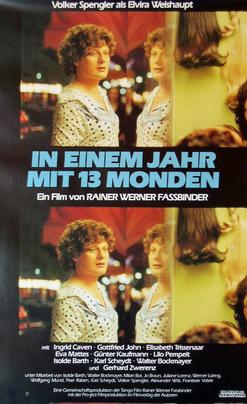
In a Year With 13 Moons


In a Year With 13 Moons (Rainer Werner Fassbinder, 1978)

This drama follows the last few days in the life of Elvira (formerly Erwin) Weisshaupt. Years before, Erwin told a co-worker, Anton, that he loved him. "Too bad, you aren't a woman," he replied. Erwin took Anton at his word. Trying to salvage something from the wreckage love has made of his life, he now hopes that Anton will not reject him again.

2016-03-08

Veronika Voss


Veronika Voss (Rainer Werner Fassbinder, 1982)

Munich, 1955: A sports journalist meets Veronika Voss (Rosel Zech), an UFA actress who supposedly had an affair with Goebbels. Now declining, Voss is kept by her "kind" doctor, Dr. Katz, supplying her house, food, clean clothes and her favourite: morphine. Voss, trying to come back towards the cinema, cannot perform an absurdly simple scene, but it attracts the attention of the journalist, who suspects that something's very wrong regarding her doctor.

2016-03-04

Lola (1981)


Lola (Rainer Werner Fassbinder, 1981)

West Germany, late 1950s: Lola is a singing prostitute working in a brothel that the town's bigwigs, even the mayor, like to frequent. To the annoyance of the corrupt construction entrepreneurs, especially a crass man named Schukert, the town's new building commissioner von Bohm is an honest and idealistic man who tries to clean up the building license politics from bribery and cheating. 

2016-03-01

The Marriage of Maria Braun

The Marriage of Maria Braun (Rainer Werner Fassbinder, 1979)

A World War II widow seeks to adjust to life in postwar Germany.

2015-10-26

The Cabinet of Dr. Caligari


Note : this review is a contribution to The Silent Cinema blogathon hosted by In the Good Old Days of Classic Hollywood and Lauren Champkin.

The Cabinet of Dr. Caligari (Robert Wiene, 1920)

Dr. Caligari's somnambulist, Cesare, and his deadly predictions.

2014-02-21

Destiny aka Behind the Wall


Destiny aka Behind the Wall (Fritz Lang, 1921)

In the Expressionistic frame story, in which human lives are each represented by a candle, Death grants a woman three chances to save her lover, if love can triumph over death. The three stories within the story each occur in a setting that is nominally historic, but really in the realm of fantasy: an adventure tale with a Persian setting out of the Arabian Nights, a Renaissance Venetian romance, and a largely comic story set in China.

2014-02-14

The Bitter Tears of Petra von Kant


The Bitter Tears of Petra von Kant (Rainer Werner Fassbinder, 1972)

This film has an all-female cast and is set in the home of the protagonist, Petra von Kant (Margit Carstensen). It follows the changing dynamics in her relationships with the other women.

2013-10-24

Nosferatu the Vampyre

Nosferatu the Vampyre (Werner Herzog, 1977)
This Gothic homage to F.W. Murnau’s Expressionistic masterpiece of 1922, brings to the big screen another vision of the classic story of Dracula. Shot simultaneously in German and in English, Werner Herzog’s version of Nosferatu highlights the bleak bringing of the plague and the loneliness of its title character.

2013-03-01

M (1930)

M (Fritz Lang, 1930)
This article is part of a series of self- imposed movie reviews set in the participation of this film critic to the 1001 Movies You Must See Before You Die Club. It is an attempt at catching up the reviews that I’ve missed in my recent period of inactivity in the blogosphere.
Films from Germany made prior to the Second World War are a bliss for any film lover. So much of the influence and themes of German Expressionism aesthetics has been imported by Hollywood especially its greatest directors : F.W. Murnau and Fritz Lang. In the case of Lang, he escaped Nazi Germany in an anecdote Lang himself contradicted many times while telling it. However, before he flew to America, Lang made a name of himself by directing some of the most influential films of all-time with his Metropolis, Spione, Dr. Mabuse, Die Nibelungen, and M amongst many others. With M, Lang tells the story of a serial killer pedophile who infuriated the public opinion, the police, and the underground gangsters. It creates a race between the policemen and the gangsters because the police was thinking that it was the underground that was responsible for those horrible crimes.

2012-12-12

Ali : Fear Eats the Soul


Ali : Fear Eats the Soul aka Angst essen Seele auf (Rainer Werner Fassbinder, 1974)

Emmi, a woman truly in the second half of life, falls in love with Ali, a Berber guest worker more than ten years younger. When they both decide to marry, everybody seems to be against them. When the folks calm down a bit, Emmi and Ali get deeply unsure about their relationship.

Shot in 15 days, this “throwaway” film by German New Waver Rainer Werner Fassbinder became his most famous and recognized movie. Based on Douglas Sirk’s melodrama All That Heaven Allows, Ali: Fear Eats the Soul is far from being a remake of the 1955 gem. It is a film that portraits a situation that creates reactions from the audiences. Almost forty years later, it is easily conceivable that a couple of a German woman in her sixties and an Arab man in his thirties will be rejected and seen as “dirty”.

2012-03-22

The Blue Angel

The Blue Angel aka Der blaue Engel (Josef von Sternberg, 1930)

The first sound film of the Weimar Republic picture two of the most famous actors of their time Emil Jannings and Marlene Dietrich. This is the film that made Dietrich became the sex symbol she represented for years. It also was the last English spoken film of Jannings who had a too prominent German accent for the American audiences. Behind the camera was one of the most talented filmmaker of his time Josef von Sternberg who actually discovered Dietrich in a cabaret and eventually became her lover for a while. The explicit sexuality of Dietrich transcends the images and time, and I am sure von Sternberg felt this at first sight just like the Professor Immanuel Rath (Emil Jannings) when he saw Lola Lola (Marlene Dietrich) singing Falling in love again.

2011-12-12

Das Boot

Das Boot aka The Boat (Wolfgan Petersen, 1981)

Before I start I want to make clear that this review is about the TV version of this feature that has been release in three different format: the Theatrical release, the Director's Cut aka TV version, and the mini-series. This viewing was a part of my quest to watch the entire list of the 1000 Greatest Films of the passionate folks at They Shoot Pictures Don't They? Das Boot being the 508th film I've seen from the list I am way ahead my goal to achieve my 500th film by the end of 2011. This adventure/War/Action/drama transgenre extravaganza from writer director Wolfgang Petersen a director who made more ordinary movies than he did great films managed to do an ok job with Das Boot. Since the film has its confortable spot on IMDb Top 250, a list I don't really give too much credit, still it gives the recognition of a popular film amongst film enthusiasts. I had more than one good reason to watch it. Anyway, it wasn't a film I wanted or had the urge to see. However, I recorded it on my DVR and it was time to give it a spin.

Introducing us to the crew of the u-boat by the exterior journalist as the witness of the inside of the litteral machine that is the works of this ship, was a classic yet efficient way to dip the audience into the core of the sets and society that represents the whole film. The kind of job that isn't related to mariners or army men makes it even more reliable to us while we enter this closed fauna. However, I think this technique is kind of bold and lacks in originality especially here, in a three hours film where anyway you get into the action and the suspense, no matter if you don't belong here no one belongs into a war!

At the same time I quite enjoyed lots of interesting aspects of the plot, the German side in the Second World War shot by Germans: I mean, how many German films were made about their side of the whole events and depicted their almost doomed ending in the last moments of the war? I can't relate to much either especially before 1981. Also I want to give credits to Petersen for having directed a very efficient film on the side of suspense, tension, and understanding of the moments of reclusion and bore these guys should have lived in the submarine. There's a claustrophobic kind of feeling when you are watching Das Boot as in the same time when the ship sinks into the depths of Ocean it almost feels like the comfort and safety of being inside the u-boat and not outside gives it a sense of maternal symbolism to the ship. Even if the whole crew is in the worst place it can possibly be I think that these are the greatest and most succesful moments depicted. The character development is at its best and the relationships between the men has this little thing that missed all along the rest of the film, urgency and enough time to let the moments fill the scene. It is almost as if the time stopped and the film took a step in quality.

After all the wait and the expectations about seing Das Boot I probably got my expectations too high or wasn't really interpelled by the story and its whole "dénouement", it kinda bored me and even if the aforementionned scenes were interesting I don't hink the entire movie is worth the time spent for the enjoyment or entertainment it brought to me. It reminded me of the Band of Brothers miniseries. It was all about entertainment, action, and few character developpment a piece of History brought back to life to fulfill the taste of distraction but no real approach or comment about war and the consequences of it all. It doesn't have to be moralist about it but at least present a coloured view and/or commentary. Worth a look.

Related Posts Plugin for WordPress, Blogger...