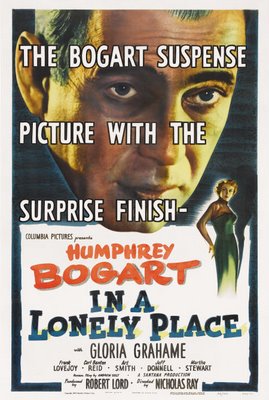
Editor’s note : this review is a
translation of one of the first reviews to ever appear on this blog back in
2009. Those were less than a 150 words long and were written immediately after
the viewing of each film. This is as aforementioned a translation and a longer
edit of this original film review.
In a Lonely Place (Nicholas Ray, 1950)
A potentially violent screenwriter is
a murder suspect until his lovely neighbor clears him. But she begins to have
doubts...
One of the
many films of the 1950’s that is considered as part of the Film Noir genre with
crisp black and white, legendary director Nicholas
Ray, and Humphrey Bogart. Add to
that Ray’s wife at the time, Gloria Grahame, and you have a great
film on paper.
The opening
scene is a piece of anthology by itself in Bogart’s
filmography, his character Dixon Steele, a drunk screenwriter on a dry spell,
is in a bar and gets to punch a man, insult another one, and gets into a
fistfight. All of that at noon. He represents the wounded man that Bogie always
succeeded to portray in films. The perception of this actor can be compared
with this character as a man that is mysterious and a bit rude like a wild
animal that struggles to be around his peers.
When someone as important and influential to Cinema as Jean-Luc Godard states that Nicholas Ray’s Bigger Than Life is one of the ten most important American sound film. No matter if it wasn’t well received at its initial release one must watch it. It is also a part in Martin Scorsese’s Introduction to American Films. Moreover, being on the list of the 1000 Greatest Films of All Time, this family drama starring James Mason as Ed Avery, Barbara Rush as his wife Lou, and Walter Mattau as his best friend Wally is also the work of a true auteur : Nicholas Ray. Godard, the same recognized luminary mentioned earlier, boldly stated that Nicholas Ray is the Cinema.
Defined as a cult classic, and often cited as one of the greatest films of one of the most recognized auteurs in the minds of the greats of the French New Wave, read here Jean-Luc Godard and François Truffaut, Nicholas Ray’s Johnny Guitar stands as a superb and innovative Western. The directors you can look for when you are listing the best Western genre filmmakers are of course John Ford, Howard Hawks, and Anthony Mann. Often forgotten, is Nicholas Ray with his Freudian approach to the genre and a redefining “mise en scène”. The “classic” Western used to be a very macho thing and the women’s roles often were characterized by their simplicity and their somewhat absence. However, here in Johnny Guitar the presence of Joan Crawford as Vienna is central and essential.
The context in which the film was created was McCarthyism in the United States and the subtext of Johnny Guitar is all about how the mass perceives the outsiders and how those outsiders are excluded. The script, written by Ben Maddow but credited to Philipp Yordan, was the work of a man (Maddow) blacklisted at the time because of leftist involvement. As the true auteur, Ray was also an outcast all his life, with auto-destructive manners and strong rumours of his bisexuality, Johnny Guitar reads like one of the most personal films ever made. It involves the struggle of everyone between good and evil and how the characters cannot be all black or all white. They are portrayed as humans and nobody’s a hero or a complete antagonist devoid of feelings. The inner struggles of its creators are reflected in a controlled yet magnificent creation that is Johnny Guitar.
Despite its flaws, and yes it has some, I would like to cite my colleague Kevyn Knox that himself quoted François Truffaut “we don’t like those films even with their flaws, we like them for those flaws”. I would like to add to this the fact that as critics we always like to praise perfect films with great directing, amazing acting, superb editing etc. But as a cinephile I tend to prefer the lesser or not the masterpiece films of a director. In example, my favourite Howard Hawks picture is Hatari!. I know that this is far from being his Rio Bravo, His Girl Friday, or Bringing Up Baby, but I will prefer a great film to a flawless picture. This is why Johnny Guitar is often categorized as overrated by its detractors for its many flaws and lesser contribution to the seventh Art. However, since it’s my review and my rating I will mete Johnny Guitar a 5 star rating.
Le Panthéon des cinéastes les plus influents de l'histoire du Cinéma est une suite à mon article sur les 25 plus grands selon mon décompte personnel.Ce que je définis en tant que Panthéon des réalisateurs sont les grands qui ont marqué l'histoire du Cinéma et qui ont amené à un niveau supérieur le langage cinématographique et, de plus, ont laissé un héritage incontestable à des générations de cinéphiles.
Les membres de ce Panthéon sont: Alfred Hitchcock (1er) Orson Welles (2e) John Ford (3e) Jean Renoir (4e) Stanley Kubrick (6e) Billy Wilder (12e) John Huston (14e) Howard Hawks (15e)
Cette liste est probablement discutable et certaines omissions et/ou modifications sont certainement à noter. Cependant, je n'ai pas encore vu de films de plusieurs Cinéastes de grande importance. Néanmoins, je désire ajouter quelques noms qui ont été exclus par faute de place et parce que je ne désirais pas monter une liste trop longue. *Il n'y a pas un ordre particulier pour cette liste. Michael Powell & Emeric Pressburger David Lean Nicholas Ray Otto Preminger Douglas Sirk Frank Capra Preston Sturges
TSPDT Greatest Films #301 In A Lonely Place (Nicholas Ray, 1950) Tout récemment j'ai fait la découverte de deux films de l'un des plus grands Cinéastes américain; Nicholas Ray. En premier lieu, c'est son Rebel Without A Cause qui me le fait connaître. Avec James Dean en tête d'affiche, ce film sublime ne m'avait pas attiré en premier lieu. Cependant, le visionnement de ce film m'a démontré la sensibilité franche de Ray et sa compréhension universelle du passage de l'enfance à l'âge adulte par le cheminement ingrat mais obligatoire qu'est l'adolescence. Rebel est un film qui n'a pris aucune ride avec le temps. À voir absolument! Le second film que j'aborde est le chef d'oeuvre qui réunit Humphrey Bogart à Nicholas Ray; In A Lonely Place. Tourné en 1950 en plein dans l'explosion du film policier américain qui plus tard deviendra le genre reconnu aujourd'hui comme le Film Noir, In A Lonely Place est un tour de force tant par sa réalisation serrée que par son scénario imprévisible. Ray démontre une grande force dans son utilisation de la tension entre les personnages dans son récit. On peut comparer sa manipulation de l'auditoire, d'une certaine manière, à ce qu'Alfred Hitchcock réussit à faire avec ses meilleures œuvres.
C'est un film à voir tant pour son histoire qui évoque le genre Thriller que pour la maitrise de Nicholas Ray et que pour le jeu très nuancé de Bogart