Showing posts with label 1959. Show all posts

2016-11-22

The Monster Of Piedras Blancas

The Monster Of Piedras Blancas (Irvin Berwick, 1959)

The monster, which looks like a nastier version of "The Creature from the Black Lagoon," invades a sleepy lighthouse town. The superstitious lighthouse keeper is worried for the safety of his beautiful teenage daughter, so he leaves food for the monster, who dwells in a nearby cave. When bodies wash up ashore, the locals take notice.

2015-03-13

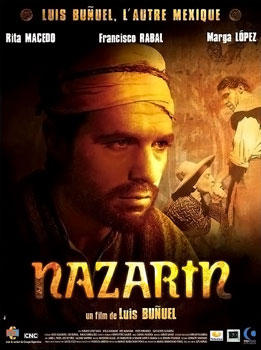
Nazarin


Nazarin (Luis Bunuel, 1959)

Nazarin is a priest, attempting to living a pure and honest life strictly according to Christian principles - but others only show him distrust and hatred, apart from the local prostitute...

Of Luis Bunuel’s Mexican period many major films have earned their recognition with Film History. Nazarin is without a doubt one of them. Winning the 1959 International prize at the Cannes festival this story of a defrocked priest trying to help and preach in a world of poverty, sickness, and injustice. As Jeffrey M. Anderson mentioned in his short and sweet review Bunuel’s Nazarin is very down to earth and his far from his surrealist cinematic approach. Anderson also highlights with his great knowledge of John Ford’s films, that Nazarin feels like Ford’s The Fugitive and was shot by the same cinematographer Gabriel Figueroa. The later’s camera work is subtle, natural, dusty, highly filled with sumptuous camera movements that captures the arid exteriors and darkens the interiors.

Religion is a central theme in Bunuel’s filmography and his treatment has often criticized by subversive manner the subject and how sometimes messianic figures can be psychotic, illogic, and contrary to moral or common sense. His moral often permitted to his storytelling abilities to punch in the face of his subject without getting too much blame.

With Nazarin, Bunuel wants to pass a message that even the most good willed fellow can fail to help their peers. Every scene ends with Nazarin letting the people in a worse position that they were before he got there. He leaves the hotel and the prostitute he was helping put fire in his room and burned down the whole place, then the workers get into a fight after he left the field, and on and on. He doesn’t solve a problem and, in fact, he tries but never succeeds. This is subtle for Bunuel but it is like as if Bunuel has decided that humanity has failed religion and not the other way around.

Nazarin is a deep film filled with deep meanings and is one of the best from Luis Bunuel’s Mexican era along with his masterpiece Los Olvidados. The fans of the director are split in two groups; the lovers of the Mexican period and the lovers of the French surrealist era. I would be more inclined to rewatch his later films that are in the second group but the whole body of Bunuel’s work is way richer with his early Spanish films, his Mexican ones, and his comedic surrealist French films. Nazarin is a must see but way more sober than The Discreet Charm of the Bourgeoisie.

2014-07-13

Night of the Ghouls

Note: this review is a contribution to the Accidentally Hilarious Blogathon hosted by the great folks over at Movies Silently. A blogathon of unintentional humor in classic film.


Night of the Ghouls (Edward D. Wood, Jr., 1959)

The sequel to Ed Wood's infamous Plan 9 From Outer Space, Night of the Ghouls presents the story of a phony medium called Dr. Acula (Kenne Duncan), okay they had me right there

2014-03-19

The Tiger of Eschnapur


The Tiger of Eschnapur (Fritz Lang, 1959)

Fritz Lang returned to Germany to direct two films The Tiger of Eschnapur and The Indian Tomb, which together tell the story of a German architect (Paul Hubschmid), the Indian maharaja (Walter Reyer) for whom he is supposed to build schools and hospitals, and the Eurasian dancer (Debra Paget) who comes between them.

2013-12-13

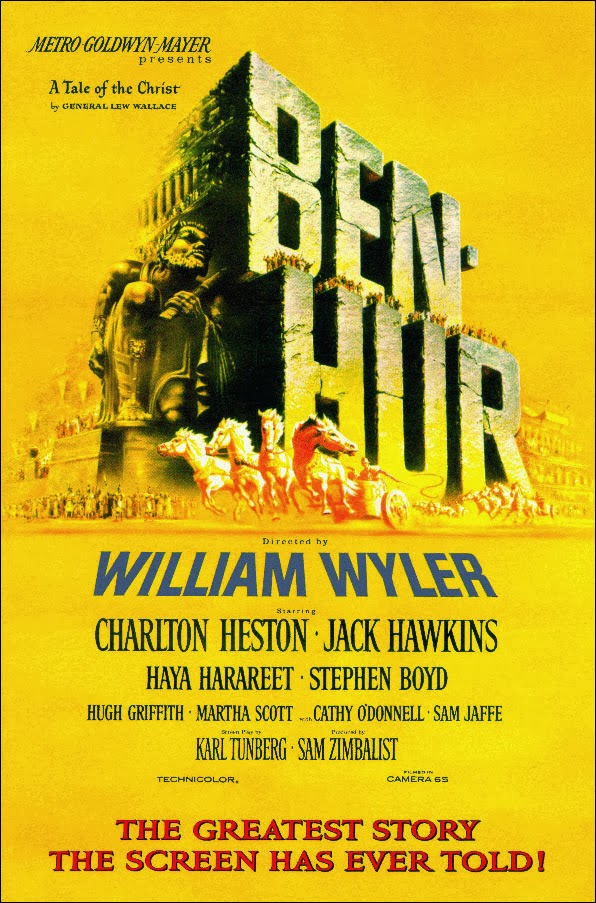
Ben-Hur (1959)


Ben-Hur (William Wyler, 1959)

Still holding the record for the most wins at the Academy Awards with 11, tied with Titanic and The Lord of the Rings : The Return of the King, Ben-Hur directed by William Wyler and starring Charlton Heston as its title role, defines the genre of biblical epic film. 

2013-04-16

Imitation of Life (1959)

Imitation of Life (Douglas Sirk, 1959)
A woman, Lora Meredith (Lana Turner), has lost her daughter (Susie) while away at Coney Island for a day of leisure. In the meanwhile, a nice woman (Juanita Moore as Annie) took care of her along with her own daughter, Sarah-Jane. When Turner finds her daughter with Annie, she accepts to take the mother and child in their apartment. Annie, a black woman with a white child, becomes in the same time Lora’s maid and helps her raise Susie while she struggles to get into show-business and follow her ambitions. It is a story at first about a woman who’s ambitions leaded her to success but also to neglect her family and potential lover. It is also about how coloured people had to suffer in America in the 1950’s, it is unbelievable to actually witness intolerance and how director Douglas Sirk actually criticizes racism. The film can even be split in two halves because the second half is mostly about Annie and Sarah-Jane and the first half about Lora, Susie, and Steve (John Gavin).

2012-11-29

North by Northwest

North by Northwest (Alfred Hitchcock, 1959)

A hapless New York advertising executive is mistaken for a government agent by a group of foreign spies, and is pursued across the country while he looks for a way to survive.

After the famous shower scene of Psycho, the scene of the chase of the crop duster after Cary Grant is the most recognizable Hitchcock moment. With this film, Hitchcock wanted to check many things on his long list of elements he liked and wanted to include in a film. First, the presence of Cary Grant his favourite leading man with whom he didn’t had much to ask except; be Cary Grant, a natural comic actor with a bad temper as being a prima donna. But his presence in the credits was instant box office success and he represented everything Hitchcock wanted to be: handsome, athletic, and popular amongst women.

2010-12-13

Apur Sansar (1959)

Apur Sansar (Satyajit Ray, 1959)

The last chapter of the trilogy of Apu by Satyajit Ray concludes this autobiographical story of its director with mastery. Apu just lost his mother and is out of school without a "real" diploma. He decides to become a writer and he teaches to pupils as a living. He hardly gets want he needs to survive. His life is miserable and it doesn't seem to get better. One day his best friend come visit and invite him on a wedding in his family. Apu accepts but on the arrival of the groom the family of the discovers that the groom is mentally ill. They decide to cancel this wedding, but the bride must get married before the sunset. If not, she will be cursed. The only solution is to take Apu as her husband. With a little resistance and lots of compassion, Apu accepts again and marries Aparna.

For a while, they live something like a happily life together until Aparna gets pregnant. She returns to her family to have the baby but a dramatic event occurs and Kajal, their son is the result. Once again, Apu gets on his own and disappears. His journey will take messianic scale. However, in conclusion he'll renew with his son Kajal and the journey of the life of Apu will continue forever.

Like the other films of the trilogy, Apur Sansar is shot with crude natural images and rests on the human Indian life. Ray approach to film is near the documentary because it documents how Indians lived and many cultural elements that are unknown by any Occidentals like your host here. The rites of marriage, the couple lives, the food making, etc. Satyajit Ray was the John Ford of his country he took a picture of his land, his time, and the richness of both to spread wide to the whole world. It's shame that his films are so hard to find in North America because his Trilogy is populated by three masterpieces.

2010-12-07

Le signe du lion (1959)

TSPDT Greatest Films #936 Le signe du lion (Eric Rohmer, 1959)

Eric Rohmer's first feature film is not his most interesting effort but still worth the look. Pierre, an American musician living in Paris on the hand of his wealthier friends receives a telegram telling him that he inherited from a rich aunt. A while after, he receives another invoice telling him that finally he doesn't inherit anymore. Having already spent all of his money celebrating the good news he doesn't have a cent when he hears the bad one. Meanwhile, his rich friends are all out of Paris on vacation, so he crashes on the street begging and living like a poor.

His poverty is represented with him wandering in the streets with a violon that gets more and more annoying as long as the films goes. The violon tune reminds of a Chaplinesque violon used to illustrate poverty and hunger. Despite, reminding some Antionionesque loneliness, Le signe du lion seems long and unmastered. The actors could have been directed with more disciplin and the film doesn't have this French New Wave energy and freshness one could hope to discover with a French film of 1959, i.e. À bout de souffle, Les 400 coups. I would recommend Eric Rohmer's Six Moral Tales before going for Le signe du lion even if it's a film to see to fully understand Eric Rohmer's "parcours".

2010-07-25

À bout de souffle

À bout de souffle (Jean-Luc Godard, 1959)

One day I've read somewhere that everything has been written, but not by me. Well, this review or essay will try to do what Godard did himself with À bout de souffle; everything has been done but not by him.

I have to admit that the first time I watched À bout de souffle I hated it to its deep core. I called JLG a dilettant and a boring pretentious wannabe filmmaker. You what? I think Godard intentionally made a film that could provoque this kind of reaction. He likes to provoke the spectator to make him think. Well it worked because many years after, the film stuck in my mind and different parts of it were recurent memries. After watching it again lately I had the urge to write down, or type down if you prefer, some thoughts about it.

Something new, no something different!
At the first viewing of À bout de souffle I must admit that I didn't knew very much who was Humphrey Bogart, Jean-Paul Belmondo or even Jean-Luc Godard himself. I am currently reading Antoine De Baecque's biography on Godard, that I deeply recommend by the way. The more I know about Godard the more I understand and appreciate his films.

The story of À bout de souffle is simple and very Hollywood film noir oriented: a young man Michel Poiccard (Jean-Paul Belmondo) steals a car and on the run on a provincial route to Paris he kills a policeman. He goes to Paris and tries to get paid for some earlier car thief and most importantly he wants to find Patricia (Jean Seberg) an American girl he "likes". Michel plays a tough guy "à la Humphrey Bogart" and even his twitch is inspired by Bogart's character in The Big Sleep; Bogart constantly rubs his ear.

From the first scene and even the first words pronounced in À bout de souffle we actually know that Poiccard is doomed: Je suis con! Ah ce que je suis con! "I'm dumb! Ah! I'm so dumb!". Just before he steals a car. Then he goes on the run and kills a cop. In these first scenes all the genius and creativity of Godard is demonstrated: the jump-cut and the narrative. The editing of the scene on the road is done with such slight angles between the takes that the viewer is destabilized. It's unnatural and if you asked a technician of the time he would say the scene just can't work. Well, it works very well! Without mentionning it or giving any indications on it the scenes are cut like a comic book. They seem to be shot in continuity but the eye knows that it is not the case. Same thing happens when Michel shots the policeman we see the gun for a second, we hear the gunshot and after we see the policeman falling near a tree. But we don't actually see Michel shooting the gun and the bullet entering the body. Why? Well Godard took for granted that any spectactor has seen this scene a thousand times shot the same classic way. Well, at first it may seem that Godard didn't knew how to shot a like that but it's the complet opposite he exactly knew how anyone would have shot that scene so he does something completly different.

If Antoine Doinel was François Truffaut, is Michel Poiccard Jean-Luc Godard?
There have been three biographies written on Jean-Luc Godard, a man that always tried to be mysterious and provocate with his films and declarations. I don't think that at nearly 80 years old he will ever write an autobiography, because there are so much in his films about himself that it is our job to take all the elements and put them together to try to understand the man, his oeuvre, and life itself.

Michel Poiccard represents the teenage years of JLG, like his character he used to steal, lie and sleep with many girls. Godard was in his teenage years a soft delinquent from a wealthy family on his mother side; the Monods. Like Poiccard, he tried to be against the current by stealing in order to get a little for each day. The long scene in Patricia's apartment represents the juvenile preoccupations; getting up at 12PM, sleeping and fooling around without any real ambition in life. Like Quentin Tarantino does in his films, Jean-Luc Godard gives lines to his characters that explains his preoccupations and his ideas. The interview scene when Patricia asks: "Quelle est votre ambition dans la vie?" for the second time and the writer answers: "Être immortel et ensuite mourrir" we can interpret thoses lines as the lines of Godard himself: with this film I want to become immortal. In the way of being recognized forever in the memory of humanity instead of never die.

Deep Impact or Jean-Luc Godard is Cinema
As of today, 50 years after its release, À bout de souffle is recognized by initiates as a masterpiece. To others, its the symbol of the French New Wave, and for some it's just another boring french film.

It's appreciation is not the most important, it's its impact on filmmaking and its reflexion of Cinema itself. In À bout de souffle when can find many references from the many filmmakers Jean-Luc Godard admired, the three scenes where conversations are muted by noises, just like Alfred Hitchcock's films. The use of handheld cameras. The exteriors filmed on the Champs Élysés and the streets of Paris instead of the studios. The many improvised scenes like Roberto Rossellini's Neorealist films and we can go on for another 1000 words on the references. In France the impact was huge and after this approach or this way of filming inspired the generation of the second golden Age of Hollywood Cinema the 1970's: Martin Scorsese, Francis Ford Coppola, Robert Altman, Terrence Malick, etc.

À bout de souffle carried every ingredient that Godard praised in 1950's Hollywood Cinema and reinterpreted its recipe to serve it back. Sometimes an external point of view gives you the push you needed to push yourself to a level you wouldn't expect yourself to able to attain.

If you don't like Godard, you don't like Cinema! to cite someone I don't remember whom but I think it was so right.

This is an uncommon lenght for a review here but I think great films inspire dense reviews. À bout de souffle is a passionate film from a passionate filmmaker.

Related Posts Plugin for WordPress, Blogger...