Showing posts with label Luis Bunuel. Show all posts

2015-04-10

The Exterminating Angel


The Exterminating Angel (Luis Buñuel, 1962)

The guests at an upper-class dinner party find themselves unable to leave.

Often described as the twin film to director Luis Buñuel’s own The Discreet Charm of the Bourgeoisie, The Exterminating Angel is a surrealist exercise of style and screenwriting. Again shot by long time collaborator to Buñuel, Gabriel Figueroa, The Exterminating Angel is the story of a group of high class bourgeois that are invited at a dinner party after the opera. Strangely as the guests arrive to the mansion almost all of the domestics leave the house just like rats in a lost ship. Then with twenty seven various repetitions in the story the guests are isolating themselves in the house and have to live together in this island. Much like a play on Lord of the Flies or an essay on Jean-Jacques Rousseau’s writings, Buñuel demonstrates how decorum and ethic codes are pompous and empty when humans are piled like a horde of dogs together.

While playing on the edge of comedy, social commentary, and experimental cinema, Buñuel was a one of a kind storyteller. Even more with The Exterminating Angel than with The Discreet Charm he had to convince us of believing such a story and not make us blink with the repetitions. The first two repetitions are quite obvious with the two arrivals of the guests and the two toasts but as the story goes the subtlety of those is almost unperceptible. Just like the characters of his story, Buñuel wants to debilitate us from seeing with our conventional and conformist eye.

In this social commentary by The Exterminating Angel, there’s a clear contempt of the upper-class and its ways. Presenting them as animals or even as wolves. It is clear that Buñuel couldn’t have made such movies some those themes under the Hays code in USA. By chance, Mexican backers believed in their director and left us a great heritage of unique films of great quality.

2015-04-02

Él


Él (Luis Bunuel, 1953)

Francisco is rich, rather strict on principles, and still a bachelor. After meeting Gloria by accident, he is suddenly intent on her becoming his wife and courts her until she agrees to marry him.

With the important number of films by Luis Bunuel that are available from his Spanish period, his Mexican exil, and his late French cinephiles from around the world can at least get something for their tastes. Even if he is more reknown for his French surrealistic films, Bunuel took many genres under his particular signature and directed essential timeless films.

With Él and its story of an obsessive lover filled with jealousy, frustration, and paranoiac persona Bunuel will go on and make one of the most interesting thrillers that will go and inspire the great Alfred Hitchcock with his scene in the church bell tower. He also used jump cuts to let his viewer know the anti-hero’s point of view and how he perceives people.

Él was the kind of film I went into with no idea what was the subject and a little bit of a reluctance for another Mexican film from Bunuel fearing this might be a lesser film from the filmmaker. However, this is one of his films I enjoyed the most lately. The only negative comment I would have to say is not even about the film itself but the french subtitles that were poorly translated. As a french speaker, Spanish is also a Latin language and I understand some bits here and there of Spanish and Italian but I could sense that some subtitles needed to say more or were just not right for the scenes. This is a case where the old adage of lost in translation is right for the moment.

Personally, I would rank Él really high but not quite a masterpiece despite the elegant cinematography by Gabriel Figueroa, the elegant but pompous sets of Franscisco’s house, and the use of modern psychology for the central character’s mental disorder. If I would make a list of the 1000 Greatest films of all time, something I am planning to do sometime when I’ll finish the one from They Shoot Pictures, Él will be on it without a doubt.

Of the fifteen Luis Bunuel films listed on the 1000 Greatest Films list, I know have seen eleven and I enjoyed each and every one of them. Needless to say that I digged Él very much. The thriller value and the obsession of love portrayed here makes it one of the most efficient films on paranoia and mental illness.

2015-03-27

The Criminal Life of Archibaldo de la Cruz


The Criminal Life of Archibaldo de la Cruz (Luis Bunuel, 1955)

The delirious journey of a mental disordered man, who is obsessed in making the perfect crime.

Another film from Luis Bunuel’s Mexican period, The Criminal Life of Archibaldo de la Cruz, works on many recurrent themes of the director’s filmography with the use of dreamt or fantasized sequences, sexual provocation and its politics, and freudian elements of childhood traumas.

As with Bunuel’s other films of this era, this is a visually interesting film with sumptuous camera movements, and an imagery of suggestive sexual elements. With its overture with the death of the governess and the revealing of her legs you have everything that you need to know about this film. The suggestion that Archibaldo de la Cruz desires death to women and links it with sexual desire. Since that movie was made in 1955 it is easily readable as the choices to suggest sexual desire and not attribute the deaths to Archibaldo was to represent a repress sexual desire but also to respect some censorship rules. In fact, the movie is much more efficient in its representation of sexuality and the imaginary criminal life of its subject.

This is a deep film in its meanings and sadly a lesser known film in the vast filmography of its director. Sure it is not as important as Los Olvidados in his Mexican period, but The Criminal Life of Archibaldo de la Cruz is essential as to its use of many surrealist elements like the mirrors and Bunuel’s foot fetish.

On my main reference list as a movie watching goal, this is the lowest ranked film in the Bunuel selection. However, this is one of the most underrated and this surpasses many titles that don’t even deserve their spot on the list. Sure it is not as celebrated as Un chien andalou or The Discreet Charm of the Bourgeoisie but I believe that once a cinephile starts digging deeper into a cinéaste he must get into the lesser known titles and discover the director’s films as a whole.

Coming soon in my Bunuel reviews; El (1952) and The Exterminating Angel both also from his Mexican period. I’ll also try to get my hands on his most virulent punch in the face of religion Simon of the Desert and the last title I’ll have to watch will be Tristana that never really interested me.

2015-03-13

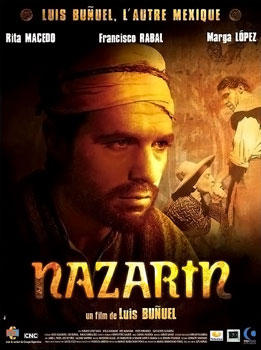
Nazarin


Nazarin (Luis Bunuel, 1959)

Nazarin is a priest, attempting to living a pure and honest life strictly according to Christian principles - but others only show him distrust and hatred, apart from the local prostitute...

Of Luis Bunuel’s Mexican period many major films have earned their recognition with Film History. Nazarin is without a doubt one of them. Winning the 1959 International prize at the Cannes festival this story of a defrocked priest trying to help and preach in a world of poverty, sickness, and injustice. As Jeffrey M. Anderson mentioned in his short and sweet review Bunuel’s Nazarin is very down to earth and his far from his surrealist cinematic approach. Anderson also highlights with his great knowledge of John Ford’s films, that Nazarin feels like Ford’s The Fugitive and was shot by the same cinematographer Gabriel Figueroa. The later’s camera work is subtle, natural, dusty, highly filled with sumptuous camera movements that captures the arid exteriors and darkens the interiors.

Religion is a central theme in Bunuel’s filmography and his treatment has often criticized by subversive manner the subject and how sometimes messianic figures can be psychotic, illogic, and contrary to moral or common sense. His moral often permitted to his storytelling abilities to punch in the face of his subject without getting too much blame.

With Nazarin, Bunuel wants to pass a message that even the most good willed fellow can fail to help their peers. Every scene ends with Nazarin letting the people in a worse position that they were before he got there. He leaves the hotel and the prostitute he was helping put fire in his room and burned down the whole place, then the workers get into a fight after he left the field, and on and on. He doesn’t solve a problem and, in fact, he tries but never succeeds. This is subtle for Bunuel but it is like as if Bunuel has decided that humanity has failed religion and not the other way around.

Nazarin is a deep film filled with deep meanings and is one of the best from Luis Bunuel’s Mexican era along with his masterpiece Los Olvidados. The fans of the director are split in two groups; the lovers of the Mexican period and the lovers of the French surrealist era. I would be more inclined to rewatch his later films that are in the second group but the whole body of Bunuel’s work is way richer with his early Spanish films, his Mexican ones, and his comedic surrealist French films. Nazarin is a must see but way more sober than The Discreet Charm of the Bourgeoisie.

2012-11-09

Los olvidados


Los olvidados (Luis Buñuel, 1950)

A group of juvenile delinquents live a violent and crime-filled life in the festering slums of Mexico City, and the morals of young Pedro are gradually corrupted and destroyed by the others...

Labelled as a surrealist, Luis Buñuel startles with this down to earth film that can remind of the Neo-Realists active at the same time in Italy. Recalling the modern near-masterpiece of Fernando Meirelles City of God, Los olvidados was one of the many influences on François Truffaut for his breakthrough film 400 Blows.  Genuinely violent and crude, Buñuel’s landmark of a movie is bleak, dark, and very personal. Instead of romancing the scums like, let’s say, Slumdog Millionaire, Buñuel depicts a world where no one is spared and where hope isn't what waits for you at the corner of every street. He deals with every problem possible and even the good natured characters have a sense of naivety that in real life there are no happy endings.

Our two main characters are Jaibo and Pedro. While one (Jaibo) is a thief and a recently escaped prisoner, the other is a little bum that follows him but still has something good inside him. However, since he faces adversity and a complete ignorance from his mother, he is split between the influence of Jaibo and his will to behave. Illustrated with a superb dream sequence that shouts Buñuel this situation is well exploited. On the other side, Jaibo is the representation of bad behaviour and the viewer has no choice but to hate the disgusting acts of the young man. It is indeed a revolting picture and the fact that the movie was shown only three days because it shocked the Mexican government can easily tell that it was not that far from reality. Shot by a recurrent Buñuel collaborator, Gabriel Figueroa gives a genuine almost documentary look to the images with his great use of lighting and shadows.

My first encounter with Buñuel was his masterpiece The Discreet Charm of the Bourgeoisie, and after I discovered his early surrealist films. Los olvidados might be a little unsettling in his filmography, while being personal with the dream sequence, the pouring of milk on the legs, and some sensual elements, every Buñuel enthusiast will get a kick out of it. During his Mexican exile he made many films that may deserve much attention but Los olvidados is the pinnacle of his passage in Central America.

2011-09-22

Le charme discret de la bourgeoisie

Le charme discret de la bourgeoisie (Luis Buñuel, 1972)


This is by far one of my favourite film of all time. Buñuel has always been a one of a kind director contributing with Salvador Dali on the surrealism with his Un chien andalou and L’Âge d’or, two masterpieces of moviemaking and dreamlike sequences that every self-respected cinephile should have seen. The symbolism of these instinctive films as so many levels of understanding and such depth that a simple essay on them isn’t enough to crack their codes.

Let’s get back to Le charme discrèt de la bourgeoisie made almost fifty years after Buñuel’s first films! What strikes you the most is how the surrealism that characterized his first films is still omnipresent but even more mastered than ever. Le charme discret de la bourgeoisie is the culmination of Buñuel’s work : the perfect surrealism film. The uses of symbolism and camera techniques is really subtle and Buñuel doesn’t need to slice the eye of a woman or get a cow in the bed of two lovers. The many situations of Le charme... are already overly enough and the closer to realism it gets the better it is. The dreamlike sequences that always feel like if you were in reality but finally you weren’t at all embarks the viewer on a trip with the bourgeois that are trying to get diner together and enjoy a nice evening.

This series of events is packed with humorous dialogues and situations. Just like Woody Allen, another admirer of Buñuel’s work, I feel that this kind of hybrid film where humour and reflection means entertainment and Cinema. It is a smart film where subtlety uncovers the hypocrisy, the fears, and the vices of the bourgeois characters populating the film. The uniqueness unity of Le charme... brings you in common places and then just when the viewer thinks he knows how the situation will turn out Buñuel gets a bunny out of his hat. This master has many tricks in his bag. You have to see the film to fully understand the reach of the whole thing.

In 1972, there were many big successes: The Godfather, Cabaret, Deliverance, What’s Up Doc?, The Getaway, Everything You Always Wanted to Know About Sex (But Were to Afraid to Ask), but in my opinion Le charme discret de la bourgeoisie along with Aguirre: The Wrath of God was the greatest film of that year. Unfortunately other films mentioned earlier will always make shadows on Buñuel’s greatest achievement.

2010-08-10

The Phantom of Liberty

Le fantôme de la liberté aka The Phantom of Liberty   (Luis Buñuel, 1974)

What characterizes Luis Bunuel in the history of films is the fact that he is probably one of the few filmmakers who adapted the surrealist concepts on the big screen in the 1920's, well during the surrealist period. His approach on filmmaking and storytelling brought many new angles to this art. On a career that lasted from 1929 to 1977, Bunuel had the time to direct 34 films.

Le fantôme de la liberté also known as The Phantom of Liberty is one of the best examples of a surrealist approach on a comedy of situations. Far from being Un chien Andalou or L'âge d'or, Le fantôme de la liberty is closer to a film like Le charme discret de la bourgeoisie. One thing charaterizes the films of Bunuel; the feeeling that we are watching the reconstitution of a dream or the dream into the dream. At some point, in these films we never know if it's a dream sequence or realit; it's never explained.

For the film regarded here, Le fantôme de la liberté, we are closer to a surrealist comedy that makes interfere many characters with each other. They populate the film each with his little story. Some stories seem to go in a direction and then at some point they go in a whole other avenue. Other stories are just unconcluded and it gives the viewer a sense of frustration because we are never asked to conclude or finish a story with character. It's like watching people on the street as they pass by us until they turn the corner and someone else comes by and attracts our attention with something completely different.

I tend to think that Bunuel attempted to criticize television that always cuts shows, films or whatever they present with publicities at every 13 or 15 minutes. A critic on the modern society that can't keep its attention on something more than the quarter of a hour. This thinking came to me when I remembered reading an interview with the late Luis Bunuel about the broadcasting of one of his films and was outraged to see it cut in half with a publicity about mattresses if I remember correctly.

Made in 1974, Le fantôme de la liberté is a fresh comedy like only Luis Buñuel could have make, a classic!

A review by Michaël Parent
Related Posts Plugin for WordPress, Blogger...