Showing posts with label 1963. Show all posts

2015-10-30

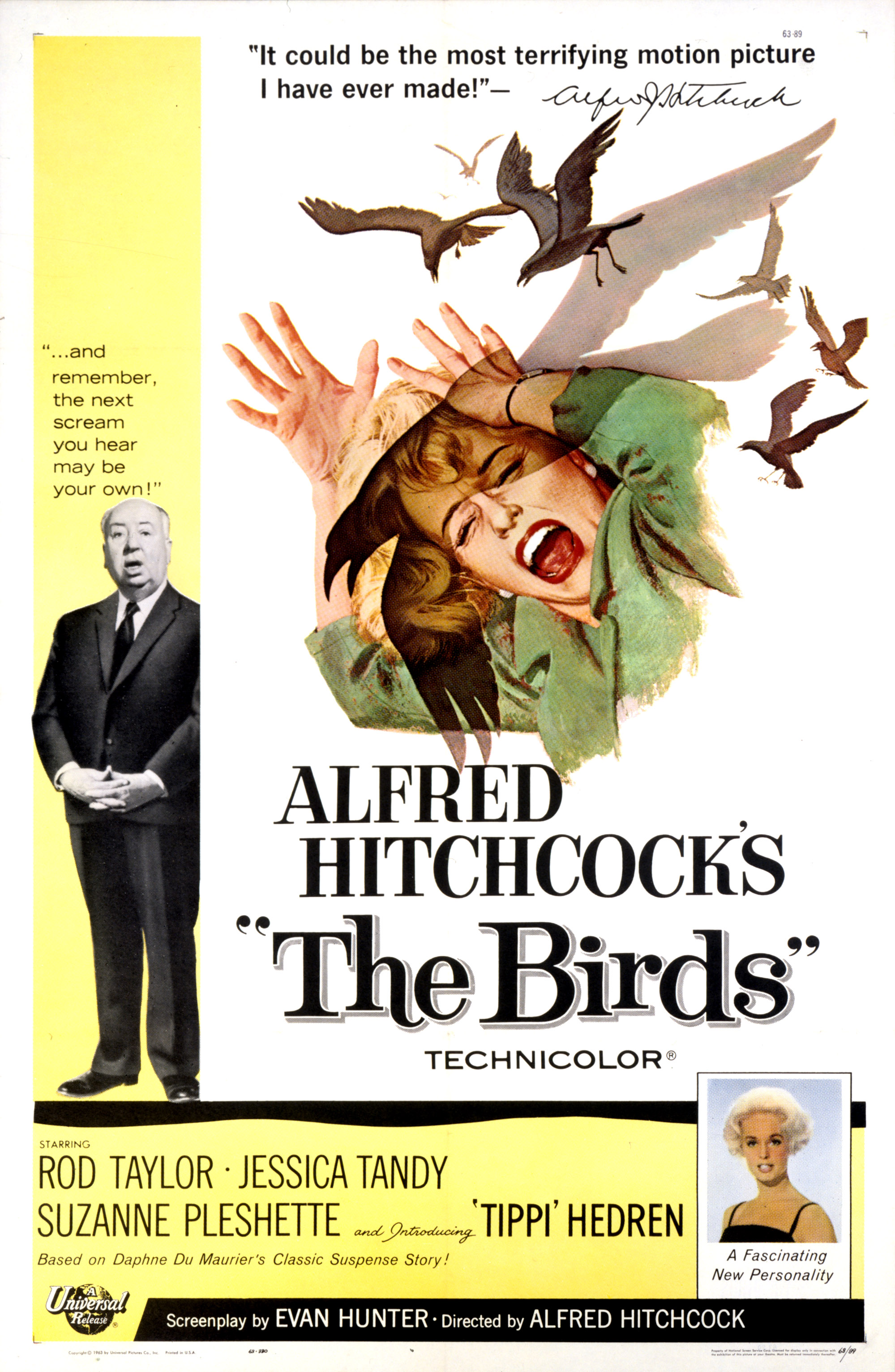
The Birds


Note : this review is a contribution to The Universal blogathon hosted by Silver Scenes.

The Birds (Alfred Hitchcock, 1963)

A wealthy San Francisco socialite pursues a potential boyfriend to a small Northern California town that slowly takes a turn for the bizarre when birds of all kinds suddenly begin to attack people there in increasing numbers and with increasing viciousness.

2014-01-31

An Actor’s Revenge


An Actor’s Revenge aka Revenge of a Kabuki Actor (Kon Ichikawa, 1963)

Three men, Sansai Dobe (Ganjirō Nakamura), Kawaguchiya (Saburō Date) and Hiromiya (Eijirō Yanagi) are responsible for the deaths of seven-year-old Yukitarō’s mother and father. Yukitarō is adopted and brought up by Kikunojō Nakamura (Chūsha Ichikawa), the actor-manager of an Osaka kabuki troupe. The adult Yukitarō (Kazuo Hasegawa) becomes an onnagata, a male actor who plays female roles. He takes the stage name Yukinojō. Like many of the great onnagata, particularly of the seventeenth and eighteenth centuries, he wears women’s clothes and uses the language and mannerisms of a woman offstage as well as on. Many years later, the troupe pays a visit to Edo, where the three men responsible for his parents’ deaths now live.

2013-08-06

Flaming Creatures

Flaming Creatures (Jack Smith, 1963)
Filmed in black and white on a film that was probably intentionally scratched and used this one of a kind short film of 43 minutes was seized on the first day it was shown in Greenwich Village. Its director, Jack Smith an openly gay man wanted to make a comedy that presented the ambiguity of sexuality and gender. Showing the human body in its most simple way and crossing the line between erotism, pornography, and the stereotypical of genders. It is quite obvious that Smith wanted to make a clash with the American conformity of the society and its preconception of everything. It is a punch in the middle of the face to all the conservatism and the heterosexual « normal » behaviors.

2012-10-19

The Haunting (1963)


The Haunting (Robert Wise, 1963)

Dr. Markway, doing research to prove the existence of ghosts, investigates Hill House, a large, eerie mansion with a lurid history of violent death and insanity.

Normally, this self proclaimed film critic would stay away from ghost stories and movies about supernatural manifestations because of an uncontrolled fear of the aforementioned made-up from mankind’s imagination. But two things got in the way of my fright of ghosts: first, they are the films that are on the quest I am rambling about all the time, second, my promises to myself and my beloved readers to get in the mood for Halloween and watch many Horror movies during October. Regarding my idiotic fear of ghosts, I know it is childish but I often have nightmares about those bastards. Plus, it probably comes from my childhood; my cousin and I were always watching Ghostbusters and we were four or five years old. Both, we are still afraid of phantoms. Well, enough with the confession and let’s do this.

In New England there was an evil House that a man named Hugh Crain build for his first wife. She died on her way to the house, then a series of strange deaths, suicides, and tragedies occurred in Hill House. With time and gossips, the house became known as a haunted house. To help his researches, Dr. Markway (Richard Johnson) leases the property and invites two women Eleanor (Julie Harris) and Theodora (Claire Bloom) because they have been in contact with the supernatural before. They also have along with them young cocksure Luke (Russ Tamblyn) who his the next heir to own the property.

It is not long after the movie opens that we understand that Eleanor is a tormented woman and that she is the central character of the movie despite her. Apparently, the house has something to do with her presence and the permanent inhabitants quickly manifest themselves. The frightening elements of the film are pretty efficient and the suggestion of the presence instead the showing of the actual ghosts is making the creep very chilling. The confrontation of logic from Dr. Markway and his interest for paranormal are themes that gives a strong foundation to the script of the film and reminds us that the ghosts are real and not some hallucination from one of the character.

For what it is with Robert Wise’s directing and mise en scène we are in for a treat. The editor of Citizen Kane, knows how to direct a wonderfully haunting (yeah, I did it) picture. Every frame is well shot and, at some points, I saw elements that reminded me of The Shining and Shutter Island. It was probably an influence on both Stanley Kubrick and Martin Scorsese. Especially The Shining, might have been influenced by it more than Kubrick might have wanted it to be. The stairs, the presence of the House and its hold on people makes it a distant parent to the Overlook Hotel.

Finally, The Haunting is one of the most successful ghost films I ever saw and the subtlety of the effects along with the depth of the story and Robert Wise’s sumptuous touch makes this a classic that will surely make my list of the best Horror films of all time. Recommended.


2012-06-08

The Great Escape


The Great Escape (John Sturges, 1963)

Being guided towards this movie by Quentin Tarantino’s 2002 list for the well respected and amazing Sight and Sound Poll I did not knew what to expect from this movie at all. Easily guessing it was a story of escapism and probably inspiring QT’s Inglourious Basterds at some point, John Sturges’ The Great Escape stars Steve McQueen, James Garner, Richard Attenborough, Charles Bronson, Donald Pleasance, and James Coburn. They portray a group of Allied prisoners specialized in escapism  in WWII jailed in an escape proof prison. Based on Historical facts, this setting is a gold mine for writers.

Their leader plans to take out several hundred at once. Just like John Sturges’ other successful film The Magnificent Seven (based on Akira Kurosawa’s Seven Samurai) it is based on a foreign classic film Jean Renoir’s Grand Illusion. Sturges is a master at remaking the spirit of a working film while Americanising it without losing the entertainment value neither the focal points of the script. In the case of The Great Escape, the final product is far better than The Magnificent Seven and less recognizable from the source material. Another aspect of Sturges is that it is clear that he is not Jean Renoir and that the depth of the message that the Frenchman wanted to spread with his film was a call for peace at the dawn of the Second World War. The humanist voice of Jean Renoir is inimitable and from this angle the American film of Sturges plays more on the fun and the thrilling suspense of the escape story more than the thought and evocation of the disaster that is a war.


A point that links both films together is the excellent performances of the ensemble casts and the evident presence of Erich Von Stroheim, Jean Gabin, Pierre Fresnay are superb. But Steve McQueen, Charles Bronson and the others gave capable and very good performances.

Sure The Great Escape is a more action centered film and the adaptation, or remaking if you prefer, kept the Historical facts of the actual story while “Hollywoodianize” it in the process. The stories of prison breaks are a genre that is proved to be popular and also very efficient as stories. Just watch Robert Bresson’s A Man Escaped or Jacques Becker’s Le trou to discover how these films aged well and still hold your breath. However, The Great Escape delivers a superbly intelligent entertainment.

2011-12-01

Les parapluies de Cherbourg

Les parapluies de Cherbourg aka The Umbrellas of Cherbourg (Jacques Demy, 1963)


Les parapluies de Cherbourg is the concretization of Demy’s childhood fantasy : to direct an entirely French musical. Brought into filmmaking by documentaries, Demy was the mellow part of the French New Wave. A member of the “left bank” because he lived on the left side of the river and because of his left approach on life, Jacques Demy made one of the first films of Catherine Deneuve and one of the most famous French film.

This wonderful tale of a beautiful romance is filled with lavish colours and entirely sang dialogues. At some point this ultimate effort of a total musical can get on the nerves of some viewers. I think it depends of the songs and the moments of the film. Moreover, I ain’t a great fan of musicals at the first place. I love The Red Shoes, Vincente Minnelli, Gene Kelly, and Stanley Donen musicals but it is at most what I can endure. A film like Moulin Rouge or Chicago was a total pain for my tastes. In the case of Demy’s film it is a question of mood, you have to be fully prepared to watch it and the quirky directing of Demy, the costumes, the sets, and many technical aspects can deeply bother someone with more subtle tastes and apprehensions. However, Les parapluies de Cherbourg was one of the most successful films of the French New Wave. The music by Michel Legrand has passed through time and still is a cultural reference for francophones like me.

The reference to Singin’ In The Rain is clear in the generic and Jacques Demy always presented his film like a ballet of umbrellas. Apart from being strongly influenced by Gene Kelly and Stanley Donen his French touch comes from Jean Cocteau, Robert Bresson and Austrian born Max Ophüls.

One of the most important aspect of this film is the rigorous reality of the facts presented by Demy. The dates and the Algerian War, two constraints the New Wavers didn’t give much importance. They didn’t wanted to make films about politics or economics. It was one of the first French films to evoke this conflict.

Even with its great success with the critics and the moviegoers on both sides of the Atlantic, Les parapluies de Cherbourg is a film I consider to have aged badly. My favourite scene of the film is the final one at the gas station with the Christmas scenery that fits with the overly coloured palette of costumes and sets. A nice film but not a favourite of mine.

2010-12-17

The Silence (1963)

TSPDT Greatest Films #452 The Silence (Ingmar Bergman, 1963)


Bergman's films always had simple stories presenting complex and intense emotions. The Silence is no exception here. Two sisters, Ester (Ingrid Thulin) and Anna (Gunnel Lindblom) travel with Anna's son. Ester is terribly ill and must pass most of her time in bed. She is an intellectual and writes a lot. Anna is still young and pretty and she easily makes contact with other human beings, getting a lover as soon as she arrives in the city. On the other side Ester would like to meet someone but she can't even leave her room. Meanwhile, Johan (Anna's son) discovers life in the corridors of the hotel meeting a troop of midgets for example.
The story, as stated before, may seem very simple but the emotions between the two sisters is so intense that sometimes we feel that this relationship always crosses the line of love and hate.

Sven Nykvist cinematography is once again impeccable with lots of crude lights and perfect camera positionning in every scene. The actress are, like every Bergman picture, tight and they inhabit their characters.

The Silence is simply another masterpiece in Ingmar Bergman long list of landmarks.

2010-11-30

La carrière de Suzanne (1963)

La carrière de Suzanne (Eric Rohmer, 1963)


Second part of the Six Moral Tales by Eric Rohmer, shot in the same year than La boulangère de Monceau, La carrière de Suzanne is in my opinion the lesser effort of the series. I kind of like how the tale is narrated but the "moral" isn't as interesting as in the other films. In Le genou de Claire, you have the elder man of 35 years old trying to seduce younger women, in La collectionneuse you have the man refusing advances from a "man eater" woman but falling in love while constantly refusing, and in L'amour l'après-midi you have the married man falling in love with another woman and escaping his life with a parallel life.

La carrière de Suzanne, is about a man who's in love with the girlfriend (Suzanne) of his best friend. The best friend is a selfish idiot who uses and disrespects Suzanne. The narrator will refuse to live his love with Suzanne because his friendship is dear to him and also because he seems to avoid it. This is the story of a subtle love triangle that will never evolve from apart of being unsaid.

Even if I think Eric Rohmer can hit, he can also miss and I think that La carrière de Suzanne is the lowest element of the Six Moral Tales. Meanwhile, I gave it a 4 out of 5 stars, compared to many films it's a very good offering, but in the great ensemble of the Six Moral Tales it's the lesser one.

2010-11-18

La boulangère de Monceau (1963)

La boulangère de Monceau (Eric Rohmer, 1963)


This nice little short also known as the first part of Rohmer's Six Moral Tales is told like a short story. The plot, a young man of Paris is captivated by a beautiful stranger he often met on the street. One day he decides to approach her and ask her to go out. But, their path won't cross again for a while. His life, is dedicated to the moment they will meet again, but time passes and he got bored of waiting so everyday he grabs a shortbread cookie in a little bakery. He agreeds to flirt with the little baker girl and slowly develops a relationship with her. The same day that the baker accepts a date, the stranger reappears...

Rohmer's moral tales are all narrated by the main character of each film and they have this literary feel to them. Their characters are often students or artists and the storyline is often about love and the beginning of relationships. La boulangère de Monceau is an excellent setting for the rest of the serie, it may have been your host's favorite one yet.

Obviously, this a film of the French New Wave and it feels a lot like one. The jump-cuts, the amateurish actors and the many wandering characters in many exterior scenes, well the film is set entirely in exteriors. The use of a beautiful black and white with many long and unedited shots and few multiple angles in the scenes. A trademark, or if you prefer, a trend very French New Wave. La boulangère de Monceau, has this something about it that gives you a good time and makes you ask for the following tales of Eric Rohmer.

2010-10-08

High and Low

High and Low (Akira Kurosawa, 1963)


An executive of a shoe company becomes a victim of extortion when his chauffeur's son is kidnapped and held for ransom.


2010-09-16

Vivre sa vie

Vivre sa vie (Jean-Luc Godard, 1963)
The Karina-Godard couple has been publicised a lot at this time and the buzz around the Nouvelle Vague was still echoing in 1963. Their relationship was very hazardous and they loved/hated each other so much it made their collaborations tough to deal but always pushed them to be at the top of their "game".

Vivre sa vie is a film that besides being very dark in its essence, is very sad. The way the film is shot, it tells fifteen facts about the life of a young woman who chose to become a prostitute to survive. Her life is ponstuated by the men she encounters and how she chose to live her life. And the end it wasn't her life anymore. Sold by a pimp to make a little profit on a simple whore. The sadness of Vivre sa vie is very heavy but never too much, the cinematography is touching and takes all the depth needed for the story. Karina's performance is one of her best ever not only in a Godard film but in her entire career. She is no longer the little girl in the body of a teenager but she is a little girl in the body of a woman. We can feel her strenght but also how fragile she is inside.

Discovering Godard's films is like discovering cinephilia: when you see one film you want to see ten new ones. You get excited by what you've just seen and you want to see what else this director could have offered. For Godard's films you feel like you'll never see them all, he has made so much cult and respected films that it's like he lived more than one life!

2010-09-14

Le petit soldat

Le petit soldat (Jean-Luc Godard, 1963)


In this crazy but passionate attempt to watch the entire films of Jean-Luc Godard I decided to not pass over any of his films. Even the ones consider of second order, or as in french we say it "films de moindre importance". Well, Le petit soldat is the second feature film by the Enfant Terrible of the Nouvelle Vague. Due to censorship it was only released in 1963 but shot in 1960.

The story is about a young frenchman Bruno (Michel Subor) a right-wing terrorist falling in love with a left-wing terrorist danish girl named Veronica Dreyer (Anna Karina) during the Algerian War for independance. Even if this is the little brother of À bout de souffle, Le petit soldat never has this fresh off-beat light but sad young breath. It should not be regarded as the following film of Godard, and maybe it was a good thing it did not came out after the buzz around of À bout de souffle. Well, it did not did much in theaters and is often forgotten in Godard's oeuvre.

Le petit soldat was the beginning of many long term collaborations for Godard's films; Anna Karina (lead actress, who will be his wife for six years), Suzanne Schiffman (Script-girl), and Laszlo Szabo(actor). Also, the work of Raoul Coutard is once again very interesting.

I, somehow, managed to love the film even if its romantized right-extremist message reflects how Godard just liked to be counter-current in his early films. This is one of his qualities/bad habits, he get something out just to make people react and be cynical. To many, with Le petit soldat he did too much...

2010-08-15

Winter Light

Winter Light (Nattvardsgästerna) (Ingmar Bergman, 1963)
Cold Nordic Sweden is depicted in Ingmar Bergman's second part of his Silence of God trilogy Winter Light. Winter is the setting of this drama that shows a pastor, his lost of meaning in his faith, the fall of Christianity that is announced in this liberating and frustrating film for Bergman. Frustrating because he expresses his melancholy and anger against a God that never showed any sign.

One of the recurring themes of the films of Ingmar Bergman is the silence or absence of God. Especially here when the pastor (Gunnar Bjornstad) tells the depressive Jonas Persson (Max von Sydow) that God had failed on him. The relationship of the pastor Tomas and his deceased wife explains his anger and his other relation with Marta (Ingrid Thulin), the only person who considers him and has more faith than him, is his kind of redemption.

This is not an easy film and it will take many viewings to understand the profound and meaning of its plot and issues. Although, the visuals are stunning and as always Sven Nykvist surpasses himself, he is able to translate the coldness and emptiness of the church, of the light of God, and of the scenery. Being a great Ingmar Bergman enthusiast I think that this is a must see from is oeuvre but not as good as Fanny and Alexander, Wild Strawberries or The Seventh Seal.

A review by Michaël Parent

2010-06-02

The Trial (1963)

The Trial (Orson Welles, 1963)


First of all, Orson Welles' films are so dense and deep that this simple review or text does not pretend to condense and analyze the oeuvre that is The Trial adapted from Kafka's novel. His entire career Orson Welles had to fight to get financing to make films, to get the final cut and preserve the integrity of his vision. The Trial is my personal favorite film from Welles' filmography; François Truffaut once wrote about it that it was The Trial he liked the least from Welles' because he wrote that K. is smaller than man and Orson Welles is bigger than men. I deeply respect François Truffaut but I must disagree with him here, I once read somewhere that Masterpieces are not perfect films and that the great films that have weakness should be loved for these weaknesses. I totally agree here on that. Perfect films are nice to watch and are excellent to learn about filmmaking and techniques, but who can claim that Battleship Potemkin, that I really respect as a perfect film, is an entertainment? I would watch my imperfect The Trial instead. But it's my opinion it's refutable too!

The Trial is the story of Josef K. being arrested for a crime he doesn't know about and instead of going to jail he stays free but everyone knows about his trial and he must deal with the shame and the justice himself. His lawyer, portrayed by Orson Welles doesn't help him at all and as long as the film goes the story seems more and more complicated and weird.

The Prologue of the film is a little tale that explains all the logic of The Trial: the logic of this story is the logic of a nightmare. Narrated by Welles himself this line says much about what the film really says. This is one of the films of the second half of the century that announces the modern post war world like in a complete other treatment Jacques Tati's oeuvre especially his masterpiece Playtime.

In the role of Josef K., Anthony Perkins, with his skeletic shape, portrays a nervous and sometimes cocky accused banker. I think he gives a very good interpretation, even if his best presence on a screen theater was as Norman Bates in Alfred Hitchcock's masterpiece Psycho. There are many others well known actors with very good parts in The Trial - Jeanne Moreau, Romy Schneider, Akim Tamiroff, and Orson Welles- but I think that Perkins' performance was above them all. The dialogues are staggered; K. will ask a question to another character and without answering to K. this character will speak ten lines of something totally out of subject and then give the information or a fraction of it to K. So it needed great acting to react adequately to Perkins' character.

The landscape is a very important character, it gave to Welles some of the best images in the abandonned Gare d'Orsay of Paris. And Edmond Richard's cinematography is stylized and unforgettable. It may be considered as experimental cinematography for some but for the twisted story The Trial represents I think that the images must reflect a twisted reality. There are many tracking shots (a technical aspect of cinematography Orson Welles couldn't afford in his self financed pictures) that shows how some situations are awkward and uncomfortable even for the audience. The sets feel overloaded and the depth of tend to minimise the characters and crush them down.

Few directors transposed literature to the screen with that mastery of the original material as Orson Welles, even if he changed some of the elements of the plot, represents to me many thinks such as individualism versus society, governments, great cities, institutions, big enterprises, etc. I think it represents how society and the modern world tend to crush or pull down individuals with their laws, procedures, administrations, well a modern day Babel tower...


A Review by Michaël Parent

2010-03-12

Mothlight un film de Stan Brakhage - Retrospective

TSPDT Greatest Films #981 Mothlight (Stan Brakhage, 1963)


A new addition on the 1000 Greatest films this year, Stan Brakhage's Mothlight of 1963. Available on YouTube this 4 minutes film is a real piece of art. It feels really analog with these brown natural colors, herbs, insects, earth, dirt, flowers, etc.

It's a rough film and it should be watched has a piece of modern art, as Visual Art. Stan Brakhage has made more than a hundred films and he uses uncommon methods to express his art on the film. He sometimes worked on the film with tools and manipulate it frame by frame. This is why this film is so short. He managed to work on every frame by himself making a second of film per day of work. It gives a very textured and natural feeling to the images. Multiple viewings are recommanded to appreciate all the work and passion in this short film.

A very interesting film for technicians and filmmakers. It is more a visual experience than a common short film.

A Film Retrospective by Michaël Parent

2010-03-08

Il gattopardo un film de Luchino Visconti - Retrospective

TSPDT Greatest Films #65 Il gattopardo (Luchino Visconti, 1963)


Il gattopardo is an extraordinary epic film on a family in Sicilia made on a scale of unequaled beauty. This story is set in the period of the Revolution of Garibaldi just before Vittorio-Emanuel took power in Italy.

Il gattopardo
depicts the many changes between the order of the world before and after the revolution. It is illustrated with the many conflicts between generations of the old and the new Italy. The main thought of Visconti is about how great changes like revolutions only changed the oppressors of the people or the structure and didn't changed the life of people. These events are big only if humanity wants to consider them. Like the general who constantly praised himself and Garibaldi by telling his story bigger and better everytime.

The images are perfect and Visconti has the hand of a great master with all his confidence. Every frame is wonderful. The long takes immerse the viewer into the majesty of the film.

But with all his perfection and beauty, Il gattopardo is a little too perfect and sometimes it's just too overwhelming and a little slow for the modern day film goers. On the other hand, this is a piece of history and should regarded as one of Luchino Visconti's masterpieces.

A Film Retrospective by Michaël Parent

Related Posts Plugin for WordPress, Blogger...